Abkhazia’s Man of the Hour

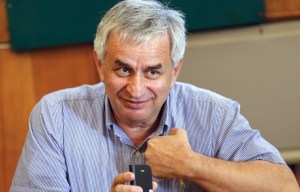
Abkhaz President-Elect Raul Khajimba (ITAR-TASS / Valery Matytsin)

Abkhaz President-Elect Raul Khajimba (ITAR-TASS / Valery Matytsin)

Abkhazia’s Raul Khajimba is the man of the hour. The victor of Abkhazia’s snap presidential election on Sunday, Khajimba has appealed to many Abkhaz as both a man of action and as a patriot. A nationalist with a history of refusing compromise with Georgia, let alone granting ethnic Georgians Abkhaz citizenship, Khajimba may be a cause of concern for some in the region. However, behind his nationalist posturing, he may also be the man to bring about a compromise, the kind that could help unite a region that is increasingly fragmented by ongoing geopolitical rivalry between Russia and the West.

Georgia has signed on to a European economic and political Association Agreement, and more hawkish members of Tbilisi’s political elite insist that it join NATO. Abkhazia and South Ossetia, Tbilisi’s two breakaways, remain in a sort of geopolitical limbo, recognized by Russia, Venezuela, Nicaragua, and Nauru but not by the rest of the world. Further south, Armenia has signed on to join the Moscow-backed Eurasian Union. To the east, oil-rich Azerbaijan, under the autocratic regime of Ilham Aliyev, remains free of any geopolitical union. Yet, Baku’s penchant for human rights abuses and bellicose statements regarding Armenia and the disputed region of Nagorny Karabakh continue to be a cause for concern. Meanwhile, the crisis and conflict in Ukraine continues.

It is far from certain what path Khajimba will take Abkhazia. If he pursues a narrow ethno-nationalist policy, then it is doubtful that it will be beneficial for the Caucasus region as a whole, let alone Abkhazia. However, he could instead opt for a more pragmatic policy and use his position to pursue a path of engagement.

A good starting point would be the Abkhaz-Georgian railway, which directly linked Armenia with Russia in Soviet times and which was closed during the war in Abkhazia of the 1990s. Armenia and the Armenian community of Abkhazia have signaled their support for such an initiative. In Georgia too, Bidzina Ivanishvili, during his tenure as Prime Minister, sought to put this issue on the table.  Though vocally opposed by Mikheil Saakashvili and his United National Movement (UNM) party, the opening of the railway with Abkhazia has widespread popular support in Georgia.  Meanwhile, Abkhazia’s political elite has been uncertain about opening the railway.  No serious action toward a resolution of this issue alone has appeared in either Tbilisi or Sukhumi beyond mere rhetoric.

Khajimba could make this happen to the benefit of Abkhazia, Georgia, Russia, and Armenia. Such a move would also set in motion the right process to engage in broader dialogue between the Abkhaz, Georgians, and Russians on issues such as a compromise resolution on the Abkhaz conflict. This would bode well for the stability of the Caucasus region as a whole.

Khajimba does indeed have connections in Moscow and received his first congratulations from Russian President Putin, even before the official announcement of his victory in Sukhumi’s Apsny Press agency. Notably, in 2004, Putin favored Khajimba for President of Abkhazia.

The newly-elected Abkhaz leader’s Kremlin connections may make him more amiable to a pragmatic political solution. However, this requires political will and, even more importantly, courage. Whether or not Khajimba opts for a path of informed pragmatism vs. one of narrow nationalism remains to be seen. Though one thing is for certain, Abkhazia, Georgia, and the Caucasus can only benefit from peace.

UPDATE (28 August 2014): On August 27, Khajimba met Putin personally at Novo-Ogaryovo near Moscow.  The talks were focused on enhanced cooperation between Abkhazia and Russia.  In an exclusive interview with ITAR-TASS, the Abkhaz leader noted that he was considering reducing Abkhazia’s border checkpoints with Georgia.  He also indicated that he was open to dialogue with Georgia but stressed that this can only be possible if Georgia signs a non-use-of-force agreement.  “We understand we won’t get away from Georgia as a neighbor anywhere, we’re destined to live side by side and to build up a relationship that will make it possible for us to minimize external risks and threats,” he said.


Independence Day

Ukrainian President Petro Poroshenko (Mikola Lazarenko / RIA Novosti)

Ukrainian President Petro Poroshenko (Mikola Lazarenko / RIA Novosti)

Today, on 24 August, Ukraine will celebrate its independence from the Soviet Union. Yet, if one observes the developments in Ukraine for the past two decades, it quickly becomes apparent that there is very little to celebrate. In the 23 years since the breakup of the USSR, more than seven million people have emigrated from the country. Now, as the conflict in the Donbas continues, that figure is over eight million and, with Russia’s incorporation of Crimea, this number becomes nine million. Between the 2004 Orange Revolution and the recent Maidan Revolution alone, approximately four million people have departed from Ukraine.

Additionally, the Ukrainian economy is in decline and default and, today, it stands on the precipice of total collapse. Even IMF-sponsored “reforms” will not be enough to bail out Ukraine’s mammoth debt and the added “bonus” of IMF-backed austerity will send the population reeling. Likewise, corruption has not halted at all in Ukraine, and has only become worse. Even the Maidan Revolution was not able to fundamentally change this problem in Ukrainian society. Today the Ukrainian political elite remains just as corrupt as it was when the Maidan Revolution broke out in November 2013. In the Rada, fist fights between rival politicians continue and it is unclear whether or not Maidan has also eased the country’s problems with poverty, unemployment, human trafficking, or organized crime.

Since the 2004 Orange Revolution, the divisions in Ukrainian society have become worse. The Ukrainian nationalists of Galicia today hate Russia or anything Russian-oriented with greater intensity than ever. By contrast, those Russian-speaking Ukrainians in South and Eastern Ukraine continue to reject any notion of membership in NATO or the EU, and they refuse to sever any ties with Russia. Meanwhile, divisions persist among Central Ukrainians while the Rusyns of Zakarpattia view the situation with exasperation.

In the Donbas, war between official Kiev and pro-Russian rebels has given way to a humanitarian catastrophe. Throughout the conflict, Kiev’s forces, including rogue far-right militias like the feared Azov battalion, have relentlessly shelled and attacked civilian infrastructure and the area’s Russian-speaking civilians. Refugees have fled en masse to Russia while others have escaped into more peaceful regions of Ukraine. Thousands died in the conflict, not only civilians, but also Ukrainians from other parts of Ukraine who were recruited to fight against their own ethnic kin. Families have become ideologically split over the conflict, while the industry in the Donbas, which is so crucial to Ukraine’s economy, has come to a total standstill. Cities like Slavyansk are in ruins. Everyday livelihoods of neighborhood bakers, doctors, and others have been disrupted. Daily institutions like grocery stores, pharmacies, banks, and schools have been destroyed or closed. Questions still remain unanswered with regard to the tragic shootdown of the MH17 Malaysian airliner.

Now, as Ukraine prepares to celebrate its 23rd independence day, reports are rife that the government of President Petro Poroshenko will seek to capture the city of Luhansk at any cost. This inevitably means more attacks on civilians, more indiscriminate shelling, and more destruction. Instead of working to declare an “independence day peace,” he is instead alienating more of his citizens against him. As a catastrophe consumes the Donbas and problems persist throughout the rest of Ukraine, including an impending economic collapse, ordinary Ukrainians will inevitably ask: “What is there to celebrate?”

Ukraine: Where Nation-Building and Empire Meet

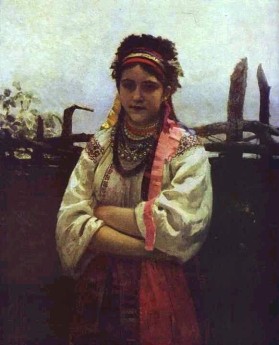
Ukrainian Girl by a Fence, Ilya Repin, 1876

Ukrainian Girl by a Fence, Ilya Repin, 1876

As the Ukraine crisis continues, there are debates emerging with regard to the relationship between Russians and Ukrainians, in language, culture, and history.

The vast majority of ordinary Russians view Ukrainians, though linguistically distinct, as being a fraternal East Slavic nation, closely bound to Russia by culture, history, and intermarriage. They further assert that Ukraine is an integral part of Russian civilization, owing to the particularly special significance of Kiev to both Russians and Ukrainians. More nationalistic Russians go even further and claim that Ukraine is merely a “concept” and that the people known as “Ukrainians” are merely an extension of the Russian nation who speak a dialect of Russian.

Some Ukrainians, particularly in the Central part of the country, would sympathize with the argument that Russians and Ukrainians are a fraternal people. In the Russian-speaking Southeast this would be further elevated to Russians and Ukrainians being “the same people.” However, as one might imagine, the nationalist discourse in Western Ukraine, particularly Galicia, is radically different. To Ukrainian nationalists, Ukrainians are “completely different” from the Russians. They have they own culture, language and history which they believe is “entirely disconnected” from anything to do with the Russians. Some more extreme Ukrainian nationalists even claim that the Ukrainian language is not only distinct from Russian, but also distinct among all Slavic or even Indo-European languages as well.

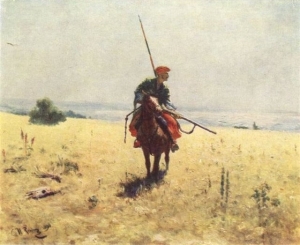
Cossack on the Steppe, Ilya Repin, 1890

Cossack on the Steppe, Ilya Repin, 1890

Of course, the truth exists somewhere in-between these conflicting narratives. It is true that Ukrainians do speak their own language and that there are aspects of Ukrainian culture that are indeed unique to Ukrainians. However, it is also true that Kiev is the common point of origin for all East Slavs including Ukrainians and Russians; that at one time in their common history, they used to speak the same language (Old East Slavic); and that the contemporary Ukrainian and Russian languages (though not exactly the same) are indeed very similar. It is also true that the Ukrainians and Russians have much in common in terms of culture, and they have both had a major impact on one another. Examples of this cultural exchange include the squat-and-kick prisyadka dance move and the beet soup borscht, both of Ukrainian origin but deeply influential in Russian culture. Nikolai Gogol was a famous Russian-language author of Ukrainian origin who often included Ukrainian themes in his writings, e.g., Taras Bulba.  The great Russian painter Ilya Repin, though himself an ethnic Russian, was born in Ukraine and also included many Ukrainian themes in his work, signaling his great love for his fellow East Slav brothers.

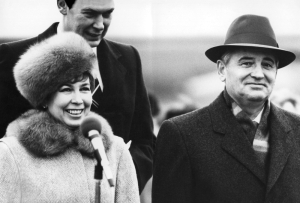
Mixed Russian-Ukrainian Soviet leader Mikhail Gorbachev and his Ukrainian wife Raisa.

Mixed Russian-Ukrainian Soviet leader Mikhail Gorbachev and his Ukrainian wife Raisa.

Intermarriage is also a major component of the Russo-Ukrainian relationship. Nikita Khrushchev and Mikhail Gorbachev were both products of mixed Russo-Ukrainian parentage; their wives, Nina Kukharchuk and Raisa Titarenko, were both fully Ukrainian. Another former leader, Lenoid Brezhnev, was also of mixed Russian-Ukrainian heritage while another, Konstantin Chernenko, came from a Russified Ukrainian family. In music, the famous Russian rock star Yuri Shevchuck is Ukrainian and the Bessarabian-born Russian tango singer of the 1930s Pyotr Leschenko was also of Ukrainian background. Additionally, the dissident Aleksandr Solzhenitsyn, the poet Yevgeny Yevtushenko, and the great Soviet rocket engineer Sergei Korolyov were all born to mixed Russian-Ukrainian parents.

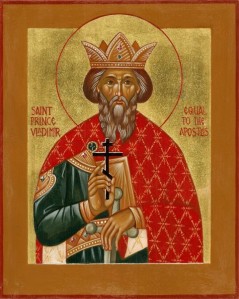
Kievan ruler Vladimir the Great was baptized at Khersones (in modern-day Sevastopol) and converted the Kievan Rus' to Christianity in the 10th century.  He is widely respected by all East Slavs (including Russians and Ukrainians) to this day.

Kievan ruler Vladimir the Great was baptized at Khersones (in modern-day Sevastopol) and converted the Kievan Rus’ to Christianity in the 10th century. Vladimir is widely revered by all East Slavs (including Russians and Ukrainians) to this day.

Rus’, Malorussia, Ukraine, and the Politics of Identity

Another aspect of the very close relationship between the Russians and the Ukrainians is the historical development of the identity of the Ukrainian people. At one point, all of the East Slavs (Russians, Ukrainians, Belarusians, and Carpatho-Rusyns) used to comprise a single people – the people of the Rus’ – who used to speak a single language known as Old East Slavic. Their faith was Orthodox Christianity. The only exception to this were the Kievan territories of Galicia and Volhynia. Forming the westernmost regions of the old Rus’, Catholic and Polish influence was very strong in these areas, particularly Galicia, and their princely families even intermarried with nearby Catholic Polish and Hungarian houses. Significantly, while there was a distrust of Catholicism in the other Rus’ territories further east, in Galicia and Volhynia, Catholic and Western ideas were welcomed and fully embraced. This early cultural division would later play a role in Ukraine’s regional identity differences centuries later.

Another key factor was language. In the 13th century, the Kievan Rus’ fell into decline and became subjected to the Mongol invasions. Its western principalities (largely correspondent to much of modern-day Central Ukraine and Belarus) were absorbed by the Grand Duchy of Lithuania, which later unified with the Kingdom of Poland at the Union of Lublin in 1569, forming the Polish-Lithuanian Commonwealth. The gradual “break-up” of the single Old East Slavic language into several different languages – Russian, Ukrainian, Belarusian, and Carpatho-Rusyn – occurred during this period. Yet, even into the early 20th century, many of these East Slavs still self-identified as “Rusyni” and spoke a language which they called “Rusynski,” both referring to the old Rus’ state.

Foreign rule further created a new dimension to the situation which involved religion. Rus’ lands under Mongol rule remained free to worship and practice their Orthodox Christian faith. By comparison, in those Rus’ lands under Polish-Lithuanian rule, Orthodoxy was at first tolerated. Later, however, the separateness in faith concerned the Polish monarchs as the Orthodox locals of the historic Rus’ lands saw their affinity not with Catholic Poland or Western Europe but with the world of Russian Orthodoxy. As such, Orthodox Christians were persecuted under Polish rule until in 1595, in exchange for an end to this persecution, the Orthodox clergy of the Polish-ruled lands agreed to the Union of Brest, forming the Ukrainian Greek Catholic (or Uniate) Church. However, in subsequent centuries, as the Russian Tsars later reclaimed the old western Rus’ lands from Poland-Lithuania in the 18th century Partitions of Poland, the Orthodox faith was reintroduced.  Significantly, in the Partitions, the Habsburg monarchy in Austria acquired the Catholic- and Western-leaning region of Galicia.

Additionally, an entirely separate situation existed further west in the region of Carpathian Rus’ (Zakarpattia). This distant western region was a borderland frontier area at the time of Kievan Rus’.  It fluctuated between the control of Orthodox East Slav Kievan rulers to the north and east and Magyar (Hungarian) Catholic rulers to the south and west. With the fall of Kievan Rus’, this Carpathian territory fell under the complete control of the Hungarian monarchs. Overtime, the close proximity of the Catholic Slovak and Magyar populations combined with the area’s separateness from the other historic Rus’ lands due to the Carpathian Mountains led it to develop its own entirely distinct identity and language (Carpatho-Rusyn). This difference was reinforced with the Union of Uzhgorod in 1646 in which the Orthodox Rusyns joined the Catholic Church as part of the Byzantine rite, forming the separate Byzantine Ruthenian Catholic Church.

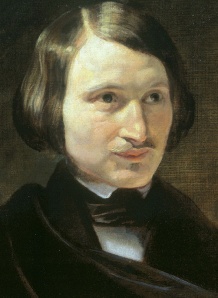
Renown Russian writer and ethnic Ukrainian, Nikolai Gogol.  A native of Central Ukraine, Gogol was the author of Dead Souls among other works.

Renown Russian writer and ethnic Ukrainian, Nikolai Gogol.

As mentioned earlier, the Russian Tsars later reclaimed much of the old western Kievan Rus’ territories in modern-day Ukraine in Belarus during the Partitions of Poland in the 18th century.  Orthodoxy was also reintroduced in these regions. The “Rusyni” identity of old persisted among the locals and, during the 19th century, two rival nation-building projects on the territory of contemporary Ukraine sought to supplant this old “Rusyni” identity with a new identity. One was the Malorussian (“Little Russian”) identity, with the name “Little Russia” derivative from old Byzantine maps referring to modern Ukraine as “Lesser Rus'” or “Rus’ Minor.” The Malorussian project claimed that modern Ukraine was a natural extension of the Russian nation. In the Malorussian view, the Ukrainian language that developed from the break-up of Old East Slavic had to be supplanted by a common standard language. In their view, this was to be Russian, a language seen by Malorussian activists as the “successor” of Old East Slavic. Nikolai Gogol, an ethnic Ukrainian who wrote in Russian, was among those who favored Malorussianism.

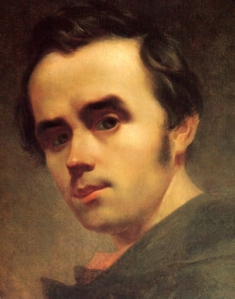
Taras Shevchenko

Taras Shevchenko

Opposing Malorussianism, was Ukrainianism. Ukrainianism postulated that the East Slavic language that developed in Ukraine signified the development of an entirely separate ethnic identity, independent of other East Slavs. They called their nation “Ukraine,” a name that like “Malorussia” developed from cartographic toponyms and has been literally translated as “borderland.” Ukrainianists emphasized the unique and distinct culture of the people of the area above all else, with a special emphasis on language and culture. Of course, this did not exclude those who viewed themselves as “Ukrainian” but also saw Russia as a fraternal East Slavic nation nonetheless. The writer Taras Shevchenko is perhaps best representative of the “Ukrainianist” group, writing almost exclusively in the Ukrainian language, though occasionally writing in Russian as well.

Of these movements, Malorussianism was favored by the Tsars who regarded themselves as the legitimate successors to the rulers of the old Kievan Rus’. Consequently, the Malorussianist policies of official Petersburg should be viewed not within the context of an empire attempting to force an assimilation on a “conquered” people, but rather as part of a nation-building project or as part of the great “reunification of Old Rus'” and “gathering of the Russian lands” as the Tsars saw it.

A similar national project was also taking place in Italy, which had just been unified under the leadership of Giuseppe Garibaldi. There, the Italian language, based on Tuscan and the Central Italian dialects, was to become the literary standard. However, in the southern island of Sicily, the locals spoke their own Romance language Sicilian, related to Italian but also distinct in its own right. In Rome, the king regarded Sicilian just as the Tsar regarded Ukrainian, as a backward provincial dialect which, with the expansion of education and literacy, would be eventually supplanted by “clean Italian” or in the Tsar’s case, “clean Russian.” Indeed, like Ukrainian, Sicilian developed distinct from other languages in Italy by virtue of its geographic separation from the mainland and historical invasions of the island by Greeks, Arabs, Normans, Germans, Spanish, and others. Yet Sicily was viewed by Italianist advocates as an integral and historical part of Italy, just as Ukraine was regarded as an integral and historical part of Russia by the educated class, the bourgeoisie, and the aristocracy.

Reply of the Zaporozhian Cossacks, 1880-91, Ilya Repin

Reply of the Zaporozhian Cossacks, 1880-91, Ilya Repin

An additional development to all of this was the emergence of three new historical territories overtime. They included Zaporozhia which established itself in the “wild fields” south of Polish-ruled territory in the 15th and 16th centuries.  In this region, rebellious Orthodox Christian Cossacks fought against the Polish monarchs.  Then, in the 17th century, the area of Slobozhanshchina (or Sloboda Ukraine) emerged around the cities of Kharkiv and Sumy.  Finally, in the 18th and 19th centuries, the area of Novorossiya was formed along the Black Sea after the Russian Tsars had finally succeeded in taking Ottoman-held territory along the coast.  In all of these regions, Ukrainian (or Malorussian) populations played primary roles in their historical formation and settlement.  Further, in all three of these regions, Orthodoxy was the primary faith.

The Malorussian-Ukrainian debate also took place across the border in the Austro-Hungarian-ruled East Slavic territories of Galicia, North Bukovina (Chernivsti), and Carpathian Rus’. There, the debate existed between Ukrainianists and Russophiles (effectively Malorussian activists under a different name). It became even more complex in Carpathian Rus’ ruled under the the Hungarian realm of the dual monarchy, between Ukrainianists, Russophiles, and Rusynists (those who chose to self-identify as Rusyn or Carpatho-Rusyn). In Galicia, where Catholic influence of both the direct Roman Catholic and Uniate strands remained strong, the debate was eventually won by the Ukrainianists. However, in Carpathian Rus’, the debate over ethnic identity still persists to this day.  Notably, during this period, many people from these Austro-Hungarian-controlled territories (particularly Galicia and Carpathian Rus’) also emigrated further west in search of opportunity.  They arrived in the United States and Canada, establishing the core of what would become the contemporary Ukrainian and Carpatho-Rusyn diasporas of today.

National Identity in the Soviet Era

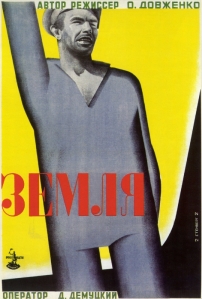
Original avant-garde poster for Aleksandr Dovzhenko's "Earth" (1930).  The film is perhaps Dovzhenko's best-known work and it is part three of the director's "Ukrainian trilogy" which also included "Zvenigora" (1928) and "Arsenal" (1929).

Original avant-garde poster for Aleksandr Dovzhenko’s Earth (1930). The film is perhaps Dovzhenko’s best-known work and it is part three of the director’s “Ukrainian trilogy” which also included Zvenigora (1928) and Arsenal (1929).

After the Russian Revolution of 1917, the civil war in Ukraine of 1917-21, and the establishment of the USSR, Ukrainianism as a movement won out over Malorussianism.  In the 1920s, the new Soviet government undertook a “Ukrainization” policy in the newly-declared Ukrainian Soviet Socialist Republic, as part of its broader nativization or korenizatsiya (коренизация) policy toward nationalities, by promoting and advancing the Ukrainian literary language. This had the effect of encouraging a major cultural and literary renaissance in Ukraine during the NEP that many Ukrainians still fondly remember today.  The advent of new art forms, like film, helped advance this renaissance, in which the great Ukrainian filmmaker Aleksandr Dovzhenko played a leading role.  A pioneer of early Soviet film, Dovzhenko is credited for not only his contributions to the development of Ukrainian cinema but also for Soviet and Russian cinema overall.

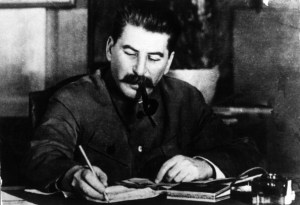
The Ukrainization policies were abruptly halted in the 1930s under Stalin whose NKVD purged the republic of real or perceived nationalists, “kulaki,” and “enemies of the people.” Yet, it should be noted that Stalin was not interested in the Malorussian-Ukrainian identity debate, but more concerned with strengthening his position throughout the entire USSR, and to this end he purged writers and intellectuals in all Soviet republics.

Joseph Stalin smoking his pipe at his desk. (Getty)

Joseph Stalin smoking his pipe at his desk. (Getty)

Compounding all of this was the terrible Soviet famine of the early 1930s. The famine hit Ukraine very hard and some Ukrainian nationalist historians even go so far as to assert that what happened was a deliberate attempt at genocide against the Ukrainian people by the Soviet government. However, this fails to take into account the fact that the famine also affected many non-Ukrainians too, including Germans, Poles, Jews, and Russians.  Likewise, the famine also hit southern Russia and northern Kazakhstan, two other major cereal-producing regions of the Soviet Union, very hard. Among those who witnessed the starvation was a young Mikhail Gorbachev, a native of southern Russia, who personally experienced the horrors of the terrible famine first-hand. It affected his own family and killed off half of his village.

Millions starved to death in this cruel campaign of forced collectivization and suppression of the so-called “kulaki.”  Yet, Western correspondents like Walter Duranty disguised the facts while Stalin and Soviet officials claimed that the campaign had made the “eternally happy” people of the Soviet agricultural heartland “dizzy with success.”  Overall, ethnicity meant little to Stalin.  Nobody was safe from the terror of the vozhd.  He was an equal-opportunity mass murderer.

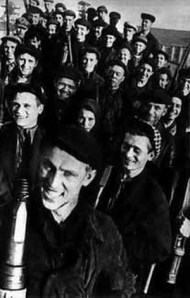
The Stakhanovite Movement in the Donbas

The Stakhanovite Movement in the Donbas

The Soviet era also saw the rise of industrialization.  The heavily industrial coal-mining region of the Donbas (Donets Basin), centered on the cities of Donetsk (also known as Yuzovka or Stalino) and Luhansk (also known as Voroshilovgrad) really emerged during this period.  Prior to this, the Donbas had been an area with a mixed Ukrainian and Russian Cossack population divided between historical Sloboda Ukraine, Novorossiya, and the Don Cossack Host.  The Soviet era firmly established the Donbas as a unique region in its own right, a truly working-class “Soviet” region where Russian was the primary language.  It was in this area that, during the Stalin era, Aleksei Stakhanov and the Stakhanovite movement emerged.

World War II left an indelible mark on Ukraine.  In the war, most Ukrainians fought alongside the Russians against the onslaught of the Nazi German war machine.  Many Ukrainian villagers in present-day Central and Southeastern Ukraine experienced violent atrocities at the hands of the hated Nazi invader and the country’s sizeable and historically significant Jewish community was decimated by the Holocaust.  The war also brought about the unification of Ukraine with the West Ukrainian territories of Galicia, Volhynia, North Bukovina, and Carpathian Rus’ (Zakarpattia).  The addition of these new territories not only “unified” Ukraine but signaled a “reunification” of all East Slavic territories for the first time in history since the fall of the Kievan Rus’ in the 13th century.  The new territories also presented (and continue to present) new complications for Ukraine’s collective identity.

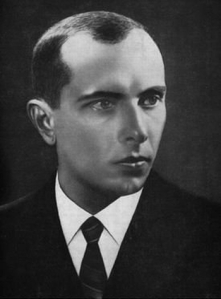
Stepan Bandera, a man regarded throughout much of Ukraine as a wartime collaborator with Nazi Germany and in Western Ukraine (especially Galicia) as a "hero."

Stepan Bandera, a man regarded throughout much of Ukraine as a wartime collaborator with Nazi Germany and in Western Ukraine (especially Galicia) as a “hero.”

While the vast majority of the people in Central and Southeastern Ukraine view World War II as the “Great Patriotic War” and the Red Army as “saviors,” the view is different in Western Ukraine.  In Galicia (centered on the city of Lviv), the Soviet Union is looked on as a “conqueror” or “oppressor” while the OUN (Organization of Ukrainian Nationalists) and Stepan Bandera who are viewed throughout most of Ukraine as wartime collaborators with the Nazis, are seen as “heroes.”  The “hero” view of Bandera also exists but is less prevalent in Volhynia where there are more positive views of the Red Army.

Meanwhile, in North Bukovina and Carpathian Rus’, the view of the Red Army as a “liberator” is much more common and there are reasons for this. North Bukovina’s Slavic population had been repressed under Romania’s chauvinistic government. Meanwhile, Carpathian Rus’ faced attempted Magyarization under Hungarian rule and neglect as part of Czechoslovakia. This, together with the region’s traditional Russophile sentiments, led the locals to welcome inclusion into the Soviet state.  Further, the additional factor of the unique Carpatho-Rusyn culture of Carpathian Rus’ also added to the complexity of Ukraine’s collective identity.  The region’s absorption into Soviet Ukraine also signaled their official shift in ethno-identification from “Carpatho-Rusyns” to “Ukrainians.”  Still, a sense of distinctiveness among the people of Zakarpattia continued to persist.

Following Stalin’s death, Ukraine experienced a very brief renaissance under Soviet leader Nikita Khrushchev.  Khrushchev, who was himself of partial Ukrainian background, even awarded the peninsula of Crimea to Soviet Ukraine, partially out of Slavic sentimentality, partially for economic and irrigation reasons. However, by the 1970s, Ukraine, along with the rest of the USSR, began to fall into stagnation.

Still, Ukrainian speakers co-existed alongside Russian speakers with no problems. Intermarriage and cultural exchange with Russians was commonplace.  The only issue with which the Soviet government had to deal was in newly-acquired Galicia, where the insurgent forces of the OUN continued conducting guerrilla operations into the mid-1950s. Yet, overall, Ukraine remained well-integrated into the Soviet Union.

By the time of glasnost, no significant national movement emerged in Ukraine except for the Rukh movement based in Galicia. Generally, most Ukrainians were uninterested in nationalism and more interested in a stable country and a working economy. 72% backed Gorbachev’s New Union Treaty in 1991, though later that year, an overwhelming majority voted in favor of a vaguely-worded referendum on “independence” with no explicit mention of an actual separation from the USSR (which was present, for example, in the wording of Armenia’s referendum on independence).

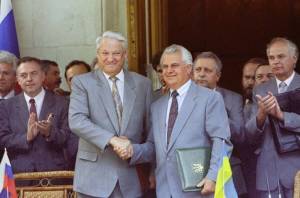
Russian President Boris Yeltsin with Ukraine's first post-Soviet President Lenoid Kravchuk.

Russian President Boris Yeltsin with Ukraine’s first post-Soviet President Lenoid Kravchuk.

Post-Soviet Ukraine

Following the Soviet collapse, Ukraine was widely expected to do well as an independent state. Despite the stagnation of the Soviet economy, Ukraine fared as one of the more prosperous Soviet republics. It had an extensive Black Sea coast, rich farmlands, Carpathian Mountain pastures, and heavy industry. However, these expectations faded within the first years of the country’s independence. From the outset, Ukraine faced two challenges: state-building and nation-building.  Its corrupt political class was unable to meet both.

In terms of state building, Ukraine had to develop independent institutions and a functional national economy. Kiev was able to develop institutions which were basically successors to the pre-existing Soviet republican institutions. However, Kiev was never able to establish a national economy. Kravchuk, Ukraine’s first post-Soviet president oversaw a corrupt privatization in the 1990s. An oligarchy and a corrupt political elite quickly emerged, stifling Ukraine’s potential development. Poverty, unemployment, organized crime, human trafficking, and other social ills that became characteristic of Ukraine’s post-independence landscape also came to the fore.

Regional politics also remained. Throughout the post-Soviet era, the people of Galicia, the epicenter of Ukrainian nationalism, continued to vote for candidates with nationalist, pro-Western, or anti-Russian credentials. By contrast, the Russian-speaking Southeast (including the Donbas and Crimea) consistently voted for pro-Russian candidates. The more divided, Surzhyk-speaking Central oblasti oscillated between candidates, as did the remote Rusyn-speaking Zakarpattia oblast. Outside of Galicia and Western Ukraine, nationalism generally gained little traction. In the Center and Zakarpattia, it was viewed with indifference and distrust. In the Southeast, it was met with outright hostility.

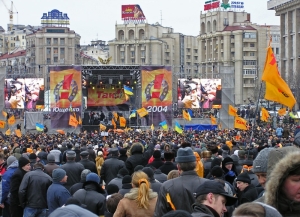
Orange Revolution 2004 (FotoArt.org.ua)

Orange Revolution 2004 (FotoArt.org.ua)

The Impact of the 2004 Orange Revolution

Ukraine’s 2004 Orange Revolution, backed by Washington and American-based NGOs, was viewed by many Ukrainians as a means of solving the country’s problems and bringing it back on its feet. However, it only exacerbated them. Fundamental issues, such as corruption, remained largely unaddressed. Meanwhile, the pro-Western and nationalist policies of President Viktor Yushchenko enhanced the divisions among Ukrainians. His total affinity for Washington, his push to see Ukraine join the EU and especially NATO, as well as his efforts to rehabilitate and bestow awards on controversial figures like Stepan Bandera, created joy in Western Ukraine, confusion in the Center, and anger in the Southeast. Notably, in 2006, the landing of the US marines in the Crimean city of Feodosiya as part of a US-Ukrainian military exercise prompted major anti-NATO protests from the local population.

The Orange Revolution also intensified these regional divisions on an electoral level. Before the revolution, the politics of Central Ukraine had been more divided, with its oblasti acting as “swing states” and “election spoilers” between pro-Russian and pro-Western candidates. But the Orange Revolution somehow changed this pattern. Though divisions in Central Ukraine persisted and still do persist to this day, the threshold majority began favoring more pro-Western politicians. Coincidental to this development was the rise of Viktor Yanukovych’s Party of Regions (henceforth PoR) which claimed to represent the interests of Russian-speaking Ukrainians and ethnic Russians in Ukraine. In elections, the PoR began to secure the solidly Russian-speaking oblasti from Odessa to the Donbas.

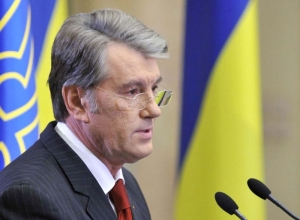
Former Ukrainian President Viktor Yushchenko

Former Ukrainian President Viktor Yushchenko (AFP)

Most striking were the ways in which these new political divisions began to change historical relations between oblasti in Ukraine. A good example is the division that now exists between Sumy and Kharkiv. Historically, these two cities and their oblasti had a long history together, going back to their common foundation in the 17th century as part of the frontier region of Slobozhanshchina (or Sloboda Ukraine). In post-Soviet Ukraine, both the Sumy and Kharkiv oblasti followed each other’s electoral patterns. However, starting with the Orange Revolution, these two oblasti began to diverge from one another. Sumy, despite its Russian-speaking culture and heritage, was the native region of Viktor Yushchenko who became “nationalized” in Galicia. Yet, despite his nationalist ideology, Yushchenko’s place of birth in Russian-speaking Sumy strengthened his credentials in Washington and among American NGOs as “the man who could bring East and West together.” However, as the case of Sumy illustrates, Yushchenko only intensified the divisions. As a result of the Orange Revolution, the Sumy oblast and city began to be carried by pro-Western politicians. Pro-Russian politicians still came close to them in elections, but the overall political orientation began to shift. By contrast, Kharkiv became a solidly pro-Russian PoR oblast.

Superimposed on all of this was the growing geopolitical competition between the United States and Russia for influence in the post-Soviet space. Many commentators warned against the expansion of US influence in the region, particularly with regard to the NATO military alliance. Yet in the 2000s, Washington began to push beyond expanding NATO into Central-East Europe. They also began to look toward the former USSR, particularly the two most strategic ex-Soviet republics: Ukraine and Georgia. The sponsorship by Washington and American NGOs of the Rose and Orange Revolutions in these countries deeply troubled Moscow. The Kremlin subsequently began to throw its support behind the PoR and Yanukovych as the most “pro-Russian” force in the country.

Therefore, the development of divergent political forces domestically within Ukraine, combined with the geopolitical competition between Russia and the West, have effectively set the stage for the present-day conflict in the country.  A solution to Ukraine’s protracted crisis can still be found – but it first and foremost requires a ceasefire, humanitarian aid relief for the people of the Donbas, and, most importantly, political will.   Moscow has signaled its readiness for such a process.

For more information on Ukraine’s historical, regional, and linguistic dynamics, see my earlier entries: What Is Ukraine? (2 March 2014, updated 15 May 2014), Who Are the Rusyns? (19 April 2014), The Historical Geography of Ukraine (15 May 2014, updated 24 August 2014), and 10 Points on the People of Southeastern Ukraine (21 June 2014).

Who Are the Yazidis of the Former Soviet Space?

Yazidis Girls Near Mt. Aragats, Armenia (Bo Løvschall)

Yazidi girls in the vicinity of Mt. Aragats, Armenia (Bo Løvschall)

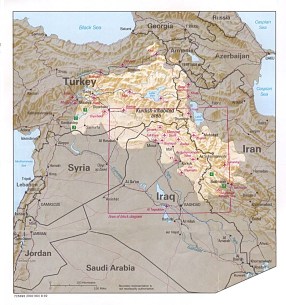
Recently the news has been replete with headlines about the atrocities being committed by the Islamic State of Iraq and the Levant (ISIL or simply the “Islamic State”) against the Yazidi people. Who are the Yazidis, exactly?

The Yazidi are an ethnoreligious group of Kurds who speak the Kurmanji dialect of Kurdish. Approximately 640,000 live in Iraq.  The next largest concentration of Yazidis in the world is actually in the former Soviet Union where about 100,000 reside. These ex-Soviet Yazidis are divided among three former Soviet republics: Russia, Armenia, and Georgia. In Iraq, they write Kurmanji using the Perso-Arabic script. In the former USSR, they use Cyrillic.

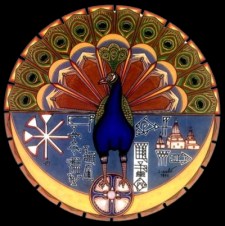
Melek Taus

Melek Taus

The Yazidis follow a unique faith that seemingly fuses together Islamic Sufi, Christian, and Zoroastrian beliefs. They worship Melek Taus, the “Peacock Angel,” who, according to their tradition, temporarily fell from God’s grace but was later redeemed. The mistaken association of the Melek Taus with Satan by other religions has led to the persecution of the Yazidis as “devil-worshipers,” the atrocities by the ISIL being among the worst in their history. They observe many ritual traditions, including an annual pilgrimage for seven days to the tomb of Sheikh Adi ibn Musafir in Lalish, north of Mosul in Iraq. As previously mentioned, the Yazidis also speak Kurmanji and have Kurdish cultural traditions. Yet, many prefer the designation “Yazidi” over “Kurd.” In some Western publications, they are occasionally referred to as the “Yazidi Kurds.”

Yazidis Fleeing Violence in Iraq (Reuters)

Yazidis fleeing violence in Iraq (Reuters)

Traditionally, Yazidis lived between northern Iraq, northeastern Syria, and southeastern Turkey. However, due to oppression and religious persecution, many have fled. In recent years, especially due to the Turkish-Kurdish conflict and the Iraq War, many emigrated to Europe, particularly to Germany and Sweden.

However, the first community of Yazidi immigrants emerged in the 19th century, when many fled to Tsarist Russia, escaping religious persecution in the Ottoman Empire. They fled over the border into the Russian Caucasus where they principally established themselves in Armenia and Georgia. Others fled further north to Russia proper. A second wave came in the early 20th century when they were targeted alongside Armenians during the Armenian Genocide in the Ottoman Empire.

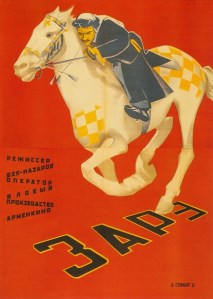
Avant-garde poster for the NEP-era Soviet Armenian film Zare (1927) about the Yazidi Kurds.

Avant-garde poster for the NEP-era Soviet Armenian film Zare (1927) about the Yazidis.  Watch the full film restored on YouTube here from EzidiTV.ru in association with ArmenFilm.

In Armenia, the Yazidis form the country’s largest ethnic minority (about 1% of the population) in an otherwise homogeneous country (98% Armenian). Most are largely concentrated in the provinces (marzer) of Aragatsotn, Armavir, and Ararat. They generally tend to be well-integrated into Armenian society. They have a history of good relations with the Armenians. The 19th century Armenian writer Khachatur Abovyan was a great friend of the Yazidis.  Some Yazidis even fought alongside the Armenians during the Turkish invasion of Armenia in 1918 and again in the war over the disputed region of Nagorny Karabakh in the 1990s. The Yazidis also have a place in Armenian cinema.  During the NEP era, in 1927, the acclaimed Soviet Armenian filmmaker Amo Bek-Nazaryan directed the film Zare about the Yazidis of Armenia.  In 2003, the Kurdish filmmaker, Hiner Saleem directed yet another film, Vodka Lemon, depicting Yazidi life in post-Soviet Armenia.

Further north, in Georgia, the Yazidis are primarily concentrated around the Georgian capital Tbilisi, where they enjoy good relations with the Georgians and the city’s other ethnic groups. However, since the Soviet collapse, many Yazidis from Armenia and Georgia have emigrated due to poor economic and employment opportunities. Most of them fled to Russia which had already developed a sizeable Yazidi community. The largest concentration of Yazidis in Russia is in the Krasnodar Krai in the North Caucasus. There are also significant communities in Nizhny Novgorod, Yaroslavl, Stavropol, Novosibirsk, Tambov, Rostov, and Moscow.

Yazidi demonstration in Tbilisi against ISIL's atrocities against the Yazidis in Iraq. (Georgian Union of Kurdish Youth)

Yazidi demonstration in Tbilisi against ISIL’s atrocities against the Yazidis in Iraq. (Georgian Union of Kurdish Youth)

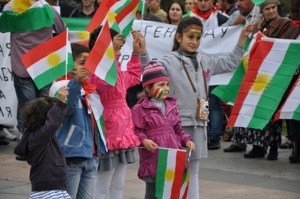
The most recent persecution of Yazidis in Iraq by ISIL has catalyzed their compatriots in the former Soviet space into action. As early as May, Yazidis in Armenia have been protesting ISIL’s actions in front of the UN building in Yerevan.  In July, in Tbilisi, the Yazidis there banded together with representatives of various Christian churches in Georgia along with Georgian MPs, human rights activists, and lawyers to protest against ISIL’s attacks on Yazidis and Christians also in front of the UN building. Even larger rallies have since been staged in both Yerevan and Tbilisi.

On 15 August, official Yerevan announced that it was “deeply concerned by the violence against the Iraqi Yazidis perpetrated by extremists” and that Armenia shares “the indignation of Yazidis living in Armenia concerning the ongoing tragic events.” Earlier on 13 August, the Armenian government announced that it would send $50,000 of humanitarian assistance to help Yazidis who have been displaced by ISIL. Meanwhile, Georgia has accepted Yazidi refugees fleeing from Iraq. On 8 August, the Russian Foreign Ministry issued a statement condemning the treatment of the Yazidis. The Yazidis in Russia also called on President Vladimir Putin to lend Russian assistance to their Iraqi compatriots.

As the plight of the Yazidis in Iraq continues, the aid from the former Soviet space will likely continue to expand. The post-Soviet Yazidis will do their best to ensure this.

UPDATE (19 August 2014): Armenian President Serj Sargsyan has voiced his concern about the Yazidis of Iraq and has called ISIL’s actions “absolutely unacceptable.” In addition, the self-proclaimed Nagorny Karabakh Republic has pledged to accept Yazidi refugees fleeing from Iraq. In Stepanakert, Davit Babayan, a spokesman for the President of Karabakh, stated that “the Armenian people cannot remain indifferent to what is happening to the Yazidi people now.”

A Guide to the “Stans” of Central Asia

Location of Central Asia in the former Soviet Union

Location of Central Asia in the former Soviet Union

One of the most interesting parts the former Soviet space is Central Asia. It is a region of diverse geography and beautiful people, with a lot of fascinating history behind it. In the West, the five countries of the area have become colloquially known as the “stans” because all of them bear the Persian suffix “-stan” meaning “land of.” The majority of the ethnic groups who live in this region are Sunni Muslims, with the exception of the Orthodox Christian Russians, the Ismaili Pamiris, and other smaller groups. The majority of the titular nationalities also speak Turkic languages, the only exception being Farsi-speaking Tajikistan.

In the Russian language, the term “Средняя Азия” (Srednyaya Aziya), literally “Middle Asia,” is used to denote the former Soviet Central Asian republics. By contrast, the term “Центральная Азия” (Tsentralnaya Aziya), or “Central Asia,” denotes a much broader geographic region, encompassing not only the former Soviet Central Asian states, but also Mongolia, Tibet, Xinjiang, Afghanistan, portions of southern Siberia, and other areas.

Post-Soviet Central Asia was gradually absorbed into the Russian Empire in the 18th and 19th centuries. Russia’s expansion into the area prompted concern from the British, who governed India further south. The result was what Rudyard Kipling called the “Great Game,” as the two great powers vied for influence in the region. The sporting geopolitical competition ended in 1907 with the Anglo-Russian Entente. In the end, much of the region went to Russia and later its successor, the Soviet Union. The Soviet government set to work on establishing ethno-national entities in the region, which eventually became full-fledged union republics. Following the breakup of the Soviet Union in 1991, these countries became fully independent states. Below are concise overviews of each:

Countries:

Location of Kazakhstan in post-Soviet Central Asia

Location of Kazakhstan in post-Soviet Central Asia

Kazakhstan
Capital: Astana
Official language(s): Kazakh, Russian
President: Nursultan Nazarbayev
Area: 2,724,900 км²
Population: 17,948,816 (CIA 2014 est.)
GDP per capita: $14,100 (CIA 2013 est.)
Geography: Steppe, grassland, arid desert, mountains
Ethnic groups (2009 census): Kazakhs (63%), Russians (23%), Uzbeks (3%), Ukrainians (2%), Uygurs (1%), Tatars (1%), Germans (1%), Others (6%)

Eagle hunters in Kazakhstan (Getty)

Eagle hunters in Kazakhstan (Getty)

Overview:

Kazakhstan is the largest of all the ex-Soviet Central Asian countries. It is the homeland of the Kazakhs (not to be confused with the similar-sounding Slavic Cossacks) who are a nomadic Turkic-speaking people with strong Mongol cultural influences.  Falconry, especially eagle falconry, and horsemanship are very popular among the Kazakhs. The Kazakhs are divided among three historical hordes: the Great Horde in the Southeast, the Middle Horde in the Center and North, and the Lesser Horde in the West.

Baikonur Cosmodrome (NASA / Bill Ingalls)

The “Gagarin’s Start” Soyuz launch pad at the Baikonur Cosmodrome.  It was from here where the famous cosmonaut Yuri Gagarin (after whom the launch pad is named) launched into space on Vostok 1 in 1961. (NASA / Bill Ingalls)

In addition to the Kazakhs, there are also many ethnic minorities in Kazakhstan, including a very large ethnic Russian minority concentrated in the North.  The sizable Russian community has a historic presence in Kazakhstan, dating back to the Tsarist era.  The community grew in the Soviet era, especially in the 1960s during Nikita Khrushchev’s Virgin Lands Campaign.  Ethnic relations have been peaceful between the Kazakhs and the large Russian minority. Likewise, relations between the governments of Kazakhstan and Russia are also very amicable. The great Baikonur Cosmodrome from which the famous Sputnik and Vostok operations were launched, is located on the territory of Kazakhstan. However, it is still controlled by Russia per a treaty between Moscow and Astana.

Viktor Tsoi

Viktor Tsoi

Kazakhstan’s ethnic mosaic also consists of a variety of other minorities such as Uzbeks, Uygurs, Ukrainians, Poles, Germans, Chechens, Ingush, Koreans, Crimean Tatars, and others. Many of these have a long history in Kazakhstan. Others arrived during the Stalin era as part of a series of forced population transfers.

Notably, the late glasnost-era Soviet rock musician, Viktor Tsoi, was partially descended from Kazakhstan’s significant Korean community. The film, The Needle (Игла), which starred Tsoi, was produced in Kazakhstan and directed by the New Wave Kazakh filmmaker, Rashid Nugmanov.

Kazakh President Nursultan Nazarbayev in 1997 (Robert D. Ward)

Kazakh President Nursultan Nazarbayev in 1997 (Robert D. Ward)

Kazakh President Nursultan Nazarbayev has been in power since Mikhail Gorbachev appointed him to lead then-Soviet Kazakhstan in 1989. Though he essentially runs the country as a one-man dictatorship where corruption remains a major problem, he nonetheless enjoys popular support for keeping stability, a balanced relationship with Moscow, and for tirelessly promoting Kazakhstan on the international stage. Nazarbayev has also been a vocal proponent for integration among the ex-Soviet states.  He has likewise succeeded in attracting foreign investment to Kazakhstan for its vast natural resources, including oil, natural gas, uranium, manganese, copper, and more.  In 1997, he moved Kazakhstan’s capital from Alma-Ata (Almaty) to Astana in a more north-central location of the country.
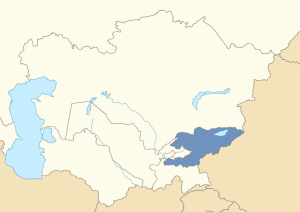
Location of Kyrgyzstan in post-Soviet Central Asia

Location of Kyrgyzstan in post-Soviet Central Asia

Kyrgyzstan
Capital: Bishkek
Official language(s): Kyrgyz, Russian
President: Almazbek Atambayev
Area: 199,951 км²
Population: 5,604,212 (2014 CIA est.)
GDP per capita: $2,500 (2013 CIA est.)
Geography: Mountains, fertile valleys
Ethnic groups (2014 census): Kyrgyz (73%), Uzbeks (14%), Russians (6%), Others (7%)
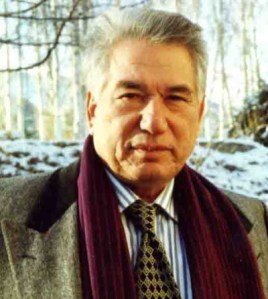
Kyrgyz writer Chinghiz Aitmatov

Kyrgyz writer Chinghiz Aitmatov

Overview:

Kyrgyzstan (also known as Kirghizia) is a small and mountainous country located south of Kazakhstan and just west of China. The Kyrgyz are a Turkic-speaking people who, like the Kazakhs, have a nomadic tradition and share many cultural influences from the Mongols. The Tian Shan mountain range runs through much of the country’s west near the much-celebrated Issyk Kul lake. Issyk Kul was a famous resort in Soviet times and also the setting for the Issyk Kul Forum.  Founded by the Soviet Kyrgyz writer Chinghiz Aitmatov during glasnost, the Forum was a way of bringing intellectuals from the East and West together. Aitmatov, who passed away in 2008, was a friend and advisor of Mikhail Gorbachev. The Kyrgyz author is still widely respected throughout the former Soviet Union and his stories are still cherished by many in the region to this day.

Kyrgyz yurt (nomadic dwelling) near Issyk Kul

Kyrgyz yurt (nomadic dwelling) near Issyk Kul

Though not as rich as its northern neighbor Kazakhstan, Kyrgyzstan has distinguished itself as the most democratic country in post-Soviet Central Asia. The current President Almazbek Atambayev claims that this derives from a democratic tradition among the Kyrgyz nomads and thus has labeled his country a “nomadic democracy.” Despite this, Kyrgyzstan is no stranger to unrest. Since the end of the Soviet era, this small country has experienced two political revolutions, one in 2005 and another in 2010. It has also seen ethnic unrest between the dominant Kyrgyz and the significant Uzbek minority in the southern city of Osh in the Fergana Valley. Clashes occurred in both 1990 and most recently in 2010. Kyrgyzstan is still recovering from the more recent ethnic riots.
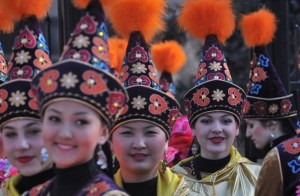
Kyrgyz women in traditional costume (AFP)

Kyrgyz women in traditional costume (AFP)

After September 11, the US opened the Manas Air Base in Kyrgyzstan. Russia’s Vladimir Putin initially approved of this move and allowed the US to operate this base in former Soviet territory as part of its war against the Taliban in Afghanistan. However, as US-Russian relations became strained, Putin decided to pull the plug on the Manas base and sought to have Bishkek close it. After his election in 2011, Kyrgyz President Atambayev announced that he would seek the closure of the base when its lease expires. In June 2014, the US vacated the base.
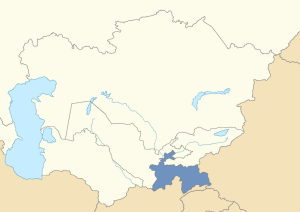
Location of Tajikistan in post-Soviet Central Asia

Location of Tajikistan in post-Soviet Central Asia

Tajikistan
Capital: Dushanbe
Official language(s): Tajik
President: Emomali Rahmon
Area: 143,100 км²
Population: 8,051,512 (2014 CIA est.)
GDP per capita: $2,300 (2013 CIA est.)
Geography: Mountains, fertile valleys
Ethnic groups (2010 census): Tajiks (84% including Pamiris), Uzbeks (14%), Others (2%)

Tajik woman in national dress

Tajik woman in national dress

Overview:

Geographically, Tajikistan is the smallest of the ex-Soviet Central Asian states. It is also the most mountainous. The Pamir Mountains cover most of the eastern part of the country in the Gorno-Badakhshan Autonomous Oblast. The Tajiks are basically a subgroup of ethnic Persians. Their native language, Tajik, is a dialect of Farsi, distinguishing them from their Turkic-speaking neighbors.

The Tajiks live not only in Tajikistan but also in significant numbers in neighboring Uzbekistan and to the south in northern Afghanistan. Ahmad Shah Massoud, the famed leader of Afghanistan’s Northern Alliance was an ethnic Tajik. In addition, Tajikistan is also home to the Pamiri people who are natives of Gorno-Badakhshan.

Spetsnaz troops in the Tajikistan Civil War (Ussuriysk Military School / Dmitry Ivlyov)

Spetsnaz troops in the Tajikistan Civil War (Ussuriysk Military School /
Dmitry Ivlyov)

Tajikistan is the poorest ex-Soviet state in Central Asia and it has a history of instability going back to the time of the Soviet collapse. After independence, the country plunged into a violent civil war.  The civil war had its origins in the unequal power distribution among the country’s regions.  The government was dominated by people from the Leninabad (today Khujand) region in the north and the republic’s security forces were dominated by people from Kulyab in the south. The people from the central Garm region and the eastern Gorno-Badakhshan Autonomous Oblast, inspired by Gorbachev’s glasnost, demanded more of a say in the government. Their political coalition was an ideological hodge-podge mix of liberal democrats, nationalists, and Islamists. Ultimately, the government refused to share power and it was this that led to the civil war between the sides.
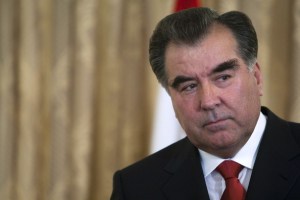
Tajik President Emomali Rahmon (Getty / Majid Saeedi)

Tajik President Emomali Rahmon (Getty / Majid Saeedi)

The conflict in Tajikistan lasted until 1997 when a power-sharing peace deal was finally agreed upon with the help of negotiation by Moscow.  Since then, the country has been relatively stable. Emomali Rahmon, the country’s longtime strongman, has remained in power since the 1990s. The drug trade, which runs from neighboring Afghanistan, seeks to use Tajikistan as a major transit route to the former Soviet states and Europe, posing a serious challenge for the government.

Recently, Tajikistan has sought to enrich itself by capitalizing on its major glacier and water resources.  Water resources are highly valued in a region like Central Asia which includes large arid desert areas.  Tajik interest in using their water resources for hydroelectric energy has created tension with drier neighbor Uzbekistan.  Tashkent is fearful that such projects could adversely affect its water supply and, by extension, its cotton production.

Location of Uzbekistan in post-Soviet Central Asia

Location of Uzbekistan in post-Soviet Central Asia

Uzbekistan
Capital: Tashkent
Official language(s): Uzbek
President: Islam Karimov
Area: 447,400 км²
Population: 28,929,716 (2014 CIA est.)
GDP per capita: $3,800 (2013 CIA est.)
Geography: Arid desert, fertile valleys, mountains
Ethnic groups (2000 estimate): Uzbeks (78%), Russians (5%), Tajiks (5%), Kazakhs (4%), Karakalpaks (2%), Others (6%)
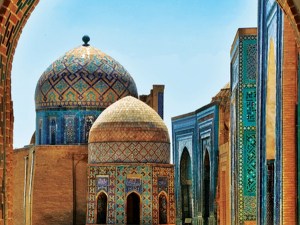
Samarkand (Malika Hotels)

Samarkand (Malika Hotels)

Overview:

Uzbekistan is the most populous country in Central Asia. Uzbeks, a Turkic-speaking people,  are the dominant population of Uzbekistan.  Their ethnonym “uzbek” literally translates as “his own lord,” meaning a “free” or “independent” person. The country also includes many ethnic minorities including Russians, Tajiks, Kazakhs, and Karakalpaks. The capital Tashkent was founded in the 8th century as an oasis on the Silk Road. Uzbekistan is also home to great Islamic cultural centers such as Bukhara, Samarkand, and the historic Khwarezm capital of Khiva, all boasting visually stunning art and architecture.  Many Tajiks live in Samarakand and Bukhara and some Tajik nationalists have even claimed these cities for Tajikistan.  However, the beauty of these great centers go beyond any ethnic or national divisions and are treasured by all Central Asians as part of their collective cultural heritage.

Kyzyl Kum (VisitUzbekistan)

The Kyzyl Kum (VisitUzbekistan)

Uzbekistan’s landscape is diverse. Much of the country’s west is covered by the hot Kyzyl Kum (“Red Sands”) desert. The large Aral Sea used to be a major feature of western Uzbekistan. However, due to Soviet-era irrigation schemes involving the Amu Darya and Syr Darya rivers and the Karimov government’s inaction, the once-great sea has now shrunk to near-nonexistence. The eastern part of Uzbekistan, centered on the Fergana Valley is more fertile, though this part of Central Asia has also been known for ethnic tension, disputed borders, and Islamic extremism. The country also has a wealth of natural resources including natural gas, oil, and gold and is renown for its cotton growth.
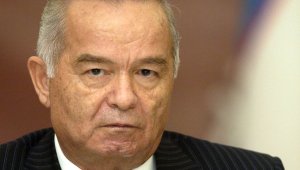
Uzbek Leader Islam Karimov (RIA Novosti / Sergey Guneev)

Uzbek Leader Islam Karimov (RIA Novosti / Sergey Guneev)

Of all the post-Soviet Central Asian states, Uzbekistan is the most repressive. The president, Islam Karimov, was elected to lead the country in 1990 and has remained in this position, establishing himself as an authoritarian despot. Rampantly corrupt, Karimov’s regime is particularly notorious for its use of medieval-style torture. Though potential Islamic extremism is a serious concern for Uzbekistan, the government has used this liberally as an excuse to crackdown on any dissent in the country. As a police state, it keeps a watchful eye on all of its citizens.  In 2005, a popular uprising against the regime in the eastern city of Andijan was put down brutally, with the Uzbek government forces cruelly firing into a crowd of men, women, and children. Estimates of those killed range from 400 to more than 1,000.

Gulnara Karimova (Getty)

Gulnara Karimova (Getty)

In recent years, Karimov’s daughter, Gulnara, has also been in the news. An oligarch with a taste for fashion and pop-singing, she is regarded as a very controversial figure. She lost her influence in Uzbekistan after she criticized her father’s repressive regime. Since then, her father has attempted to silence her, but she has continued her criticism of his policies regardless.  She was recently arrested.

After the 9/11 attacks, Russian President Vladimir Putin allowed the US to use Uzbekistan’s Karshi-Khanabad Air Base for its operations in Afghanistan. However, after the US criticized Karimov’s crackdown at Andijan, Tashkent told Washington to vacate the base. Russia, whose relations were already souring with the US at this time, approved of the evacuation of the base.  However, relations between Moscow and Tashkent have also been uneasy. In 2012, Uzbekistan withdrew from the Moscow-backed CSTO military alliance.

Location of Turkmenistan in post-Soviet Central Asia

Location of Turkmenistan in post-Soviet Central Asia

Turkmenistan
Capital: Ashgabat
Official language(s): Turkmen
President: Gurbanguly Berdymuhamedov
Area: 491,210 км²
Population: 5,171,943 (2014 CIA est.)
GDP per capita: $9,700 (2013 CIA est.)
Geography: Arid desert
Ethnic groups (2010 estimate): Turkmen (79%), Uzbeks (9%), Russians (3%), Kazakhs (3%), Others (6%)
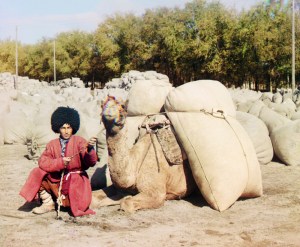
Turkmen man with camel, early 20th century (Sergey Prokudin-Gorsky)

Turkmen man with camel, early 20th century (Sergey Prokudin-Gorsky)

Overview:

Turkmenistan (also known as Turkmenia) is the homeland of the Turkmen, a traditionally nomadic Turkic-speaking people. The country borders Iran to the southwest and Afghanistan to the southeast. About 70% of its territory is covered by the inhospitable Karakum (“Black Sands”) Desert and its population is consequently sparse and spread out. Camel herding is a major occupation for many Turkmen and it is not uncommon to see dromedaries lazily walking alongside Turkmenistan’s vast desert highways. Many great powers have passed through far-flung Turkmenistan’s desert landscape over the centuries, particularly the Persians who left behind historical ruined cities like Merv and Nisa.

Darvaza Natural Gas Crater, Turkmenistan (National Geographic / Nick Hannes and Hollandse Hoogte)

Darvaza Natural Gas Crater, Turkmenistan (National Geographic / Nick Hannes and Hollandse Hoogte)

On the surface, Turkmenistan appears to be a desolate country with little to offer. Yet appearances can be deceiving.  Underneath Turkmenistan’s barren land are rich deposits of oil and especially natural gas. In fact, Turkmenistan has the fourth largest reserves of natural gas in the world. This has attracted a lot of interest, from the traditional power of Russia to new players in the region, such as the US and China. Perhaps the best illustration of the scale of Turkmenistan’s reserves is the fiery Darvaza natural gas crater (also known as the “Doorway to Hell”) located in the middle of the Karakum. In 1971, Soviet engineers began to drill for natural gas in this area. However, the ground beneath the drilling rig sank below grade, creating a large pit. The Soviets decided to burn the pit, fearful of the release of poisonous gases. It was initially believed that the gas would burn out in a matter of weeks. However, it has persisted for nearly 43 years.  The first human expedition of the fiery pit was made by explorer George Kourounis in November 2013.

Saparmurat Niyazov gold statue in Ashgabat (Robert Preston)

Saparmurat Niyazov gold statue in Ashgabat (Robert Preston)

One of the more unusual phenomena to emerge from Turkmenistan since the Soviet collapse has been its late President Saparmurat Niyazov. Niyazov was an authoritarian leader who was just as eccentric as he was autocratic. Channeling Turkey’s Atatürk, he Latinized the previously Cyrillic-based Turkmen alphabet and styled himself “Turkmenbashi,” meaning “Leader of the Turkmen.” He established an all-pervasive personality cult and even erected a gold statue to himself in the capital Ashgabat. Niyazov also issued bizarre decrees such as banning ballet, opera, makeup, and lip-syncing, and named months after his own family members. In addition, he authored a book known as the Ruhnama, a text comparable to Mao’s Little Red Book or Muammar Gaddafi’s Green Book, containing a mix of spiritual guidance, pseudo-history, autobiography, and poetic verse. The book was made mandatory in all Turkmen schools and a monument to it was even built in Ashgabat. Following Niyazov’s death in 2006, his successor Gurbanguly Berdymuhamedov reversed many of his absurd decrees and removed his personality cult. However, Berdymuhamedov too appears to prefer ruling as an all-powerful authoritarian leader as opposed to introducing any sort of competitive democracy to Turkmenistan.

Anatoly Kuznetsov as Comrade Sukhov in White Sun of the Desert

Anatoly Kuznetsov as Comrade Sukhov in White Sun of the Desert (1970).

In the post-Soviet world Turkmenistan is also widely renown as the setting for the much celebrated 1970 Soviet film White Sun of the Desert (Белое солнце пустыни). This film, which featured the famous song Your Honor Lady Luck (Ваше благородие, госпожа Удача) by the bard Bulat Okudzhava, was one of many in the Soviet “Ostern” genre.  These “Osterns” (or “Easterns”) very much resembled American Westerners, except they were set in the deserts of Soviet Central Asia as opposed to the American southwest. Directed by Vladimir Motyl, White Sun of the Desert also introduced many common phrases into the Russian language including “Восток — дело тонкое” (“The East — a delicate matter”), “Вопросы есть? Вопросов нет!” (“Are there any questions? Of course not!”), “Таможня дает добро!” (“Customs gives the green light!”), and “Гюльчатай, открой личико!” (“Gyulchatai, show your face!”).

Autonomous regions:

Location of the Gorno-Badakhshan Autonomous Oblast within Tajikistan in post-Soviet Central Asia

Location of the Gorno-Badakhshan Autonomous Oblast within Tajikistan in post-Soviet Central Asia

Gorno-Badakhshan Autonomous Oblast, Tajikistan
Capital: Khorog
Official language(s): Tajik (Pamiri languages widely spoken)
Governor: Shodikhon Jamshedov
Area: 64,200 км²
Population: 218,000 (2008 est.)
Geography: Mountainous
Ethnic groups: Pamiris, Kyrgyz

Overview:

The Gorno-Badakhshan Autonomous Oblast is perhaps the highest region in the former Soviet Union. It is almost completely covered by the Pamir mountains which, along with the nearby Himalayas, have been dubbed the “Roof of the World.” The tallest mountain peak of the former Russian Empire and the former USSR, Peak Kommunism (now Ismoil Somoni Peak) is located in Gorno-Badakhshan.

Pamiri children in Barchadev, Gorno-Badakhshan Autonomous Oblast, Tajikistan (Robert Middleton)

Pamiri children in Barchadev, Gorno-Badakhshan Autonomous Oblast, Tajikistan (Robert Middleton)

The population of the oblast is primarily comprised of ethnic Pamiris, an Iranic people distinct from the Tajiks who speak the Pamiri languages, not Farsi. Unlike the mostly Sunni Tajiks, the Pamiris are Ismaili Muslims (an off-shoot of Shiism). In addition to their homeland in Gorno-Badakhshan, the Pamiris also live in Afghanistan’s northernmost province of Badakhshan and in the westernmost portions of China’s Xinjiang Uyghur Autonomous Region (particularly in the Tashkurgan Tajik Autonomous County). They are closely related to the Wakhi speakers of Afghanistan’s Wakhan corridor and Pakistan’s far-northern Gilgit-Baltistan territory (part of disputed Kashmir).

Khorog, capital of the Gorno-Badakhshan Autonomous Oblast (Bakhriddin Isamutdinov)

Khorog, capital of the Gorno-Badakhshan Autonomous Oblast (Bakhriddin Isamutdinov)

The region was the last part of post-Soviet Central Asia to become part of the Russian Empire in 1895.  It was also the last territory acquired by the Russian Empire before the Revolution of 1917. [CORRECTION (11 Sept. 2016): The last territory acquired by the Russian Empire was actually the Severnaya Zemlya archipelago in the high Arctic in 1913.  Other northern islands were also claimed by the Russian Empire prior to 1917, including Franz Josef Land, Victoria Island, and Wrangel Island.  However, all of these islands would only be formally annexed to Russia in 1926 by the Soviet government.]

The boundary was drawn dividing the historic Badakhshan region between the Russian and British Empires (the latter of which controlled the foreign affairs of Afghanistan).   The Chinese Qing dynasty also had claim over the region.  It was not until 2002 that the People’s Republic of China finalized its frontiers with then post-Soviet Tajikistan.  However, the Republic of China, exiled in Taiwan, refuses to recognize this and continues to claim Gorno-Badakhshan as part of mainland China.

During the 1990s civil war in Tajikistan, the Pamiris of Gorno-Badakhshan sided with the Garmis in demanding more equal power from the government.  Many people from Garm and Gorno-Badakhshan had been relocated to the country’s south and western cotton-growing areas during the Soviet era.  During the early part of the war, many of the Garmis and Pamiris in this part of the country faced attacks and expulsions from government forces in what Human Rights Watch dubbed an “ethnic cleansing campaign.” Many fled back to their traditional native regions in Tajikistan, while others fled across the border into Afghanistan.  The result was a radicalization of the sides and an intensification of the conflict.
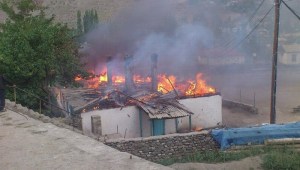
Clashes in Gorno-Badakhshan, 2012 (Reuters)

Clashes in Gorno-Badakhshan, 2012 (Reuters)

The civil war continued in Tajikistan until a power-sharing a agreement was brokered with Russian assistance in 1997.  Since then, Gorno-Badakhshan has remained relatively peaceful. However, in 2012, clashes erupted in the region between loyalists of the warlord Tolib Ayombekov and the Tajik military. Moscow observed the situation with concern.  After intense fighting on July 24, Tajik leader Emomali Rahmon called for a ceasefire. Peace and stability have since been restored to the area.
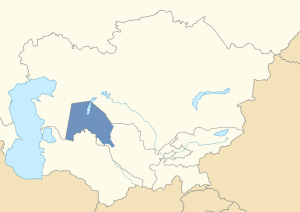
Location of the Karakalpakstan within Uzbekistan in post-Soviet Central Asia

Location of the Karakalpakstan within Uzbekistan in post-Soviet Central Asia

Karakalpakstan Autonomous Republic, Uzbekistan
Capital: Nukus
Official language(s): Karakalpak, Uzbek
Governor: Musa Erniyazov
Area: 164,900 км²
Population: 1,711,800 (2013 est.)
Geography: Arid desert
Ethnic groups (2007 estimate): Karakalpaks (33%), Uzbeks (33%), Kazakhs (25%), Others (9%)

Overview:

Karakalpakstan is an autonomous region that encompasses much of western Uzbekistan. Linguistically and culturally, the Karakalpaks closely resemble the Kazakhs more than the Uzbeks.  It is noteworthy that the area was once an autonomous region within Soviet Kazakhstan during the NEP era of the 1920s, before its jurisdiction was transferred to the Russian SFSR in 1930 and eventually to Soviet Uzbekistan in 1936. The name “Karakalpak” roughly translates as “black hat,” but the origin of this name is obscure. There are theories linking the Karakalpaks to the Chorni Klobuky (“black hat”) mercenaries of the Kievan Rus’ from the 11th and 12th centuries, though aside from the common meaning of their names, there is no evidence linking these two groups.  The Karakalpak homeland is arid and almost completely covered by desert.

Photographs illustrating the diminution of the Aral Sea. From left to right: (top row) 1973, 1989, 1999, (bottom row) 2001, 2003, 2009 (US Geological Survey and NASA)

Photographs illustrating the diminution of the Aral Sea. From left to right: (top row) 1973, 1989, 1999, (bottom row) 2001, 2003, 2009 (US Geological Survey and NASA)

Karakalpakstan was once a prosperous region in Soviet times. However, in the post-Soviet era, the region has fared badly within independent Uzbekistan. It has become the country’s poorest region and has suffered the greatest from the rapidly diminishing and now disappearing Aral Sea, which used to be a major feature of the region. The area is now experiencing a severe drought. Temperatures have increased. Sea salt and other chemicals from the dried bed of the salient sea have become wind-borne, poisoning the local environment and creating serious respiratory problems for the people living in the area. Meanwhile, the sea continues to shrink and Tashkent has done nothing to prevent what many regard as an environmental catastrophe. There are rumblings by some Karakalpak activists about possible independence from Uzbekistan, though Tashkent has been quick to deny this.

Nukus Art Museum (Panoramio)

Nukus Art Museum (Panoramio)

The ancient oasis region of Khwarezm encompassed a significant portion of modern Karakalpakstan, particularly in the Amu Darya river delta.  As such, the area has inherited many historic ruins and archeological sites of interest.  Additionally, the capital Nukus is also the home of the famed Nukus Art Museum, or more formally the State Art Museum of the Republic of Karakalpakstan, after I. V. Savitsky. The museum houses the second largest collection of Russian avant-garde art in the world after the Russian Museum in St. Petersburg. Igor Savitsky, the museum’s founder, collected them at great risk of his own life, especially during Stalin’s era. In 2010, the museum was prominently featured in the documentary, The Desert of Forbidden Art with narration by Ben Kingsley and others.

Moscow’s Sochi Summit on Karabakh

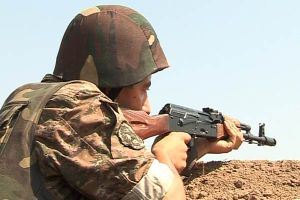
Karabakh Armenian Soldier on the Frontline with Azerbaijan (nkrmil.am)

Karabakh Armenian Soldier on the Frontline with Azerbaijan (nkrmil.am)

In recent weeks, Armenia and its sister republic of Nagorny Karabakh have been experiencing an increase of violence along the contact line with Azerbaijan, claiming the lives of many soldiers on both sides. The fighting has been so intense that some observers have dubbed it the worst the region has seen since the 1994 ceasefire.

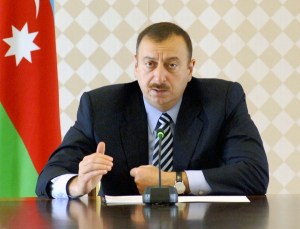
Ceasefire violations have been common since the 1994 armistice, with Azerbaijan often doing the violating as a means of warning the Armenians and the international community that it is not pleased with the status quo. Since the death of longtime Azerbaijani leader Heydar Aliyev and the succession of his son Ilham, the ceasefire violations have only increased in their intensity and aggressiveness. This reflects much of the character of the regime of Ilham Aliyev, who frequently engages in bellicose anti-Armenian rhetoric as a means of rallying the population around his notoriously corrupt government. He has often referred to the Armenians as a “worthless” nation and has continuously vowed to not only invade Karabakh but also advance on the Armenian capital Yerevan and to take the country’s turquoise Lake Sevan and the ruggedly mountainous Syunik region as well. Aliyev has also worked to use his country’s oil wealth as a means of not only enriching himself, his family, and his clique but also massively increasing Azerbaijan’s military spending. All this while brutally and swiftly stifling voices of dissent at home, earning Aliyev’s Azerbaijan an international reputation as an authoritarian petrostate – a corrupt kleptocratic khanate on the Caspian.

Azerbaijani President Ilham Aliyev

Azerbaijani President Ilham Aliyev

Aliyev’s strategy is a dangerous one. By intensifying ceasefire violations, engaging in aggressive rhetoric, and massively spending on the military, he believes that this will increase his authority and legitimacy domestically.  However, he is instead driving the region toward a war that neither the Armenian nor Azerbaijani sides need. In fact, despite its astronomical spending on high-tech military equipment, Azerbaijan is in a particularly bad place to start a war. Among other things, the Azerbaijani army is poorly-trained and rampantly corrupt. This is compounded by the fact that Aliyev does not want to have a military that is too strong because there has been a history of military coups in post-Soviet Azerbaijan. A war would also be devastating for Baku because the Armenians could easily target the Western-backed oil pipeline that runs through Azerbaijan. Further, it would be extremely difficult for Azerbaijani tanks to make it through Karabakh’s very mountainous terrain, which the local Armenians know intimately and would use as a “natural fortress” to fight against the Azeris. Finally, Armenia has very good security relations with the Russian military, which would protect Armenia in the case that a new conflict erupts.

Map of Armenia and the self-proclaimed Nagorny Karabakh Republic (NKR) in the Caucasus

Map of Armenia and the self-proclaimed Nagorny Karabakh Republic (NKR) in the Caucasus

Nevertheless, Azerbaijan has persisted in violating the ceasefire along the line of contact and not just in the vicinity of Karabakh. In recent years, there have been several ceasefire violations along the border with Armenia’s northern province of Tavush, close to the border with Georgia. Then in June, Azerbaijan launched an unexpected attack on Armenia from its exclave of Nakhichevan. The exclave has a naturally-defined border with Armenia running along the Vayots Dzor and Syunik (or Zangezur) mountain ranges. The situation has remained largely calm along this border due to the fact that Armenia controls the heights looking over Nakhichevan.

Protection mounds placed near the Armenian-Nakhichevan border, July 2014

Defensive mounds placed near Armenia’s north-south highway along the Armenian-Nakhichevan border, July 2014. (Photograph by this writer)

However, one section of Armenia’s border with Nakhichevan, between the Armenian Ararat province and the northern Nakhichevan district of Sadarak, remains less secure and it was there where the recent border attack unexpectedly occurred. While traveling along Armenia’s north-south highway in Ararat province this July, I witnessed large mounds along the roadside of this section of the border that had been setup by the Armenian military. They are intended to protect civilian drivers from Azerbaijani artillery and indeed, the attacks on Armenian positions are so close that they have actually reached this highway.

In yet another recent episode in early July, three men from Azerbaijan (allegedly Azerbaijani commandos) infiltrated the Karabakh contact line and entered into the region of Karvatchar (or Kelbajar) where they killed two people and seriously injured another. One was shot dead while the other two are on trial for murder in Nagorny Karabakh. All of this has only increased fears in Armenia about the start of a potential new conflict in the region, which very few in Armenia desire. It has also made efforts for peace and dialogue between the sides even more difficult.

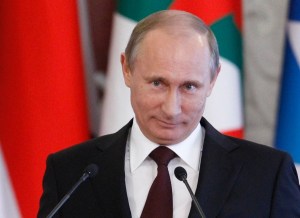
Russian President Vladimir Putin (Reuters / Maxim Shemetov)

Russian President Vladimir Putin (Reuters / Maxim Shemetov)

Despite this, Armenia’s Sargsyan and Azerbaijan’s Aliyev have been invited to Sochi at the behest of Russian President Vladimir Putin. The meeting was already planned in advance. Moscow wants to strengthen its position in the Caucasus, especially regarding the Eurasian Union. As efforts to lure Georgia back into Moscow’s fold have stalled, the Kremlin is instead looking to the possible prospect of bringing the sides together and luring Azerbaijan into its Eurasian Union. However, despite some recent warm-up in the relations between Baku and Moscow, Aliyev appears largely content with remaining independent of any geopolitical union, whether it be the Eurasian Union or the EU.

In this context and in the context of the more recent ceasefire violations, Moscow is now shifting gears and trying to play the role of a peacemaker. It realizes that an immediate peace deal over Karabakh is unattainable and is instead working to simply calm tensions and prevent another war from breaking out. As noted above, if a new conflict erupted in Karabakh, Moscow would be obliged by treaty to assist Armenia in ensuring its security. However, given the conflict in Ukraine’s Donbas, a war in the Caucasus is the last thing that Moscow needs. Therefore, Putin’s primary objective at the Sochi summit is to de-escalate tensions between the sides, as Moscow was successfully able to do during the 2014 Sochi Olympics.

Overall, one thing is most certain: nobody in the region would benefit from a new war over Karabakh.

Donbas Tragedy

Donbas refugees in Simferopol (Reuters / Andrey Iglov)

Refugees from Ukraine’s conflict-ridden Donbas in Simferopol, Crimea (Reuters / Andrey Iglov)

Note: An updated and slightly expanded version of this piece was published in The Nation magazine as Is Ukraine on the Brink of Tragedy? on 3 September 2014.

As the conflict in Ukraine’s Donbas (also known as “Donbass” in Russian) continues to rage, there is ongoing debate about what will happen if Kiev manages to reassert its control over the region. To some in Moscow, the defeat of the rebels means the defeat of Russia. They argue that if Kiev succeeds in taking the Donbas, it will mean the whole of Ukraine proper in NATO with possible fighting even in Russian-controlled Crimea. By contrast, Washington’s view is that a victory over the rebels in the Donbas would signal a “victory for democracy” and for Ukraine’s “European choice” (and possibly even “Euro-Atlantic choice”).

Are these narratives accurate? Will Russia really lose out geopolitically if Kiev defeats the rebels? Would this really be a victory for Washington? Would Ukraine become stable and would the defeat of the rebels really signal the start of Ukraine’s “path toward democracy?”

In reality, even if Kiev manages to defeat the rebels and reestablish its control over its rebel oblasti, there will still be many more daunting challenges to face.

First and foremost, the vast majority of Russian-speaking Southeastern Ukrainians from Odessa to Kharkov (many of whom did not even support the rebels) will still view Kiev with distrust and as a “coup government” regardless. Additionally, if Kiev persists with driving through painful IMF-sponsored economic austerity “reforms,” it will turn not only the entire Southeast but also the more mixed areas of Central Ukraine against them. The situation will likely be even more challenging for Kiev in the Donbas itself where civilians have faced near-constant shellings, bombardments, and atrocities. Many of their neighbors, friends, and families have also made the trek to Russia as refugees. According to the UN, close to a million Ukrainians have fled to Russia since the crisis in Ukraine began.

Then there are bombed-out towns like Slavyansk, the remnants of the “anti-terrorist” assault. Kiev will already have difficulty supplying itself and Europe for a long, cold winter. How will they supply a city like Slavyansk where the infrastructure has been virtually bombed into oblivion? It is doubtful that anyone would want to stay in a bombed-out shell of a building for a freezing cold winter, especially a family.

Further, despite the persistence of US State Department officials and the US political elite, the American government can realistically go only so far in supporting the scenario that they helped to create. They will quickly discover that they simply do not have the resources and funds to continue supporting Kiev. Even if they did, those funds would be almost guaranteed to be misused and misspent by Ukraine’s corrupt political elite.

Certainly, for those supporters of Maidan, the reality of the corrupt Ukrainian political elite will come to roost very soon. In addition to painful economic reforms, it is unlikely that there will be any major effort to tackle Ukraine’s massive corruption issue or pay off its astronomical debt. That said, the disappointment with Maidan may well come faster than did the disillusionment with the 2004 Orange Revolution.

Therefore, while it may seem to some in Moscow that a defeat of the Donbas rebels signals the “imminent defeat of Russia,” in reality time is on Russia’s side.

However, then the question becomes: until the realities of the situation begin to set in, how much more suffering will the Ukrainian people have to endure?

After all, the greatest tragedy of the Ukraine crisis is that when future historians look back at all the damage that has been done by this conflict – the deaths, the divided families, the refugees, the destroyed cities, the severed economic links, the ruined diplomatic ties, etc. – they will perhaps wonder, as historians of other unnecessary wars do today: was it really worth it?

Russia and Georgia: Where to Go Next?

Georgian Prime Minister Irakli Garibashvili (left) and EU's José Barroso (right)

Georgian Prime Minister Irakli Garibashvili (left) and EU’s José Barroso (right) (Georgian Government)

On Friday, Georgia signed its Association Agreement with the EU. The event was favorably celebrated in Tbilisi and touted in the West as a “first step toward the EU.”

However, the agreement does not guarantee automatic membership in the EU. In this regard, Georgia still has a long way to go. Russia has voiced its concerns regarding the EU agreement. Abkhazia, one of Georgia’s breakaway republics on the Black Sea, has echoed this sentiment. On July 1, its Foreign Ministry declared the following:

It is quite obvious that signing of the Association Agreement with the EU does not provide to Georgia an immediate perspective for membership in this union, but at the same time, it distances Georgia from cooperation with neighboring states, first of all, with the Russian Federation and Republic of Abkhazia.

There has also been concern in the West, and to a lesser degree in Georgia, regarding an even greater Russian reaction. Some fear a reversal of the progress made on economic ties while still others fear an invasion of Georgia proper.

Yet Moscow will likely not resort to hard retaliatory measures as has been widely speculated in the West. In its effort to bring all the ex-Soviet states into its Eurasian Union, instead Moscow has sought to pursue its aims by proposing offers and deals that may make the ex-Soviet republics more amiable to it.

Georgia is an important country to include in a proposed supranational union of ex-Soviet states, not just for Putin, but for any future Russian leader for several reasons.  Georgia has historically been viewed in Moscow as the “center” of the Caucasus region and the gateway to Eurasia. Outside of Abkhazia, it possesses a prosperous Black Sea coast that includes port cities and resorts like Poti and Batumi. Russia views the Black Sea as a vital geostrategic region and as part of its traditional zone of influence. Georgia naturally plays a role in this. The United States, Russia’s rival in the region, has also realized the geopolitical significance of Georgia and thus has focused much of its efforts on trying to bring Georgia into Euro-Atlantic structures. Whether or not such ambitions will help US-Russian relations, global security, or Georgia’s own efforts toward reform, remains an open question.

Prince Pyotr Bagration, George Dawe (1820)

Prince Pyotr Bagration, George Dawe (1820)

Further, there are also cultural and interpersonal affinities between Russia and Georgia. A Georgian nationalist might state that “as people, Russians and Georgians were never brothers and sisters” and that this is “Soviet mythology.” However, the truth and reality are far different from such ethnonationalist pronouncements. Despite the rupture in relations from the 2008 war, most Russians admire the Georgians, if only because of their reputation as easy-going party people. Conversely, many Georgians deeply admire Russian culture, literature, and language. At least 92% of Georgians still speak Russian as a second language. There are also the shared ties of Orthodox Christianity. Additionally, as many as one million ethnic Georgians live and work in Russia, and that number is estimated by some to be even higher. Georgians are generally well-integrated in Russian life and freely intermarry with Slavic Russians. The most famous Georgian in Russian history is probably Prince Bagration, the hero of the Napoleonic War. The most infamous is probably Joseph Stalin.

These are the reasons why Russia values Georgia and why its long-term plan is to lure Tbilisi back through some goodwill gesture. The obvious place for this to occur would be in Georgia’s two breakaway regions: Abkhazia and South Ossetia. Both were recognized by Russia as independent states after the 2008 war, thus further complicating Georgian-Russian relations. However, Moscow’s aim at the time was to “respond” to the West’s recognition of Kosovo and to domestically discredit Georgia’s controversial President, Mikheil Saakashvili.

Georgia's Moscow attaché Zurab Abashidze (Georgian Government)

Georgia’s Moscow attaché Zurab Abashidze (Georgian Government)

With these goals attained and with a new government in Georgia willing to talk to Moscow, Russia may be more flexible on the issue. Already Bidzina Ivanishvili has stated that the goal of reunification with the two breakaways is Georgia’s top priority and the Georgian attaché to Moscow, Zurab Abashidze, has confirmed this position, even tying it to the re-establishment of relations between Georgia and Russia. At the same time, Russia will not betray the interests or rights of the Abkhaz or Ossetes. Instead, the logical solution lies in working to find a compromise between them and Tbilisi to forge some sort of federal or confederal solution. This can be accomplished informally without direct diplomatic relations, even outside of the Geneva framework which, like its OSCE counterpart on Nagorny Karabakh, has failed to produce any serious results or resolutions.

It is likewise unclear how the recent revolution in Abkhazia will affect such talks. Regardless of speculation on whether or not Russia played a role in the revolution, or whether it was an entirely domestic Abkhaz affair, it is clear that whomever the Abkhaz select as their next president, he or she will play a decisive role in working to normalize relations between Abkhazia and Georgia. Certainly, even this depends on the development of Georgian-Russian relations.

Woman casts ballot in the South Ossetian parliamentary election as her daughter watches (ITAR-TASS)

Woman casts ballot in the South Ossetian parliamentary election as her daughter watches (ITAR-TASS)

Meanwhile, the situation in South Ossetia is less clear. United Ossetia, the victors of the recent parliament vote in the breakaway region, advocate joining North Ossetia in a political union with Russia. It is unclear if they will follow through with such a program or, if under pressure from Moscow, they will take a more compromising stand on relations with Georgia. Moscow has already distanced itself from Ossetian demands and will likely react with caution if South Ossetians do indeed vote for a political union with Russia (as Moscow did with the Donbas rebels in Ukraine). In general though, the outcome of all of this remains to be seen.

The Georgians are also looking for an opening with Moscow not just in terms of a resolution to its conflicts. Tbilisi also wants to ensure that if Moscow makes an attractive counteroffer to the EU, it must consider Georgian national sensitivities. Any effort toward integration among post-Soviet states cannot be imperial in nature, but rather a union of equal states. If the Eurasian Union, like the EU, were to ensure an official status for Georgian and other national languages, then such an idea would become much more attractive to Tbilisi and would make the Eurasian Union an easier sell to the Georgian public at large. Moscow must keep in mind its own long tradition of multiculturalism, universalism, and ethnic tolerance that has preceded the birth of post-war “EU values” by several centuries. In order to be a viable international player, Russia must do more to embrace this great tradition of multiculturalism and shun all forms of ethnic Russian nationalism that not only threaten the unity of Russia but also its geopolitical interests in the ex-Soviet space as well. In this regard, presenting the Eurasian Union as a “union of equals” to Georgia would certainly work to its advantage.

Bidzina Ivanishvili (RIA Novosti / Aleksandr Imedashvili)

Bidzina Ivanishvili (RIA Novosti / Aleksandr Imedashvili)

Efforts toward a reconciliation with Moscow by Tbilisi began almost immediately after the victory of Bidzina Ivanishvili and the Georgian Dream coalition in 2012. However, the progress of such a reconciliation had to be limited to basic issues, such as trade and visa questions. This was due not only to the complex situation that existed over Georgia’s breakaways, but also because of the fact that Saakashvili still remained the President into 2013 and thus still held significant political influence. Following the electoral victory of Margvelashvili in 2013 and Ivanishvili’s appointment of Garibashvili as the new Prime Minister, the chances for an enhanced reconciliation grew significantly. During the Sochi Olympics, Putin proposed meeting with the Georgian President. Abashidze, and his Russian counterpart Grigory Karasin, agreed to meet and plan this high-level visit which was supposed to take place in March. However, as the Ukraine crisis worsened and the crisis in Crimea erupted, the proposed meeting was postponed indefinitely.

Both Moscow and Tbilisi likely have their reasons for this. Moscow is not only focused primarily on the outcome of Ukraine but it is also clear that, since Yanukovych’s ouster, it learned from recent history and sought to not place the potentially friendly government in Tbilisi in the same position as Yanukovych. Already Mikheil Saakashvili has threatened to launch his own “Georgian Maidan,” and a Georgian volte-face on the EU Association Agreement would have been the perfect excuse to launch such a revolt. Tbilisi likely shares this same concern and that probably played a part in its considerations on how to approach Moscow. Adding to this were other considerations on the Georgian side, such as its desire to balance its relations between East and West. The government also sought to maximize its support base in the recent local government elections.

The Georgian government also has a problem in that its party, the Georgian Dream coalition, is still a coalition. Garibashvili and Margvelashvili, though they have disagreed on petty issues such as who will sign the Association Agreement, are nevertheless allied on the question of Russia. They favor a pragmatic and balanced approach. This is contrasted by Davit Usupashvili who heads the Georgian parliament, a very vocal critic of Moscow and a stalwart supporter of NATO expansion. Defense Minister Irakli Alasania has been traditionally more moderate and once played a key role in bringing the Abkhaz and Georgians close to a peace. However, during his stint as Defense Minister, his advocacy for NATO membership and his proposal to place missile bases on Georgia soil near Abkhazia have raised eyebrows in Moscow, Tbilisi, Sukhumi, and Tshkinvali.

Tbilisi was likewise concerned over the Russian annexation of Crimea and of the potential implications of this for Georgia’s breakaways, though Russia quickly assured Tbilisi afterward that Crimea was a unique case and that Russia was not interested in annexing Abkhazia or South Ossetia. The Georgian Prime Minister Garibashvili reaffirmed this view on an interview with the BBC.

What the next step will be in Tbilisi’s relations with Moscow remains to be seen. However, there are compromises and deals to be made. One aspect of Tbilisi’s protracted conflicts with Moscow, Sukhumi, and Tskhinvali remains clear: that from a basic geographic perspective, cooperation between Russia, Georgia, Abkhazia, and South Ossetia, is not only desirable and logical, but necessary.

Some Georgians may want to break away totally from Russia and join Europe, but they seem to forget the simple fact of geography; that the Kura is not the Seine and that Georgia is not at the center of Europe but at its very fringe. Historically, it has had less-than-pleasant relations with its larger Islamic neighbors like Turkey and Iran. It shares a very long northern border with Russia, a country that has served for centuries as Tbilisi’s protector and as its lifeline to the rest of Europe. Georgian nationalists can try to wish Russia away all they want, but the fact is that Russia is there and Tbilisi has to deal with it and can even benefit from it.

For its part, Russia views Tbilisi as an important factor in its security policy, and in turn needs Georgia to secure its position in the Caucasus region, especially in the unstable North Caucasus. Thus, while ethnic Russian nationalists may believe that weakening or punishing Georgia for its “independent attitude” will help Russia, in fact they are far from correct. This will only exacerbate regional divisions and animosities that will most certainly not serve the interests of Russian security.

Finally, the Abkhaz and Ossetian nationalists too may try to wish Georgia away, but this is unrealistic as well. Geography and centuries of close cultural ties demand coexistence and compromise. Thus, it is to everybody’s benefit and advantage that there be a solution to the protracted conflicts plaguing the Georgians, Russians, Abkhaz, and Ossetes. Above all, it is the people of Georgia, Abkhazia, South Ossetia, and Russia who will benefit the most from a peaceful diplomatic solution. This is what the politicians of these countries and regions have to realize if any tangible progress is to be accomplished.

Moscow’s Kurdish Question

Israeli Prime Minister Benjamin Netanyahu (Reuters / Lucas Jackson)

Israeli Prime Minister Benjamin Netanyahu (Reuters / Lucas Jackson)

On Sunday, Israeli Prime Minister Benjamin “Bibi” Netanyahu voiced his support for an independent Kurdish state. Israel is certainly in a good position to do this. It has bad relations with Syria, Turkey, and Iran, while Iraq appears to be disintegrating. It also has long had sympathy with the Kurdish cause and it would view an independent Kurdistan as a boon to its “periphery doctrine.”

The Kurds are the largest nation in the world (around 30 million people) who do not have their own country. They are a largely nomadic people who primarily live in the mountainous borderlands of Turkey, Iraq, Syria, and Iran. They speak an Indo-European language closely related to Farsi and that is subdivided into several dialects such as Kurmanji, Sorani, and Gorani. The Kurdish language has been written in three different alphabets: Latin (in Turkey), Perso-Arabic (in Iraq, Iran, and Syria), and Cyrillic (in the former USSR). The majority of Kurds practice Sunni Islam, though a significant minority also practice the Yazidi faith, a religion associated with Zoroastrianism. The Kurds who follow the latter usually identify themselves as a distinct ethno-religious group altogether (the Yazidis), even though they speak Kurdish and follow Kurdish traditions. For the most part, the Yazidis live in Iraq and Syria, though significant communities also exist in Armenia, Georgia, and Russia.

CIA map of Kurdish-inhabited regions from 1992, courtesy of the Perry-Castañeda Library Map Collection at The University of Texas at Austin

1992 CIA map of Kurdish-inhabited regions, courtesy of the Perry-Castañeda Library Map Collection at The University of Texas at Austin

Denied their own state, the history of the Kurds in the 20th and 21st centuries has been one of near-endless uprisings and bloodshed. In particular, the Kurds in Turkey have been in almost constant revolt against Ankara since the beginning of the Turkish republic. Turkey sought to forcibly assimilate the Kurds as “Mountain Turks” and to actively suppress Kurdish culture and language. The Kurdish uprisings became especially heated under the leadership of Abdullah Öcalan, leader of the Marxist-Leninist Kurdistan Workers’ Party (PKK). In the war between Turkey and the PKK, human rights abuses were committed by both sides, but especially by Turkey. Kurdish uprisings also occurred in neighboring Iraq, Syria, and Iran. In Iraq, the plight of the Kurds gripped headlines in the 1980s when Saddam Hussein used poison gas to suppress a Kurdish uprising, killing hundreds of thousands of Kurdish citizens. His Al-Anfal Campaign is today referred to by many Kurds as “genocide.”

Netanyahu’s move to support Kurdish independence comes as the Kurds of Iraq and Syria remain almost entirely isolated from Damascus and Baghdad, cut off by territory seized by the radically militant Islamic State of Iraq and the Levant (ISIL). ISIL has menaced the southern border regions of Kurdish-controlled territory and has appalled and shocked the world with its flagrant abuses of human rights.

In an immediate response to ISIL, Russia has dispatched fighter jets and advisors to assist Baghdad in its fight against the self-proclaimed militant Islamic state. Russia has issues of its own with regard to militant radical Islam. In the North Caucasus, the war in Chechnya in the 1990s began as a more nationally-based conflict. However, as the conflict progressed, radical Islam began to overtake nationalism as the dominant ideology of the Chechen rebels. Soon, this ideology spread, facilitated by the work of Saudi missionaries, to other parts of the North Caucasus, notably Daghestan, thus widening the scope of the situation. Russia’s recent aid to Baghdad and its very strong support for Bashar Assad’s Syria need to be comprehended in this context.

Russian Foreign Minister Sergei Lavrov Meets Masoud Barzani in Moscow (KRG)

Russian Foreign Minister Sergei Lavrov Meets Masoud Barzani in Moscow (KRG)

But what about the Kurds? Will the Kremlin too back Netanyahu’s call for an independent Kurdish state? This does not seem likely for the immediate future. Russia has good working relations with Turkey and Iran and, as mentioned above, it has both stood by Assad’s Syria and has aided official Baghdad.

At the same time, Russia also has a lengthy relationship with the Kurds, dating back to the Tsarist era. In 1946, the USSR supported the creation of a Mahabad Kurdish Republic in Northern Iran.  After the fall of that state, Moscow gave refuge to one of its key figures, the famous Iraqi Kurdish rebel leader Mustafa Barzani, and his followers.  Barzani was the father of Masoud Barzani, the current President of Iraqi Kurdistan.  In February 2013, the younger Barzani paid an official visit to Moscow where he was greeted warmly and met with President Vladimir Putin, Foreign Minister Sergei Lavrov, and others.  His “independent” attitude reportedly shocked Baghdad.

Kurdish Children at a Kurdish Demonstration in Moscow (PUK Media)

Kurdish Children at a Kurdish Demonstration in Moscow (PUK Media)

Beginning in the 1960s, Kurdish-language radio broadcasts were made from Yerevan in then-Soviet Armenia and could be received by Kurds from other countries like Turkey where broadcasting in Kurdish was officially prohibited. Some Turkish Kurds even believed that broadcasting in Kurdish was impossible until they heard the Soviet broadcasts.  There were also Kurdish-language Soviet newspapers like Riya Taze.  Earlier, there was also the brief experience of the so-called “Red Kurdistan” (“Kurdistana Sor”) in the Caucasus.  Further, it has been alleged that when the PKK began its insurgency against Turkey in the mid-1980s, it received support from the Soviet Union.

There is also a significant and active Kurdish diaspora population (both Muslim and Yazidi) in Russia. In Soviet times, this population was even larger since it also included Kurdish populations in the now-independent republics of the Caucasus and Central Asia.

Given this history and the situation on the ground, it is possible that if the situation between the ISIL and Syria and Iraq continues to worsen, Russia may well follow Israel’s lead and back Kurdish independence. Ultimately, though, it remains to be seen what will happen next and how Moscow’s Kurdish policy will evolve.

What Will Be the Legacy of Ukraine’s Maidan?

Euromaidan Protestors in Kiev (Photolure)

Euromaidan Protestors in Kiev (Photolure)

Though Western commentators have rushed to hail Ukraine’s Euromaidan as a “democratic” revolution, in truth its results still remain very far from certain.

It can be said that Euromaidan was a truly post-Soviet movement. In other words, it was a revolt in which many fervently believed that simply joining an organization (in this case the EU) could instantly solve all their problems. This recalls other instances in Ukraine and other former Soviet states in which people voted for a given politician believing that he or she will be the “savior” of their respective country.

Of course, the reality is that joining the EU holds no promise of immediate reform for Ukraine. In fact, it will likely mean that Ukraine (a near-bankrupt country) will have to fall in line with harsh EU austerity programs, thus only creating more problems. It is also true that EU institutions can indeed help Ukraine reform itself and reduce corruption. However, they cannot simply “cure” Ukraine of the corruption issue. What Ukrainians who supported the Maidan do not seem to realize is that Ukraine must work toward fundamental reform on its own.  Unfortunately, with Ukraine’s present corrupt political elite, this does not seem to be an immediate prospect. In this regard, if Ukraine were to actually join the EU, it would become like Bulgaria or Romania, i.e., a large country which despite joining the EU, continues to be plagued by corruption, poverty, and other issues. However, given Ukraine’s large size and the sheer level of corruption and poverty, the task of integrating this country into the EU would be even more problematic, especially because the EU is still in the process of recovering from its own very serious Eurozone crisis.

Poland is often evoked by advocates of Ukrainian EU membership as an example for Ukraine to follow. However, this too is misleading. Poland’s perceived success was not due to simply joining the EU. It was the result of hard work and serious reform efforts conducted by the Polish government both before and after joining the EU.  Again, this illustrates that joining the EU alone will not be a solution to a country’s problems.  The reform can only come from that country alone.

Yet another problem with Maidan is that it seems to have been encouraged and driven by internal and external forces who are not acting in the interests of the Ukrainian people or its demands. The internal forces are Ukraine’s corrupt political elite who see an opportunity, not so much for Ukraine, but for themselves. The external forces are those Western countries with geopolitical interests in Ukraine, especially the United States. It is acknowledged that the emotions of those fighting against the corrupt government of Viktor Yanukovych and for democratic reform were truly genuine. However, these same emotions were also manipulated by the above mentioned internal and external forces, which sought to achieve their own aims in Ukraine and which are not seriously interested in the genuine, fundamental reform of the country.

Outside the EU, there is the Moscow-backed option of the Eurasian Union. Casting common stereotypes about corruption in Russia aside, the Eurasian Union and Russia actually do offer impressive results to Ukraine. Regardless of Putin’s questionable democratic credentials, it is apparent that he has managed to stabilize the situation in Russia, especially from where it was in the 1990s. The economy is stable and growing. The middle class is growing. The birthrate is growing and not just in “national” republics like Chechnya but in the Slavic Russian heartland as well. Corruption is decreasing (slowly, but still decreasing — Russia ranked 143 on Transparency International’s CPI in 2007 and last year ranked 127, still very corrupt but a significant improvement nonetheless). Alcoholism too is decreasing (albeit again, slowly).

At the same time, Russia still has many problems. Poverty remains a serious issue and Putin, though reigning in several oligarchs, has not reigned in all of them. Though the print media is free in Russia, television, from which many Russians get their news, entertainment, and information is still controlled by the government.  In addition to all of this, the most daunting task facing the Eurasian Union idea is its lack of a coherent vision. The EU presents itself as supportive of human rights, democracy, reform, etc. By contrast, the Eurasian Union, which is a direct descendant of earlier integration efforts in the post-Soviet space, does not really have a set of ideals, aside from the natural historical, cultural, and economic links that bind the ex-Soviet countries. What the Eurasian Union needs is a common vision and, in this regard, the best would most likely be a common social democratic vision. Such a vision would be a natural fit for populations in the ex-Soviet space suffering from widespread poverty and joblessness and who are somewhat used to leftist economic models, given the Soviet experience.

The Eurasian Union also needs to promote itself as a “union of equals,” meaning that all of its members should have a stake in it.  In this respect, all the national languages (not just Russian but Ukrainian, Georgian, Armenian, Kazakh, etc.) should have equal status in the union as well.  Like in the European Union, all documents regarding the Eurasian Union should be translated into all of the state languages of each member state.  Such a policy would make the Eurasian Union far more attractive to the former Soviet states and would demonstrate a sensitivity and understanding toward national cultures.  By contrast, campaigns to have ex-Soviet states adopt Russian as a co-official language will fail because the republics will only perceive this as an “imperial” endeavor.  In other words, Russian is already widely spoken in these countries.  Why push the issue and create a problem where there is none?  As Mikhail Gorbachev (one of the leading advocates of post-Soviet integration) has stated, if the Eurasian Union is to work and succeed, it must be a real union of equals, not an empire.

Overall, whatever the choice Ukrainians make, they must realize that they cannot simply “sign up” to join this union or that union and expect instant reform.  True reform can only come ultimately from the Ukrainians themselves.