Putin and Poroshenko: A Tale of Two Presidents

Updated on 15 March 2015 with newly revealed information on Crimea.

Ukraine’s Petro Poroshenko and Russia’s Vladimir Putin are in a pickle. Both presidents have a crisis on their hands in Ukraine. Both presidents know genuinely how to resolve it: through diplomacy and dialogue. However, the currents of the crisis in Ukraine, and that of history in general, seem to be moving faster than either gentlemen would prefer.

Putin and Poroshenko

Putin and Poroshenko

Following his election as Ukraine’s President, the Podolian “Shokoladni Tsar” Poroshenko inherited the so-called “anti-Terrorist operation” from the Yatsenyuk government. Poroshenko seems to want to end the conflict and has vocally sought to reach out to his Russian-speaking compatriots in the Donbas. Yet at the same time, he appears restrained in what he can do, and at times even appears to even endorse the controversial “anti-Terror” campaign that has thus far cost hundreds of lives, including many civilians. There are at least three reasons for this.

One is that the 2004 Orange Revolution constitution was restored in Ukraine, which effectively means that the Ukrainian parliament, the Rada, has more power than Poroshenko. Therefore, by law, Poroshenko is limited in what he can do.

Dmytro Yarosh, leader of the far-right paramilitary organization Right Sector, flanked by two members of the group.  Right Sector has actively participated in the controversial "anti-terrorist operation" in the Donbas in which hundreds of civilians have died.  (Reuters / David Mdzinarishvili)

Dmytro Yarosh, leader of the far-right paramilitary organization Right Sector, flanked by two members of the group. Right Sector has actively participated in the controversial “anti-terrorist operation” in the Donbas in which hundreds of civilians have died. (Reuters / David Mdzinarishvili)

The second problem that Poroshenko faces is the fact that the “anti-Terrorist operation” is led by a disparate assortment of groups including Right Sector (Praviy Sektor) and other far-right militants, the Maidan self-defense forces, oligarch-financed militias (effectively “private armies”), and (allegedly) mercenaries from other countries. The regular Ukrainian army, with defections and desertions, has proved to be unreliable for Kiev. Therefore, to “reign in” the rebels, it relies on these “independent” groups and militias. The problem with this strategy is that the latter are truly “independent” and thus it is difficult for Poroshenko to command them to “stop,” even though he is now calling for a cease-fire.

Finally, Poroshenko is under pressure from rival political forces, primarily the Batkivshchyna party and its leader Yulia Tymoshenko, who has threatened to launch “another Maidan” if Poroshenko’s presidency proves to be a disappointment. In a concerning development, the usually pro-Western and liberal Batkivshchyna now appears to be co-opting itself with Ukraine’s nationalists. In fact, since this crisis commenced, nationalism and Russophobia appear to have become increasingly prevalent within the Ukrainian political elite; though it is doubtful that these attitudes reflect the popular sentiment of the vast majority of Ukrainian people.

Aleksandr Dugin

Aleksandr Dugin

On the Russian side, Putin is in a no less enviable position. Despite Western and Ukrainian allegations that the Donbas rebels are effectively Russian puppets, the truth is that they are indeed largely comprised of locals. However, they do indeed have supporters and handlers across the border in Russia. These are primarily extremist and nationalist Russian political forces led by fanatical ideologues and writers like Aleksandr Dugin and Aleksandr Prokhanov and fierce commanders like Igor Strelkov. They write for far-right Russians gazetas like “Zavtra,” reenact battles from the 1918-22 Russian Civil War as White Army officers, and like their nationalist Ukrainian counterparts, they too harbor antisemitic sentiments. They dream of forging an authoritarian Eurasian state, a vision that (despite Western rhetoric) is in fact quite different from post-Soviet integration schemes like Putin’s Eurasian Union or similar ideas proposed by Mikhail Gorbachev, Kazakhstan’s Nursultan Nazarbayev, and others in the past.

The Russian nationalists supporting the Donbas rebels are not officially backed by the Russian government. Instead, they are acting out of sheer nationalist zeal.  However, hardliners among Russia’s political elite, like Dmitry Rogozin, are putting great pressure on Putin to intervene to support the rebels. For his part, Putin has to balance relations between the hardliners like Rogozin and the more liberal wing of the Kremlin represented by Dmitry Medvedev and other liberals from Putin’s Sobchak days. As I wrote earlier, the hardliners earlier demanded that Putin immediately annex Crimea. The Medvedev group supported a referendum on the issue but ultimately favored caution, arguing that an outright annexation would make relations with the West worse. In the end, Putin ordered a special operation in Crimea in which the troops of the Black Sea Fleet gained control of the peninsula as a so-called “self-defense force.”  He also took the position that he would support the final outcome of the Crimean referendum, whatever the result.  In the end, the population voted for the incorporation of Crimea into Russia and Putin backed this decision.

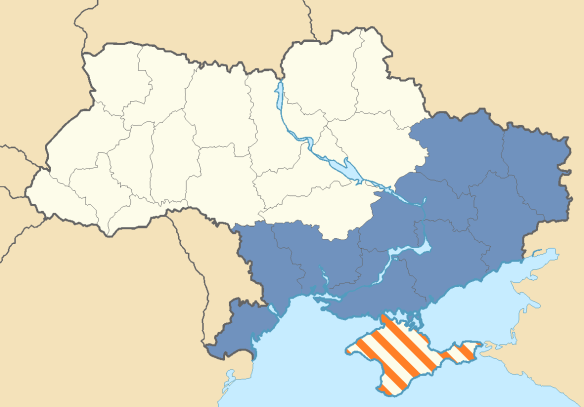
This has not occurred with the Donbas and Eastern Ukraine. Despite invoking the rhetoric of “Novorossiya,” Putin has refrained from intervening in Ukraine, a decision that was likely not only influenced by Medvedev and the liberals, but also by other dynamics as well. These include the mere fact that the division between the Russian-speaking oblasti and the mixed Russo-Ukrainian Surzhyk-speaking oblasti in Ukraine is ambiguous. Thus it would be very dangerous for Russia to intervene militarily, if only for this reason. Further, Putin had clear geopolitical objectives in Crimea centered around concerns regarding the Black Sea naval base and potential NATO expansion. There are no such geopolitical concerns for Eastern Ukraine specifically, though in the bigger picture, the fate of Ukraine as a totality is important for Russia geopolitically. That said, while Russia will likely not intervene militarily in Ukraine to support the Donbas rebels, it may lend itself to other initiatives, including establishing a humanitarian corridor.  Given the outcry in the Russian public over the atrocities and violence occurring in the Donbas in Kiev’s controversial “anti-terrorist operation,” this may very well happen.

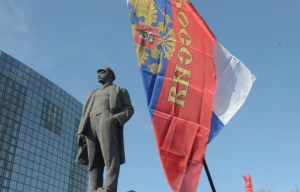
Flag of the Donetsk People's Republic (AFP)

Flag of the Donetsk People’s Republic (AFP)

Finally, it must be noted that a major shortcoming and self-defeating factor of the Donbas rebels is their narrow focus. Their ideology is based on Russian nationalism, Orthodoxy, Russian-speakers, the southeastern oblasti of Ukraine, and “Novorossiya” (even though Novorossiya historically did not cover all of the Russian-speaking oblasti). However, this hardly makes for a viable ideology that can attract large numbers of people and that the Kremlin can feel justified in supporting. Such an ideology may find traction in the Donbas where sympathies for Russia run particularly high. However, in the old Sloboda Ukraine (centered on Kharkiv), historic Zaporozhia (centered on Dnepropetrovsk), and the “core” of Novorossiya (cities like Odessa and Nikolayev), the ideology of the rebels has garnered very little traction, even if the population has a strong dislike of the post-Maidan government and disapproves of the atrocities being committed in the so-called “anti-Terrorist operation.” Also, most have no interest in seceding from the Ukrainian state, even though they strongly dislike the current government.

Further, while the majority of the locals in Southeastern Ukraine speak Russian and take their cultural cues from Russia, they still identify as ethnic Ukrainians. Tsarist-era censuses (particularly the 1897 census) attest to the fact that the people of this area largely self-identified as “Malorussians” (i.e., Ukrainians) in Tsarist times. Hence, the people of these oblasti are indeed of Ukrainian origin and are not ethnic Russians who simply adopted the “Ukrainian” ethnonym in the Soviet era. Therefore, unless the rebels think in terms of “Ukraine” as opposed to “the Donbas” or “Novorossiya,” most southeastern Ukrainians will continue to view them with skepticism.

As the Ukraine crisis enters a violent, prolonged military phase, its greatest tragedy is that the people of the Donbas and other regions of Ukraine will continue to suffer in the process, becoming cannon fodder for rival Ukrainian and Russian nationalist visions. Meanwhile, Putin and Poroshenko will continue to remain hostage to events that are unfolding fast. History will proceed, regardless of what either president has to say about it.
Between East and West: The Curious Case of Kirovograd

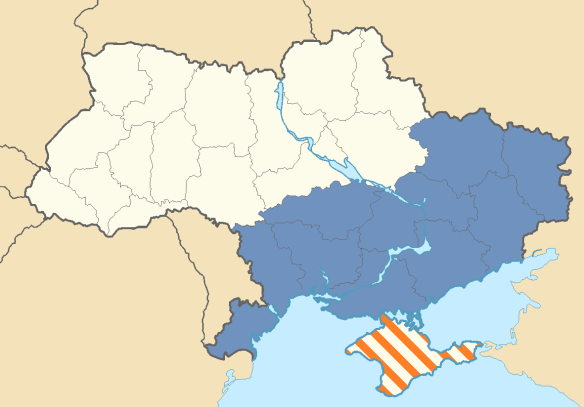
Where does East Ukraine begin and West Ukraine end? Conversely, where does West Ukraine begin and East Ukraine end? These are not easy questions to answer primarily due to the existence of the Surzhyk-speaking Central Ukraine, which lies between East and West. Indeed, it is Central Ukraine that comprises the great “transition point” by which Lviv gradually merges into Luhansk and vice versa.

It is for this reason that simply drawing an arbitrary “dividing line” through Ukraine is exceedingly dangerous and problematic.

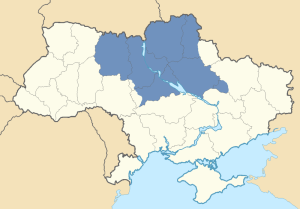
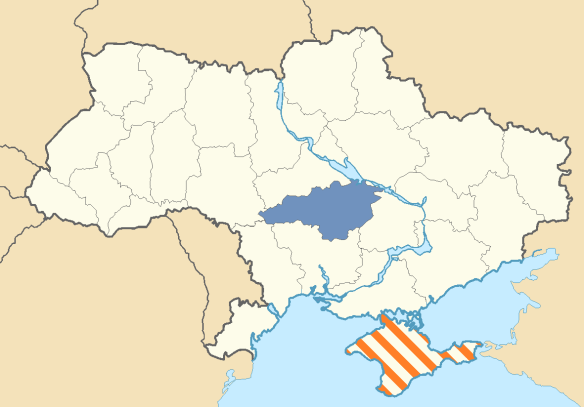
Nowhere is this more vividly illustrated than in the mixed oblast of Kirovograd. Much of the area was part of the historic region of Zaporozhia, and later Novorossiya. At one time, a good portion of the oblast’s northern raioni comprised the region of Nova Serbia, a short-lived borderland march on the Polish frontier that was organized as a safe haven for Serbian, Romanian, and other Balkan refugees. The capital city, after which the oblast is named, was founded in the 18th century as “Yelisavetgrad” meaning “City of Elizabeth” after both the Russian Tsaritsa Elizabeth and her patron saint of the same name. Following the Russian Revolution, the city was renamed Zinovievsk after the Communist leader Grigoriy Zionviev. However, after the assassination of Sergey Kirov and the beginning of Zinoviev’s fall from grace with Stalin, the city assumed its present name in the 1930s. Since the Soviet collapse, there have been proposals to return the city to its Tsarist-era name or to give it a new name entirely, though no official steps have been made in this regard.

Elections between pro-Western and pro-Russian political candidates in this specific oblast have been especially close. Yuschenko and Tymoshenko both won here, but by close margins. In 1999, the oblast favored the Communist Petro Symonenko for President of Ukraine. In the 2014 presidential election, the majority of the oblast’s raioni registered low voter turnout, with only the capital city and the westernmost raioni near Poroshenko’s native oblast of Vinnitsya registering high voter turnouts. Linguistically, the Kirovograd oblast is inhabited by both Russian and Surzhyk speakers who frequently intermarry and mix socially with one another. In terms of classification, Kirovograd can be best described as “mezhdu” (между) in Russian or “mizh” (між) in Ukrainian — that is, an area somewhere in-between.

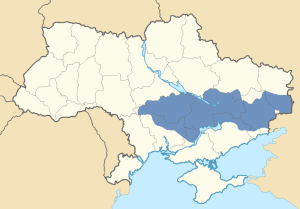
Location of the Kirovograd Oblast in Ukraine

Location of the Kirovograd Oblast in Ukraine

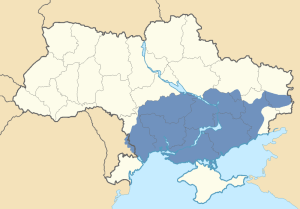
Defining this as a region either as part of the Russophone oblasti or outside of them is thus very problematic. In fact, conflicting maps in this regard have already emerged. Aleksandr Dugin, a Russian nationalist thinker and the chief ideological supporter of the Donbas rebels, has presented a map showing the proposed “Novorossiya” state including all of the Southern and Eastern oblasti plus Kirovograd. Meanwhile, maps issued by the rebels show Kirovograd as not being included within the scope of “Novorossiya.”

Aleksandr Dugin's Proposed Territorial Extent of the Federal State of Novorossiya

Aleksandr Dugin’s proposed territorial extent of the Federal State of Novorossiya.

The Proposed Territorial Extent of the Federal State of Novorossiya by the Donbas Rebels

The proposed territorial extent of the Federal State of Novorossiya by the Donbas rebels.

Ironically, one can say that the Kirovograd oblast is actually more “Novorossiya” than the Kharkiv region, an area that was never historically part of Novorossiya. Instead, Kharkiv was the center of the old historic region of Slobozhanshchina (or Sloboda Ukraine) along with other cities like Sumy and Izyum. Yet strangely, the Donbas rebels always claim Kharkiv to be part of “Novorossiya,” while Kirovograd, which was largely a part of both historical Novorossiya and Zaporohizia, is sometimes included in “Novorossiya” by the rebels and sometimes not.

Location of Novorossiya in Ukraine and Transnistria

Location of historic Novorossiya in Ukraine and Transnistria

The situation of Kirovograd illustrates the complexity of Ukraine’s linguistic and cultural divisions and demonstrates that any effort to simply divide Ukraine into two even halves would be extremely difficult, problematic, and dangerous. If conflict were to emerge here, it would not fall simply along linguistic lines, but rather along familial and interpersonal ones. This fact alone is most likely at least part of the reason that official Moscow has thus far refrained from invading Ukraine or giving material support to the Donbas rebels (instead, as I have previously argued, it is the nationalists and hardliners in the Kremlin who are backing the rebels in their own capacity).

Historical footage of Zakarpattia from the Czech National Film Archive

In a “sequel” to my earlier overview on the Carpatho-Rusyns and the Zakarpattia oblast of Ukraine, below are some glimpses of life in the Zakarpattia/Carpathian Rus’ region during the interwar period, when the area was formally part of Czechoslovakia. I came across this footage from 1922-1930 online which comes the Czech National Film Archive in Prague. Enjoy!:


How Influential is Ukraine’s Far-Right?

Ukraine's Praviy Sektor (Reuters / Vasily Fedosenko)

Ukraine’s Praviy Sektor (Reuters / Vasily Fedosenko)

As in any crisis situation, the crisis in Ukraine has been subject to polar interpretations. Russia, the Donbas rebels, and others are quick to paint what is happening in Kiev as a “fascist coup” and that the entire Kiev government is comprised “entirely of fascists.” On the other side, Western governments (primarily the United States and the European Union) and the Kiev government have stated that the far-right in Ukraine has marginal electoral support and thus has “virtually no influence in the country.”

As in any historical event, the truth is neither black nor white, but somewhere in between. It is indeed correct that both Right Sector (Praviy Sektor) and Svoboda are on the electoral margins (I even know people in Western Ukraine who can vouch for this). However, it would be wrong to mitigate their influence entirely.

Oleh Tyahnybok, leader of Ukraine's far-right Svoboda party (zbroya.info)

Oleh Tyahnybok, leader of Svoboda (zbroya.info)

At the end of the day, it was Right Sector and Svoboda that still played a crucial role in helping the present Kiev government rise to power. In return, they were granted positions in the government. Most of the posts awarded to the far-right have been given to Svoboda, though the newly-appointed Education Minister, Serhiy Kvit, is affiliated with Right Sector and its associated far-right paramilitary organization Trident (Tryzub). Also, Svoboda was conferred governorship of five oblasti: Lviv, Ternopil, and Rivne in the West and Zhytomyr and Poltava in the Center (though they have never been a major force in either of these two Central oblasti). Since there are a total of 24 oblasti in Ukraine, this means that Svoboda and its leader Oleh Tyahnybok effectively control about 20% of them.  Further, if one were to add up the total area of the oblasti ruled by Svoboda and then divide that by the total area of Ukraine, then one would arrive at approximately the same percentage (i.e., 20% of the country overall).  Given this, the question inevitably arises: how can a political party with the support of less than 2% of the entire electorate of Ukraine govern about 20% of the country?

Of the two right-wing parties, Svoboda is arguably less of a threat than Right Sector. Right Sector has very little popular support in Ukraine but they talk big and they are armed, so they cannot be easily dismissed. From my research and observations, it seems that they clearly played a role in the violence in the “anti-Terrorist operation” in the Southeastern oblasti. Right Sector is largely to blame for the Trade Unions fire-massacre in Odessa and they have also been involved in the shootings of civilians in the Donbas. Kiev has heavily relied on them and other private militias in recent weeks because their own military, drawn on recruits from all parts of Ukraine but primarily from the Central oblasti, has proven to be unreliable (with defections, etc.).

Therefore, it is indeed correct to say that the far-right has marginal support in Ukraine. However, at the same time, one cannot dismiss their potential danger, since they do retain influential political positions in the present government and their more militant segments (Right Sector, Patriots of Ukraine, Trident, etc.) are indeed armed and have participated in violence in the country.

Who are the Donbas Rebels?

Updated on 15 March 2015 with newly revealed information on Crimea.

Lenin in the Donbas (Andrew Butko)

Lenin in the Donbas (Andrew Butko)

As I have written previously, based on the available evidence, I have concluded that most of the Donbas rebels are indeed locals. At the same time, I also believe that they are being encouraged by Russian nationalists from Russia, such as Igor Strelkov.  These nationalists are acting in a private capacity to not only assist but also encourage the rebels.  It is important to note that they are not supported in their endeavors by official Moscow.

However, the hardline faction of the Russian political elite, led by Dmitry Rogozin, wants Putin to intervene in Eastern Ukraine to support the rebels.  They took a similar position on Crimea.  Following ouster of Yanukovych from power in Kiev, a debate ensued in Moscow on the fate of Crimea.  Concerns regarding NATO expansion in Ukraine, the influence of the far-right in the new Kiev government, and the potential effort by the new Kiev government to expel the Russian Black Sea Fleet from Sevastopol prompted the debate over the peninsula’s status.  Such fears were not unfounded as many in the Kiev government supported Ukrainian NATO membership, while others sought to cancel Russia’s lease on the base – and still others on the far-right (particularly Oleh Tyahnybok and Svoboda) wanted to abolish Crimea’s autonomy entirely.

The hardliners demanded immediate annexation, arguing that you either “take Crimea today” or “fight there tomorrow.”  At the same time, the more liberal political wing in Moscow (represented by Dmitry Medvedev and others from Putin’s St. Petersburg Sobchak days) was opposed to annexing Crimea outright.  They favored a referendum on the issue, but preferred to delay a final decision on the matter and use Crimea as a “bargaining chip” to ensure the presence of the Sevastopol base and to ensure that Ukraine does not join NATO.  Additionally, they argued, if Russia were to “reunite” with Crimea right away, it would make relations with the West even worse.

Putin ordered an emergency opinion poll during this time that showed that the vast majority of Crimeans wanted to join Russia. Weighing all options, Putin ultimately decided to support the pro-Russian movement in Crimea through a special operation, using the troops from the Black Sea Fleet to gain control of the peninsula as a so-called “self-defense force,” starting on 27 February 2014.

Putin also took the position that he would favor the outcome of the referendum, whatever the final result.  As he said in a new documentary on Crimea that was aired on Russian television on 15 March 2015, his “final goal was to allow the people express their wishes on how they want to live. I decided for myself: what the people want will happen. If they want greater autonomy with some extra rights within Ukraine, so be it. If they decide otherwise, we cannot fail them.”  The referendum was then organized in which the majority of the voters cast their ballots in favor of reunification with Russia. The rest is history.

The hardliners seek to convince Putin to take a similar position in Eastern Ukraine. However, the potential of intervening there is far more dangerous. Primarily, the linguistic demarcation between Russian-speaking Southeastern Ukraine and Surzhyk-speaking Central Ukraine is very blurred. Thus a Russian intervention would only make the situation more dangerous. Given this and other factors, Putin has not did not yielded to the pressure of the hardliners to intervene, even after a referendum was organized in the Donbas. In this regard, the more liberal St. Petersburg faction in the Kremlin, led by Medvedev and others, has been successful in persuading Putin not to intervene.  The most that Putin conceded to the hardliners with regard to Eastern Ukraine was his invoking of historic “Novorossiya.” However, even here, Putin has recently moved away from making such statements and has made attempts to clarify his use of that term to stress that Moscow is not seeking territorial claims on Ukraine.

Social Democracy, Not Nationalism, Is What Ukraine Needs

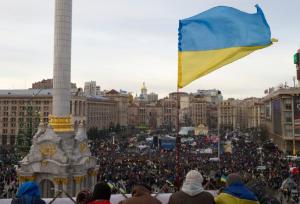
Ukrainian protestors in Kiev (AP/Ivan Sekretarev)

Ukrainian protestors in Kiev (AP/Ivan Sekretarev)

In a recent op-ed in The New Republic, Pulitzer Prize-winning author Anne Applebaum wrote that “nationalism is exactly what Ukraine needs” and that “the tiny group of nationalists in Ukraine… represent the country’s only hope of escaping apathy, rapacious corruption, and, eventually, dismemberment.”

I would respectfully beg to differ.

Nationalism is not what Ukraine needs.

The former Soviet Union has already had enough Gamsakhurdias, Tyahnyboks, and Zhirinovskys. Controversial individuals like these, claiming to act in the interests of “their nation,” cause too much instability and chaos. Their chauvinistic discourse, provocations, and insular ideologies only divide, not unite, people. Consequently, if nationalism is encouraged in Ukraine, it has a high likelihood of only dividing the country even more. Already extreme nationalist groups, like Right Sector (Praviy Sektor) and Svoboda, have alienated the majority of the people in the Southeast, a good number of people in the Center, and yes, even some in the West too. In fact, in the Southeast, events like the recent tragedy in Odessa or the shooting in Mariupol, have only fueled a strong rejection of these groups among locals.

Ms. Applebaum also conflates the concept of nationalism with more inclusive civic patriotism. However, no Western journalist can change the fact that groups such as Right Sector are indeed far-right organizations whose actions have proved to be divisive among Ukrainians. Thus, nationalism is far from the solution to the problem, especially if the ultimate objective is a united Ukraine.

So, what does Ukraine really need? First, it needs leadership.

The average Ukrainian might as well throw up his or her arms when observing the choices (or lack thereof) from which they have to choose. From corrupt oligarchs to far-right thugs, where is the choice?

A future leader of Ukraine must rise above rampant corruption, a self-centered political elite, and political extremists. Such a leader should also work to unite the country and take into account the different interests of all Ukrainians, whether they speak pure Ukrainian, Surzhyk, Carpatho-Rusyn, or Russian. Invoking divisive nationalist rhetoric will not serve to bring the people together. A true leader of Ukraine would be required to balance everybody’s views and outlook.

A future leader should also be an idealist, ready to work for reform. Not IMF-style “shock therapy” austerity reform, but real, genuine social reform. This would be social democracy.

What Ukraine, Russia, and all former Soviet countries need is not wild card, run-amuck capitalism in which wealth is concentrated in the hands of a few rich oligarchs and corrupt politicians. Instead, they need true, genuine social democratic systems. Such systems would ensure democratic rights, free elections, and free speech for all citizens. At the same time, capitalism would be controlled, balanced by a system of social welfare and social justice. After all, how can democracy truly be “democratic” if the majority of the population is disenfranchised? The people of Ukraine and the former USSR need a voice and social democracy can grant it to them.

Finally, attaining social democracy is also something that Ukrainians fundamentally must accomplish for themselves. Certainly, the EU cannot solve Ukraine’s problems. They are still dealing with a major financial crisis and have been unable to curb corruption and bad governance in new member states like Croatia, Hungary, Bulgaria, and Romania. If the EU was indeed the “panacea of democracy” as it is so often presented, then why do these countries still have corrupt and inefficient governments today?

Consequently, it is only up to Ukrainians to pull themselves together and to solve their own issues. Social democracy, not nationalism, can unite the country and move it forward.

The Historical Geography of Ukraine: An Overview

Updated and expanded on 24 August and 2 September 2014 with additional information.

Given all the discussion about Ukraine’s regional divisions, I thought that it might be useful for observers if I gave a quick overview of the historical geography of Ukraine by the larger regions within the country.  This may help sort out the uses and abuses of history in the ongoing Ukraine crisis.

Regional Map of Ukraine

Regional Map of Ukraine

Western Ukraine:

Location of Galicia in Ukraine

Location of Galicia in Ukraine

Galicia:

  • Contemporary regions: Lviv, Ternopil, and Ivano-Frankivsk oblasti
  • Major cities and towns: Lviv, Ternopil, and Ivano-Frankivsk
  • Notes: Part of Austria-Hungary and then interwar Poland before becoming part of the USSR. It must be emphasized that this region was never part of the Russian Empire, though it was a principality of the old Kievan Rus’.
Location of Volhynia in Ukraine

Location of Volhynia in Ukraine

Volhynia:

  • Contemporary area: Volhyn and Rivne oblasti
  • Major cities and towns: Lutsk and Rivne
  • Notes: Part of the Russian Empire and then interwar Poland before becoming part of the USSR.
Location of Northern Bukovina and Northern Bessarabia in Ukraine

Location of Northern Bukovina and Northern Bessarabia in Ukraine

Northern Bukovina and Northern Bessarabia:

  • Contemporary area: Chernvisti oblast
  • Major cities and towns: Chernvisti and Khotyn
  • Notes: Though geographically part of the West, this region has voting and linguistic patterns that are similar those found in Central Ukraine. The locals largely speak the mixed Russian-Ukrainian language Surzhyk (spoken by most in Central Ukraine) and elections here are very close. There is also a large Romanian minority (about 20% of the total population) which plays an additional factor in the region’s politics. The area was part of the interwar Kingdom of Romania and Romanian nationalists in Bucharest still claim the region as rightfully their’s.
Location of Carpathian Rus' in Ukraine

Location of Carpathian Rus’ in Ukraine

Carpathian Rus’, also known as Subcarpathian Rus’ or Transcarpathian Rus’:

  • Contemporary area: Zakarpattia oblast
  • Major cities and towns: Uzhgorod, Mukachevo, Khust, and Rakhiv
  • Notes: Part of the Kingdom of Hungary within Austria-Hungary and then part of interwar Czechoslovakia before becoming part of the USSR. The homeland of the Carpatho-Rusyns, Carpathian Rus’ is sometimes considered its own distinct region due to its unique ethnic, linguistic, and cultural character. There is also a 12% Hungarian minority in this region. Hungarian nationalists in Budapest who refuse to recognize the 1920 Treaty of Trianon still claim the region as rightfully their’s.
Location of Dnieper Ukraine in Ukraine

Location of Dnieper Ukraine in Ukraine

Central Ukraine:

Dnieper Ukraine:

  • Contemporary area: Most of the Central oblasti of Ukraine, particularly the Kiev, Cherkasy, Poltava, and Zhytomyr oblasti.
  • Major cities and towns: Kiev, Cherkasy, Poltava, and Zhytomyr
Location of Podolia in Ukraine and Transnistria

Location of Podolia in Ukraine and Transnistria

Podolia:

  • Contemporary area: All of the Vinnitsyia and Khmelnytskyi oblasti, with the southwesternmost parts of the Kiev oblast, the westernmost parts of the Cherkasy oblast, the northern portions of the Odessa oblast, and the northern parts of the breakaway region of Transnistria in Moldova.
  • Major cities and towns: Vinnitsyia, Khmelnytskyi, Kamianets-Podilskyi, and Rybnitsa
Location of Polesia in Ukraine

Location of Polesia in Ukraine

Polesia:

  • Contemporary area: Northern parts of the Zhytomyr, Kiev, Chernihiv, and Sumy oblasti, sometimes including the northern parts of Volhynia too.
  • Major cities and towns: Chernihiv, Shostka, Nizhyn, and Korosten

Southeastern Ukraine:

Location of Zaporozhia in Ukraine

Location of Zaporozhia in Ukraine

Zaporozhia:

  • Contemporary area: The core territory of this region encompassed the Dnipropetrovsk oblast, the northern portions of the Zaporozhia oblast, and virtually all of the Central Ukrainian oblast of Kirovograd. Additionally, it included the very small southernmost portion of the Poltava oblast south of the Dnieper River, around the southern side of the industrial city of Kremenchuk.  Zaporozhia also extended east to include parts of the Kharkiv, Donetsk and Luhansk oblasti and south to include the northernmost portions of the Nikolayev and Kherson oblasti.
  • Major cities and towns: Dnipropetrovsk, Zaporozhia, Kryvyi Rih, and Kirovograd
  • Notes: The word “porozh” in Ukrainian and Russian indicates “rapids” so the name literally means “land beyond the rapids” (referring to the rapids of the river Dnieper).
Location of Sloboda Ukraine in Ukraine

Location of Sloboda Ukraine in Ukraine

Sloboda Ukraine (Free Ukraine), also known as Sloboda Zemlya (Free Land) or Slobozhanshchina:

  • Contemporary area: Almost all of the Kharkiv oblast, except for the southernmost parts.  Also included were the southern portions of the Central Ukrainian Sumy oblast, the northernmost portions of the Donetsk oblast, and the areas of the Luhansk oblast north of the Seversky Donets river.
  • Major cities and towns: Kharkiv, Sumy, Izyum, and Starobilsk
  • Notes: The Tsarist-era Kharkov guberniya approximately corresponds to the boundaries of Sloboda Ukraine.  According to the Tsarist census of 1897, the guberniya’s population was majority ethnic “Little Russian” (i.e., Ukrainian).  Also, until 1939, the city of Sumy and the southern portions of the modern-day Sumy oblast were part of the Soviet-era Kharkov oblast.
Location of Donbas in Ukraine

Location of the Donbas in Ukraine

The Donbas:

  • Contemporary area: The Donetsk and Luhansk oblasti (also the breakaway “People’s Republics” of Donetsk and Luhansk).
  • Major cities and towns: Donetsk, Luhansk, Mariupol, Slavyansk, and Kramatorsk
  • Notes: The name is short for “Donets Basin.” In Tsarist times, the Donbas region was administratively divided. The northern portions of both oblasti were part of the Kharkov guberniya (the historic Sloboda Ukraine), while their western portions were part of the Yekaterinoslav guberniya (the eastern part of historic Novorossiya), and their eastern portions were part of the Don Host Oblast which also included significant portions of Southern Russia. Due to the latter fact, some might argue that the eastern Donbas was once “part of Russia.” However, such an argument is problematic because, in this region, the distinction between what is “Russian” and what is “Ukrainian” becomes increasingly blurred. For instance, this area between Russia and Ukraine is so demographically mixed that some Ukrainians might conversely claim parts of Southern Russia as “Ukrainian.” The blurriness is compounded by the fact that the Cossacks who historically lived in these areas were not from an exclusive national group. They were both Russians and Ukrainians.
Location of Crimea

Location of Crimea

Crimea, also known as Taurida:

  • Contemporary area: The Republic of Crimea and the Federal City of Sevastopol administered by Russia, the Autonomous Republic of Crimea and the City of Sevastopol, claimed by Ukraine.
  • Major cities and towns: Sevastopol, Simferopol, Kerch, Feodosiya, and Yalta
  • Notes: In addition to the Crimean peninsula, the Tsarist-era Taurida guberniya also included significant portions of the modern Kherson and Zaporozhia oblasti in contemporary Ukraine. However, this “mainland” part of the guberniya (also considered to be part of “Novorossiya proper”) significantly differed demographically from the peninsula. According to the 1897 Tsarist census, the mainland’s population was primarily “Little Russian” (Ukrainian) with a significant “Great Russian” (ethnic Russian) minority, while the population of the peninsula was largely “Great Russian” and Tatar with a significant Ukrainian minority and additional ethnic minorities of Germans, Jews, Bulgarians, Greeks, Armenians, Poles, and others.
Location of the Budzhak in Ukraine

Location of the Budzhak in Ukraine

The Budzhak:

  • Contemporary area: Portion of the Odessa oblast situated south of Moldova, east of Romania and the Danube, and west of the Dniester, on the Black Sea coast.
  • Major cities and towns: Izmail and Bilhorod-Dnistrovskyi (Akkerman)
  • Notes: Historically the southernmost part of Bessarabia, this region was part of the interwar Kingdom of Romania until it was annexed by the Soviet Union in 1940. In Soviet Ukraine, it was administered as the Akkerman oblast, later renamed the Izmail oblast. In 1954, the oblast was abolished and incorporated into the Odessa oblast. A multiethnic region, the Budzhak is majority Ukrainian with substantial Bulgarian, Russian, Romanian, and Gagauz minorities. The name “Budzhak” is derived from the Turkish word “bucak,” meaning “district” or “corner.”
Location of the Yedisan in Ukraine and Transnistria

Location of the Yedisan in Ukraine and Transnistria

The Yedisan:

  • Contemporary area: The southern portions of Transnistria and the Odessa oblast (excluding the Budzhak), the southern portion of the Nikolayev oblast, and the southwestern portion of the Kherson oblast.
  • Major cities and towns: Odessa, Nikolayev, and Tiraspol
  • Notes: The name “Yedisan” (alternatively transliterated as “Edisan” or “Jedisan”) is derived from a nomadic Nogai Turkic tribe who once inhabited this area. It literally means “seven titles” referring to seven different subdivisions among the tribe. In the 18th century, the region was incorporated into Imperial Russia by Catherine the Great as part of Novorossiya and settled by Ukrainians (Malorussians), Russians, and others. The area was also known as “Ochakov Tartary” after the historic fortress of Ochakov located in the contemporary Nikolayev oblast.
Location of Novorossiya in Ukraine and Transnistria

Location of Novorossiya in Ukraine and Transnistria

Novorossiya (New Russia):

  • Contemporary area: The Nikolayev and Kherson oblasti, the southern portions of Transnistria and the Odessa oblast (excluding the Budzhak), the southern part of the Zaporozhia oblast, the southeasternmost area of the Kharkiv oblast, the Western half of the Donbas (including the cities of Donetsk and Luhansk), and most of the historical region of Zaporozhia. Novorossiya also occasionally included Bessarabia (Moldova proper with the Budzhak region of the Odessa oblast), Crimea, and the Don Host Oblast (the eastern half of the Donbas and significant portions of Southern Russia).
  • Major cities and towns: Odessa, Nikolayev, Kherson, Tiraspol, and Berdyansk
  • Notes: It must be emphasized that, with the exception of its southeasternmost area, much of the territory of the modern-day Kharkiv oblast was not part of Novorossiya. Further the majority population of the core territory of Novorossiya (Odessa, Nikolayev, Kherson, southern Transnistria, western Donbas, and historic Zaporozhia) in the 1897 Tsarist census were identified as ethnic “Little Russians” (Ukrainians) with significant minorities of “Great Russians” (ethnic Russians) and, in the Odessa area, Jews. Consequently, the idea of making this region a part of Soviet Ukraine was logical from a geographic and ethnographic standpoint. Thus, it must be emphasized that the assignment of these territories was not a “great mistake” by the Bolsheviks as Russian President Vladimir Putin, Russian Deputy Prime Minister Dmitry Rogozin and others have been claiming. Indeed, it is likely that Putin is advancing the Novorossiya claim to placate hardliners like Rogozin in the Kremlin who want to invade Southeastern Ukraine and are attempting to use historical revisionism to show that the region is “another Crimea” in order to justify such actions. However, no invasion can be justified and would be a disaster for both Russia and Ukraine.
Location of Novaya Serbiya in Ukraine

Location of Novaya Serbiya in Ukraine

Novaya Serbiya (New Serbia):

  • Contemporary area: Northern portions of the Kirovograd oblast, with some adjoining areas of the neighboring Cherkasy, Poltava, and Dnipropetrovsk oblasti.
  • Major cities and towns: Novomyrgorod
  • Notes: Founded by Tsarist Russia as a military frontier with Poland in the 1750s populated by Serbs, Montenegrins, Romanians, and others from Habsburg Austria (hence the name). The territory was later abolished in 1764 and incorporated into Novorossiya.
Location of Slavo-Serbiya in Ukraine

Location of Slavo-Serbiya in Ukraine

Slavo-Serbiya (Slavo-Serbia):

  • Contemporary area: Border regions between the modern-day Donetsk and Luhansk oblasti.
  • Major cities and towns: Artemivsk (Bakhmut)
  • Notes: Founded by Tsarist Russia as a refuge for Serbs, Montenegrins, Romanians, Bulgarians, Hungarians, Greeks, and others. The territory was later abolished in 1764 and incorporated into Novorossiya.

For more information on Ukraine’s diverse regional divisions, see my earlier post, What is Ukraine? from March here, now updated and expanded to include the latest information about Ukraine.

Odessa: A Ukrainian Tragedy

Odessa's celebrated Potemkin Steps, once the scene of Sergei Eisenstein's famed 1925 Soviet classic, The Battleship Potemkin. (Palmyra.od.ua)

Odessa’s celebrated Potemkin Steps, once the scene of Sergei Eisenstein’s famed 1925 Soviet classic, The Battleship Potemkin. (Palmyra.od.ua)

Odessa is a beautiful, theatrical city, renown for its humor, wit, culture, and charm. Yet, at the same time, it is also a city that has experienced much pain and tragedy in its history. Since the horrors of World War II, who would have guessed that nearly 70 years later, the people of this celebrated “St. Petersburg of the south” would again have cause to mourn?

It is beyond doubt that the 2 May massacre in Odessa was a turning point for the crisis in Ukraine. Last Friday was a painful day of mourning for a country that is already on the brink of catastrophe. One might expect that such grief would lead toward greater unity within the country and perhaps pave the way for a rational, constructive dialogue toward peace.

Instead, the massacre has only hardened opinions in Ukraine. Throughout the southeast, including Odessa, popular anger and opposition to the Turchynov-Yatsenyuk government is currently on the rise. In Central Ukraine and Kiev, public opinion over the tragedy is divided. In Western Ukraine, while many have expressed sorrow for the deaths, the popular stance largely does not want to fully explore what happened in Odessa.  The involvement of the pro-Kiev activists is downplayed and “pro-Russian provocateurs” are blamed instead.  According to one observer in Western Ukraine, the reaction from some in the West on social media has been “less than compassionate” and “even hubristic.”  Further west, in the remote Rusyn-speaking oblast of Zakarpattia, popular reaction to the tragedy in Odessa is unclear.  Meanwhile, as tensions rise, Odessa’s historic Jewish community, which had been experiencing a cultural and religious revival in recent years (including a Yiddish language revival), is planning to evacuate the city en masse.

In the United States, mainstream media networks like ABC, CNN, and Fox have practically ignored the massacre. In the rare case that it is mentioned, the question of responsibility is always vague. Official Washington offered its condolences on Saturday in the same manner, without naming any perpetrators. Later, though the US Ambassador in Kiev Geoffrey Pyatt admitted in an interview with CNN that there was no evidence of a Russian role in the massacre.

Frank-Walter Steinmeier (Frank-walter-steinmeier.de)

Germany’s Frank-Walter Steinmeier has called for fresh talks to de-escalate the crisis.  (Frank-walter-steinmeier.de)

In Germany, opposition to the events in Ukraine as well as a desire for a resolution to the crisis are growing. One member of the ruling Christian Democrats stated that Germany “should stop being a servant of the Americans” and that confrontation with Russia over Ukraine was “blind to history and deaf to the other side.” Meanwhile, Germany’s Social Democrat Foreign Minister Frank-Walter Steinmeier called for a new round of Geneva talks.  A veteran diplomat, Steinmeier has stated that the new talks will “send a ‘strong political signal’ that previous agreements will be implemented.” The plan now has the backing of Chancellor Angela Merkel.

Russia’s response to Odessa has been remarkably reserved. Moscow condemned the massacre in very strong terms and the State Duma has demanded a probe into the tragedy. However, Russia has refrained from intervening directly in Ukraine, despite anger in Moscow and pressure by hardliners in the Kremlin to invade.

It is undeniably apparent that Right Sector and far-right football fans known as the “Ultras” were singularly responsible for what happened in Odessa. On YouTube, footage has emerged showing the nationalists starting the fire and later shooting anti-Kiev activists who attempted to leave the burning building.

The Turchynov-Yatsenyuk government has sought to downplay the massacre, instead expressing very general “sorrow” for the victims and emphasizing the clashes that preceded it between supporters and opponents of the government. In every case, they are quick to blame the initial clashes on “pro-Russian provocateurs.” During his visit to Odessa, Prime Minister Yatsenyuk reiterated the same script, though also blaming the security services for not stopping the violence.

Yatsenyuk also pledged a de-centralization of powers to the oblasti and to this end, a bill for a nationwide plebiscite on the issue has been registered at the Ukrainian Rada. Yet people living in Ukraine’s southeast are skeptical. The government has announced vaguely-worded “de-centralizations” in the past, but these were ultimately never realized. In a much less calculated move, the government has also dispatched a special all-volunteer battalion of Kiev’s National Guard to Odessa. It is doubtful that such a move will help de-escalate tensions and build confidence in this part of Ukraine. Opposition to the government runs high in Odessa.  Some have even gone so far as to refer to the massacre as an act of “genocide.” Meanwhile, the “anti-terrorist operation” continues in Eastern Ukraine, which is now effectively in a state of war with Kiev.

Overall, anxiety and apprehension remain high throughout Ukraine in the aftermath of the Odessa massacre. If social media is any indication, it demonstrates that people throughout the country have fundamentally different views and interpretations of the event. Dialogue is extremely important to restoring order and peace, but it is increasingly being supplemented by a discourse of “my interpretation is better than yours” and even worse “us vs. them.” In the backdrop of all this is a fast deteriorating socioeconomic situation and the near-bankruptcy of the country. Ukrainians together need to emerge with white flag in hand to set aside their differences and engage in a serious, meaningful dialogue to find solutions to their problems. War, no matter what, should never be an option.

The 2 May Odessa Massacre and Its Significance on the Ukraine Crisis

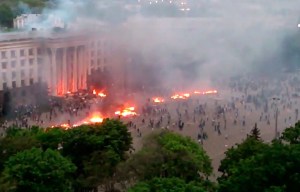
The Trade Union building of Odessa in flames (ITAR-TASS)

The Trade Union building of Odessa in flames (ITAR-TASS)

On Friday, at least 46 people, mostly anti-Kiev activists, were killed in the southern Ukrainian city of Odessa.  At least 39 died after being trapped in the Odessa House of Trade Unions which was reported to have been lit on fire by far-right football hooligans and activists from the far-right Kiev-affiliated group Right Sector (Praviy Sektor). Some were burned alive while others suffocated to death or jumped out the windows to escape.  At least three were reportedly shot dead. Close to 200 were injured with at least 25 in critical condition.

The massacre was the bloody culmination of clashes between supporters and opponents of the controversial Turchynov-Yatsenyuk government in Kiev. The supporters were primarily Right Sector and its allies, including far-right football hooligans known as the Ultras, who are said to have instigated the violence.  “Glory to Ukraine,” “Death to enemies,” and “Knife the Moskali” they chanted.

The city of Odessa has declared a three-day period of mourning on 3 May.  Russian President Putin has expressed “deep condolences” to the families of those who died.

The significance of this massacre to the ongoing crisis in Ukraine is threefold:

  1. It represents the worst violence of the Ukraine crisis since the events in February.
  2. It will likely further erode the credibility of the Turchynov-Yatsenyuk government throughout all regions of Ukraine.
  3. It has demonstrated that Russia, though harshly critical about the actions that took place in Odessa, has been nonetheless restrained in responding to this tragedy. This is very difficult for Moscow because of its anger over the overall situation as well as pressure from Russian hardliners who want Russia to invade Ukraine. Still, the Kremlin will likely continue to show restraint on the issue (at least for now) as the stakes of a direct intervention in Ukraine are too high. In the meantime, Kiev appears to be provoking Moscow to respond to events occurring in the Russophone regions. It is specifically using Right Sector to accomplish this.  Now headquartered in the southeastern town of Dnipropetrovsk, Right Sector activists have launched attacks on cities and towns in and throughout southeastern Ukraine.

The massacre is an especially tragic event for Odessa, a multicultural, cosmopolitan, and theatrical port city on the Black City. Renown for its humor, Odessa is blessed with a heritage of mixed Russian, Ukrainian, Jewish, and Mediterranean influences. Its people speak their own colorful dialect of Russian with smatterings of Ukrainian and Yiddish.  Yet, the May massacre will likely go down as yet another tragedy in Odessan history, a history that also includes several anti-Jewish pogroms, the Russian Revolution, the Russian Civil War, famine, Stalin’s Terror, World War II, and the horrors of the Holocaust. Yet as in these tragedies, the people of Odessa will likely turn to their quick wit, irreverence, and celebrated sense of humor to deal with this latest painful episode in their collective history.

The Myth of the European Panacea

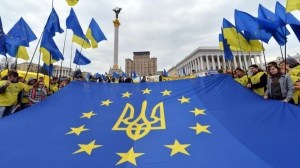
The EU flag was a prominent symbol of Ukraine's Euromaidan (img.pravda.com.ua)

The EU flag was a prominent symbol of Ukraine’s Euromaidan (img.pravda.com.ua)

Capitalism hit the former Soviet Union very hard in the 1990s. That was the Boris Yeltsin era of “shock therapy” wherein the economic ideas of Larry Summers, Jeffrey Sachs, and others transformed the countries of the former USSR from state-dominated economies with capitalist elements to the capitalism of the wild, unregulated sort. The results of such a severe and rapid transition were disastrous for these countries, socially, politically, and economically. The ramifications of those years are still felt throughout much of the former Soviet space today, both directly and indirectly.

In Russia itself, the “shock therapy” brand of capitalism was implemented with aid from American advisors such as Sachs and by “democratic” Russian “reformers” like Yegor Gaidar, Anatoly Chubais, and others.  Their subsequent “reforms” plunged approximately 75% of Russians into poverty and reversed many of the country’s hard-won 20th century achievements, becoming, in the words of Russian scholar Stephen F. Cohen of NYU, “the first nation ever to undergo actual demodernization in peacetime.” It changed public perceptions with regard to the West. If there were many Russians in 1991-92 who were supportive of the basic idea of having democracy, the years of “shock therapy” created a desire for much-needed “stabilnost” and caused many to view the West as primarily responsible for such a terrible economic catastrophe.

Similar rapid transitions to market economies occurred throughout the former Soviet sphere, leaving legacies of entrenched oligarchies, monopolies, economic disparity, poverty, bad business environments, and most of all, corruption. For the citizens of former Soviet states like Ukraine, Georgia, Moldova, and Armenia, the EU and its Eastern Partnership program appear to be effective remedies to finally “cure” their economies of these diseases once and for all. The reputation of the EU for its rules, regulations, and carrot-and-stick initiatives seemed to be a cure-all solution to many.

“Like hopeless alcoholics, we are trying to toss ourselves into a rehab, where caring Europeans will cure us from the addiction (in our case – corruption),” wrote the Armenian comedian Sergey Sargsyan. Indeed, corruption remains a very serious problem for all four of the Eastern Partnership states that sought deeper ties with the EU, with Georgia ranking 55, Armenia 94, Moldova 102, and Ukraine 144 on the 2013 Corruption Perceptions Index of 177 countries (CPI) by Transparency International.  The issue of corruption is especially serious in Ukraine where the oligarchy and the political elite, from Tymoshenko to Yanukovych, have robbed the country and its people into bankruptcy.  Consequently, the EU is viewed as a panacea, a “symbol” for the hope of a better future.  In the words of Mark Adomanis and Luka Orešković with regard to Ukraine specifically:

Given Ukraine’s omnipresent corruption, the lack of legal security and, most importantly, the country’s economic implosion, it is not surprising that many citizens would latch onto a symbol (“Europe”) that is associated with all of the things that the country itself lacks. Throughout Ukraine, Europe is popularly identified with economic prosperity, transparency, democracy, and the rule of law, with the possibility of living a “normal life” of dignity and material security.

In contrast to the EU, the Moscow-backed Eurasian Union at face-value appears to offer little, especially with regard to combating corruption. With a CPI ranking of 127, corruption is widespread in Russia, though the Kremlin does realize the gravity of the issue and has been trying to fix it in recent years. Still, the continued presence of corruption combined with oligarchic monopolies, has likewise made opportunities for independent businesses and entrepreneurs very difficult. Together, these issues stifle real economic growth and potential and pose a serious challenge to competition, innovation, and entrepreneurship. Additionally, the fact that much of Russia’s economy is also based on non-renewable natural resources has also raised very serious concerns.

“The main reason why many Armenians are not crazy about joining the Russian Customs Union is not the Russian people, culture, literature, or cuisine,” wrote the Armenian comedian Sergey Sargsyan. “The problem is corruption.”

Despite this, Russia is remarkably holding its own. The Kremlin managed to pay off much of its foreign debt from the 1990s. Moscow’s economy is also currently growing much faster than that of the EU. Additionally, the birthrate of the once “dying Russia” has also bounced back and is on the rise, not only in national autonomous republics like Chechnya, but also deep into the Slavic Russian heartland as well.

Still, is the EU a viable alternative solution to these countries’ economic woes?  It is true that the Europeans would undoubtedly implement their rules, regulations, and carrot-and-stick reforms on these countries. However, by placing their hopes on the EU, which is still limping along from the devastating 2008 Eurozone crisis, these countries are staking their fate on a supranational union that cannot bring them any serious promises of lasting economic prosperity and stability. In November 2013, the noted American Economist Paul Krugman wrote in The New York Times that his…

…joke slogan for Obama has been, ‘It’s not as bad as the Great Depression!’ But Europe can’t even claim that. At this point it’s just as bad as the Great Depression — and where European economies were recovering strongly by this point in the 30s, they’re stalling now. Doing worse than the 30s; that’s a remarkable achievement.

Indeed, by investing so much hope in an entity as economically unstable as the EU, the people of the ex-Soviet states “run the risk of being sorely disappointed with their ‘civilizational choice’” in the manner that ordinary Russians were sorely disappointed with capitalism in the Yeltsin era of the 1990s.  There is also no guarantee that the corruption issue has been completely solved either.  In Bulgaria and Romania for instance, corruption remains particularly widespread. Even more interesting, according to the 2013 CPI report, non-EU member Georgia actually ranked higher on transparency than not only Bulgaria and Romania, but other EU members such as Croatia, the Czech Republic, Slovakia, Italy, and Greece. Meanwhile, Armenia and Moldova rank higher than prospective EU member Albania! Further, according to Adomanis and Orešković:

The three most recent entrants to the EU (Bulgaria, Romania, and Croatia) have performed terribly since the onset of the financial crisis. Croatia, in particular, has seen no economic growth for the past seven years.  After many years of painstaking reform, per capita incomes in these countries are still less than 40% of West European averages. Even more alarmingly, these three countries have almost entirely stopped converging with the “old” EU members in the West.

In spite of all this, both politicians and citizens in the former Soviet Union seem completely sold on the vision of the “European paradise.” At Ukraine’s Maidan, some activists even believed that “in Europe there is no police brutality.” Apparently, they have never been to Greece, Spain, Portugal, Italy, Bulgaria, or France.

Joining the EU at this point will likely not bring about the long-desired dream of economic prosperity. In fact, it could become potentially destabilizing, especially for a country as large and diverse as Ukraine with an economy that, if not near bankruptcy, is already bankrupt.  That said, as unrest continues in Ukraine, ordinary Ukrainians must consider the question, “should we rely on the EU to help us out of our situation, or is up to us, the Ukrainians alone, to create a better future for ourselves?”