Who are the Donbas Rebels?

Updated on 15 March 2015 with newly revealed information on Crimea.

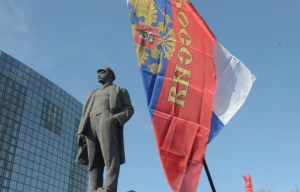
Lenin in the Donbas (Andrew Butko)

Lenin in the Donbas (Andrew Butko)

As I have written previously, based on the available evidence, I have concluded that most of the Donbas rebels are indeed locals. At the same time, I also believe that they are being encouraged by Russian nationalists from Russia, such as Igor Strelkov.  These nationalists are acting in a private capacity to not only assist but also encourage the rebels.  It is important to note that they are not supported in their endeavors by official Moscow.

However, the hardline faction of the Russian political elite, led by Dmitry Rogozin, wants Putin to intervene in Eastern Ukraine to support the rebels.  They took a similar position on Crimea.  Following ouster of Yanukovych from power in Kiev, a debate ensued in Moscow on the fate of Crimea.  Concerns regarding NATO expansion in Ukraine, the influence of the far-right in the new Kiev government, and the potential effort by the new Kiev government to expel the Russian Black Sea Fleet from Sevastopol prompted the debate over the peninsula’s status.  Such fears were not unfounded as many in the Kiev government supported Ukrainian NATO membership, while others sought to cancel Russia’s lease on the base – and still others on the far-right (particularly Oleh Tyahnybok and Svoboda) wanted to abolish Crimea’s autonomy entirely.

The hardliners demanded immediate annexation, arguing that you either “take Crimea today” or “fight there tomorrow.”  At the same time, the more liberal political wing in Moscow (represented by Dmitry Medvedev and others from Putin’s St. Petersburg Sobchak days) was opposed to annexing Crimea outright.  They favored a referendum on the issue, but preferred to delay a final decision on the matter and use Crimea as a “bargaining chip” to ensure the presence of the Sevastopol base and to ensure that Ukraine does not join NATO.  Additionally, they argued, if Russia were to “reunite” with Crimea right away, it would make relations with the West even worse.

Putin ordered an emergency opinion poll during this time that showed that the vast majority of Crimeans wanted to join Russia. Weighing all options, Putin ultimately decided to support the pro-Russian movement in Crimea through a special operation, using the troops from the Black Sea Fleet to gain control of the peninsula as a so-called “self-defense force,” starting on 27 February 2014.

Putin also took the position that he would favor the outcome of the referendum, whatever the final result.  As he said in a new documentary on Crimea that was aired on Russian television on 15 March 2015, his “final goal was to allow the people express their wishes on how they want to live. I decided for myself: what the people want will happen. If they want greater autonomy with some extra rights within Ukraine, so be it. If they decide otherwise, we cannot fail them.”  The referendum was then organized in which the majority of the voters cast their ballots in favor of reunification with Russia. The rest is history.

The hardliners seek to convince Putin to take a similar position in Eastern Ukraine. However, the potential of intervening there is far more dangerous. Primarily, the linguistic demarcation between Russian-speaking Southeastern Ukraine and Surzhyk-speaking Central Ukraine is very blurred. Thus a Russian intervention would only make the situation more dangerous. Given this and other factors, Putin has not did not yielded to the pressure of the hardliners to intervene, even after a referendum was organized in the Donbas. In this regard, the more liberal St. Petersburg faction in the Kremlin, led by Medvedev and others, has been successful in persuading Putin not to intervene.  The most that Putin conceded to the hardliners with regard to Eastern Ukraine was his invoking of historic “Novorossiya.” However, even here, Putin has recently moved away from making such statements and has made attempts to clarify his use of that term to stress that Moscow is not seeking territorial claims on Ukraine.

Darial: An Opportunity for Georgian-Russian Cooperation?

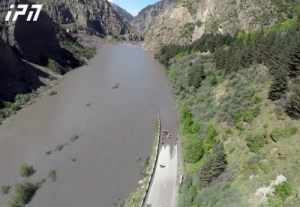
Photograph of the Darial Gorge Disaster (Interpress News Agency)

Photograph of the Darial Gorge Disaster (Interpress News Agency)

Located along the Georgian Military Road, south of Vladikavkaz and just north of Mount Kazbek, one finds the famous Darial Gorge. Once celebrated in Lermontov’s romantic poem, The Demon, the Darial was the site of a terrible disaster on Saturday.

A major landslide originating from the Devdoraki glacier on the northern slopes of Kazbek, brought down a massive wave of debris and mud into the gorge. One Ukrainian citizen, a truck driver, was killed. Seven others are reported missing. Three trucks are reportedly buried in the debris. The landslide blocked the Terek river bed and destroyed part of the Georgian Military Road linking Georgia to Russia, the only overland link between the two countries given the unresolved Georgian-Abkhaz conflict.

The disaster also halted the flow of natural gas from Russia to Georgia’s southern neighbor, Armenia, which heavily relies on this resource. Armenians also rely on the Georgian Military Road as a point of direct land access from Georgia to Russia, where many Armenians are migrant workers. The only other possible outlet would be from the Georgian port cities of Batumi or Poti on the Black Sea to Sochi in Russia via boat. These links are especially vital for Armenia, a country still blockaded by Turkey and Azerbaijan over the Nagorny Karabakh dispute. Consequently, for Armenians, Georgia is more than just a neighboring country. It is a lifeline.

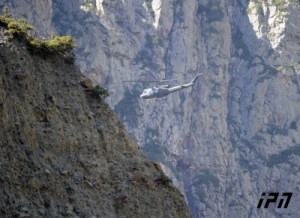
Rescue crews were immediately mobilized at the scene of the disaster. 150 people were rescued, primarily “customs, border guard and police employees, as well as several foreign citizens, who are cargo truck drivers.” All were evacuated by helicopter. Twelve workers (all Turkish citizens), trapped in the derivation tunnel of the nearby Darial hydro power plant, were also rescued. The power plant, which is under construction, is highly controversial in Georgia. Georgian environmental activists say that building the dam could adversely affect the area’s ecology.

Georgian President Margvelashvili in the Darial Gorge (Interpress News Agency)

Georgian President Margvelashvili in the Darial Gorge (Interpress News Agency)

Prime Minister Irakli Garibashvili and several of his ministers, including Georgian football superstar-turned-energy-minister Kakha Kaladze, arrived in the area to hold a meeting on the emergency.  Garibashvili left his helicopter to the rescuers and returned to Tbilisi instead by car.  President Giorgi Margvelashvili also went to the Darial to survey the damage. When he arrived from Tbilisi, he concluded that the mountain collapse was larger than the 2007 landslide in Georgia.

Significantly, the first foreign aid came from Russia.  Immediately following the disaster, contact was established with Russia’s Ministry of Emergency Situations.  The Russian Foreign Ministry has pledged to mobilize aid to assist Georgia in its recovery efforts.  To this end, it has given Georgia 18 metric tons of diesel fuel to “secure uninterrupted work of heavy equipment” to clean up the area affected by the landslide.  Prime Minister Irakli Garibashvili has thanked Moscow for its assistance.  On the morning of May 19, official Armenia has offered aid to Tbilisi as well.

Rescue Helicopter in the Darial (Interpress News Agency)

Rescue Helicopter in the Darial Gorge (Interpress News Agency)

From the Russian side, sending aid to the disaster zone is now much easier thanks to Moscow’s recent unilateral full reopening of the Georgian Military Road back in March. The road was closed completely in 2006 due to tension between Russia and Georgia’s then-President Mikheil Saakashvili. It was partially reopened in 2010, before being fully reopened in March this year.

The recovery efforts come amid a stalled Russo-Georgian rapprochement. During the Sochi Olympic Games in February, Russian President Vladimir Putin invited Georgian President Margvelashvili to a direct meeting. It would be the first such meeting between the Russian and Georgian political leaderships since the 2008 war. Unfortunately, the process toward this meeting has been delayed by the ongoing crisis in Ukraine. At a recent Prague meeting between Georgia’s special envoy to Russia, Zurab Abashidze, and his Russian counterpart, Grigory Karasin, the issue was reportedly discussed, though no date has been set for the actual meeting.

Meanwhile, in light of the crisis in Ukraine, the West has taken advantage of the absence of diplomatic relations between Russia and Georgia and has redoubled its efforts to ensure that Georgia maintains a pro-EU and pro-NATO path. Unlike the previous Saakashvili government, which was categorically pro-Western, the present Georgian Dream government in Tbilisi has sought a balanced relationship between both Russia and the West.  This past week, Georgia’s Abashdize said that ideally, Georgia would have free trade regimes with both Russia and the European Union. Earlier in September, shortly after Armenia’s U-turn on the EU in favor of the Moscow-backed Eurasian Union, Georgia’s then-Prime Minister Bidzina Ivanishvili, said that Georgia too may consider joining the Eurasian Union “if it will be advantageous for our country.” Though no longer in office, the Imeretian billionaire is still financially supporting the Georgian Dream government and is widely believed to be actively working with them behind-the-scenes.

Russia and Georgia need to seize the moment to restore relations and move forward. Cooperation on the rescue and recovery effort from the Darial disaster presents a good opening for renewed diplomacy on both sides.

Social Democracy, Not Nationalism, Is What Ukraine Needs

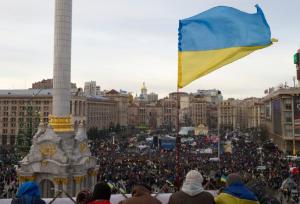
Ukrainian protestors in Kiev (AP/Ivan Sekretarev)

Ukrainian protestors in Kiev (AP/Ivan Sekretarev)

In a recent op-ed in The New Republic, Pulitzer Prize-winning author Anne Applebaum wrote that “nationalism is exactly what Ukraine needs” and that “the tiny group of nationalists in Ukraine… represent the country’s only hope of escaping apathy, rapacious corruption, and, eventually, dismemberment.”

I would respectfully beg to differ.

Nationalism is not what Ukraine needs.

The former Soviet Union has already had enough Gamsakhurdias, Tyahnyboks, and Zhirinovskys. Controversial individuals like these, claiming to act in the interests of “their nation,” cause too much instability and chaos. Their chauvinistic discourse, provocations, and insular ideologies only divide, not unite, people. Consequently, if nationalism is encouraged in Ukraine, it has a high likelihood of only dividing the country even more. Already extreme nationalist groups, like Right Sector (Praviy Sektor) and Svoboda, have alienated the majority of the people in the Southeast, a good number of people in the Center, and yes, even some in the West too. In fact, in the Southeast, events like the recent tragedy in Odessa or the shooting in Mariupol, have only fueled a strong rejection of these groups among locals.

Ms. Applebaum also conflates the concept of nationalism with more inclusive civic patriotism. However, no Western journalist can change the fact that groups such as Right Sector are indeed far-right organizations whose actions have proved to be divisive among Ukrainians. Thus, nationalism is far from the solution to the problem, especially if the ultimate objective is a united Ukraine.

So, what does Ukraine really need? First, it needs leadership.

The average Ukrainian might as well throw up his or her arms when observing the choices (or lack thereof) from which they have to choose. From corrupt oligarchs to far-right thugs, where is the choice?

A future leader of Ukraine must rise above rampant corruption, a self-centered political elite, and political extremists. Such a leader should also work to unite the country and take into account the different interests of all Ukrainians, whether they speak pure Ukrainian, Surzhyk, Carpatho-Rusyn, or Russian. Invoking divisive nationalist rhetoric will not serve to bring the people together. A true leader of Ukraine would be required to balance everybody’s views and outlook.

A future leader should also be an idealist, ready to work for reform. Not IMF-style “shock therapy” austerity reform, but real, genuine social reform. This would be social democracy.

What Ukraine, Russia, and all former Soviet countries need is not wild card, run-amuck capitalism in which wealth is concentrated in the hands of a few rich oligarchs and corrupt politicians. Instead, they need true, genuine social democratic systems. Such systems would ensure democratic rights, free elections, and free speech for all citizens. At the same time, capitalism would be controlled, balanced by a system of social welfare and social justice. After all, how can democracy truly be “democratic” if the majority of the population is disenfranchised? The people of Ukraine and the former USSR need a voice and social democracy can grant it to them.

Finally, attaining social democracy is also something that Ukrainians fundamentally must accomplish for themselves. Certainly, the EU cannot solve Ukraine’s problems. They are still dealing with a major financial crisis and have been unable to curb corruption and bad governance in new member states like Croatia, Hungary, Bulgaria, and Romania. If the EU was indeed the “panacea of democracy” as it is so often presented, then why do these countries still have corrupt and inefficient governments today?

Consequently, it is only up to Ukrainians to pull themselves together and to solve their own issues. Social democracy, not nationalism, can unite the country and move it forward.

The Historical Geography of Ukraine: An Overview

Updated and expanded on 24 August and 2 September 2014 with additional information.

Given all the discussion about Ukraine’s regional divisions, I thought that it might be useful for observers if I gave a quick overview of the historical geography of Ukraine by the larger regions within the country.  This may help sort out the uses and abuses of history in the ongoing Ukraine crisis.

Regional Map of Ukraine

Regional Map of Ukraine

Western Ukraine:

Location of Galicia in Ukraine

Location of Galicia in Ukraine

Galicia:

  • Contemporary regions: Lviv, Ternopil, and Ivano-Frankivsk oblasti
  • Major cities and towns: Lviv, Ternopil, and Ivano-Frankivsk
  • Notes: Part of Austria-Hungary and then interwar Poland before becoming part of the USSR. It must be emphasized that this region was never part of the Russian Empire, though it was a principality of the old Kievan Rus’.
Location of Volhynia in Ukraine

Location of Volhynia in Ukraine

Volhynia:

  • Contemporary area: Volhyn and Rivne oblasti
  • Major cities and towns: Lutsk and Rivne
  • Notes: Part of the Russian Empire and then interwar Poland before becoming part of the USSR.
Location of Northern Bukovina and Northern Bessarabia in Ukraine

Location of Northern Bukovina and Northern Bessarabia in Ukraine

Northern Bukovina and Northern Bessarabia:

  • Contemporary area: Chernvisti oblast
  • Major cities and towns: Chernvisti and Khotyn
  • Notes: Though geographically part of the West, this region has voting and linguistic patterns that are similar those found in Central Ukraine. The locals largely speak the mixed Russian-Ukrainian language Surzhyk (spoken by most in Central Ukraine) and elections here are very close. There is also a large Romanian minority (about 20% of the total population) which plays an additional factor in the region’s politics. The area was part of the interwar Kingdom of Romania and Romanian nationalists in Bucharest still claim the region as rightfully their’s.
Location of Carpathian Rus' in Ukraine

Location of Carpathian Rus’ in Ukraine

Carpathian Rus’, also known as Subcarpathian Rus’ or Transcarpathian Rus’:

  • Contemporary area: Zakarpattia oblast
  • Major cities and towns: Uzhgorod, Mukachevo, Khust, and Rakhiv
  • Notes: Part of the Kingdom of Hungary within Austria-Hungary and then part of interwar Czechoslovakia before becoming part of the USSR. The homeland of the Carpatho-Rusyns, Carpathian Rus’ is sometimes considered its own distinct region due to its unique ethnic, linguistic, and cultural character. There is also a 12% Hungarian minority in this region. Hungarian nationalists in Budapest who refuse to recognize the 1920 Treaty of Trianon still claim the region as rightfully their’s.
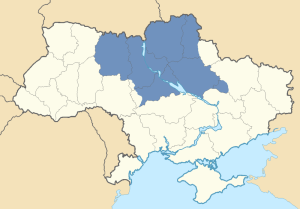
Location of Dnieper Ukraine in Ukraine

Location of Dnieper Ukraine in Ukraine

Central Ukraine:

Dnieper Ukraine:

  • Contemporary area: Most of the Central oblasti of Ukraine, particularly the Kiev, Cherkasy, Poltava, and Zhytomyr oblasti.
  • Major cities and towns: Kiev, Cherkasy, Poltava, and Zhytomyr
Location of Podolia in Ukraine and Transnistria

Location of Podolia in Ukraine and Transnistria

Podolia:

  • Contemporary area: All of the Vinnitsyia and Khmelnytskyi oblasti, with the southwesternmost parts of the Kiev oblast, the westernmost parts of the Cherkasy oblast, the northern portions of the Odessa oblast, and the northern parts of the breakaway region of Transnistria in Moldova.
  • Major cities and towns: Vinnitsyia, Khmelnytskyi, Kamianets-Podilskyi, and Rybnitsa
Location of Polesia in Ukraine

Location of Polesia in Ukraine

Polesia:

  • Contemporary area: Northern parts of the Zhytomyr, Kiev, Chernihiv, and Sumy oblasti, sometimes including the northern parts of Volhynia too.
  • Major cities and towns: Chernihiv, Shostka, Nizhyn, and Korosten

Southeastern Ukraine:

Location of Zaporozhia in Ukraine

Location of Zaporozhia in Ukraine

Zaporozhia:

  • Contemporary area: The core territory of this region encompassed the Dnipropetrovsk oblast, the northern portions of the Zaporozhia oblast, and virtually all of the Central Ukrainian oblast of Kirovograd. Additionally, it included the very small southernmost portion of the Poltava oblast south of the Dnieper River, around the southern side of the industrial city of Kremenchuk.  Zaporozhia also extended east to include parts of the Kharkiv, Donetsk and Luhansk oblasti and south to include the northernmost portions of the Nikolayev and Kherson oblasti.
  • Major cities and towns: Dnipropetrovsk, Zaporozhia, Kryvyi Rih, and Kirovograd
  • Notes: The word “porozh” in Ukrainian and Russian indicates “rapids” so the name literally means “land beyond the rapids” (referring to the rapids of the river Dnieper).
Location of Sloboda Ukraine in Ukraine

Location of Sloboda Ukraine in Ukraine

Sloboda Ukraine (Free Ukraine), also known as Sloboda Zemlya (Free Land) or Slobozhanshchina:

  • Contemporary area: Almost all of the Kharkiv oblast, except for the southernmost parts.  Also included were the southern portions of the Central Ukrainian Sumy oblast, the northernmost portions of the Donetsk oblast, and the areas of the Luhansk oblast north of the Seversky Donets river.
  • Major cities and towns: Kharkiv, Sumy, Izyum, and Starobilsk
  • Notes: The Tsarist-era Kharkov guberniya approximately corresponds to the boundaries of Sloboda Ukraine.  According to the Tsarist census of 1897, the guberniya’s population was majority ethnic “Little Russian” (i.e., Ukrainian).  Also, until 1939, the city of Sumy and the southern portions of the modern-day Sumy oblast were part of the Soviet-era Kharkov oblast.
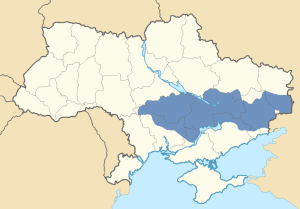
Location of Donbas in Ukraine

Location of the Donbas in Ukraine

The Donbas:

  • Contemporary area: The Donetsk and Luhansk oblasti (also the breakaway “People’s Republics” of Donetsk and Luhansk).
  • Major cities and towns: Donetsk, Luhansk, Mariupol, Slavyansk, and Kramatorsk
  • Notes: The name is short for “Donets Basin.” In Tsarist times, the Donbas region was administratively divided. The northern portions of both oblasti were part of the Kharkov guberniya (the historic Sloboda Ukraine), while their western portions were part of the Yekaterinoslav guberniya (the eastern part of historic Novorossiya), and their eastern portions were part of the Don Host Oblast which also included significant portions of Southern Russia. Due to the latter fact, some might argue that the eastern Donbas was once “part of Russia.” However, such an argument is problematic because, in this region, the distinction between what is “Russian” and what is “Ukrainian” becomes increasingly blurred. For instance, this area between Russia and Ukraine is so demographically mixed that some Ukrainians might conversely claim parts of Southern Russia as “Ukrainian.” The blurriness is compounded by the fact that the Cossacks who historically lived in these areas were not from an exclusive national group. They were both Russians and Ukrainians.
Location of Crimea

Location of Crimea

Crimea, also known as Taurida:

  • Contemporary area: The Republic of Crimea and the Federal City of Sevastopol administered by Russia, the Autonomous Republic of Crimea and the City of Sevastopol, claimed by Ukraine.
  • Major cities and towns: Sevastopol, Simferopol, Kerch, Feodosiya, and Yalta
  • Notes: In addition to the Crimean peninsula, the Tsarist-era Taurida guberniya also included significant portions of the modern Kherson and Zaporozhia oblasti in contemporary Ukraine. However, this “mainland” part of the guberniya (also considered to be part of “Novorossiya proper”) significantly differed demographically from the peninsula. According to the 1897 Tsarist census, the mainland’s population was primarily “Little Russian” (Ukrainian) with a significant “Great Russian” (ethnic Russian) minority, while the population of the peninsula was largely “Great Russian” and Tatar with a significant Ukrainian minority and additional ethnic minorities of Germans, Jews, Bulgarians, Greeks, Armenians, Poles, and others.
Location of the Budzhak in Ukraine

Location of the Budzhak in Ukraine

The Budzhak:

  • Contemporary area: Portion of the Odessa oblast situated south of Moldova, east of Romania and the Danube, and west of the Dniester, on the Black Sea coast.
  • Major cities and towns: Izmail and Bilhorod-Dnistrovskyi (Akkerman)
  • Notes: Historically the southernmost part of Bessarabia, this region was part of the interwar Kingdom of Romania until it was annexed by the Soviet Union in 1940. In Soviet Ukraine, it was administered as the Akkerman oblast, later renamed the Izmail oblast. In 1954, the oblast was abolished and incorporated into the Odessa oblast. A multiethnic region, the Budzhak is majority Ukrainian with substantial Bulgarian, Russian, Romanian, and Gagauz minorities. The name “Budzhak” is derived from the Turkish word “bucak,” meaning “district” or “corner.”
Location of the Yedisan in Ukraine and Transnistria

Location of the Yedisan in Ukraine and Transnistria

The Yedisan:

  • Contemporary area: The southern portions of Transnistria and the Odessa oblast (excluding the Budzhak), the southern portion of the Nikolayev oblast, and the southwestern portion of the Kherson oblast.
  • Major cities and towns: Odessa, Nikolayev, and Tiraspol
  • Notes: The name “Yedisan” (alternatively transliterated as “Edisan” or “Jedisan”) is derived from a nomadic Nogai Turkic tribe who once inhabited this area. It literally means “seven titles” referring to seven different subdivisions among the tribe. In the 18th century, the region was incorporated into Imperial Russia by Catherine the Great as part of Novorossiya and settled by Ukrainians (Malorussians), Russians, and others. The area was also known as “Ochakov Tartary” after the historic fortress of Ochakov located in the contemporary Nikolayev oblast.
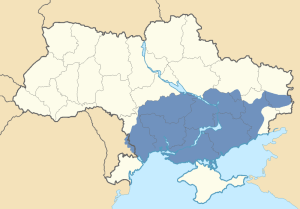
Location of Novorossiya in Ukraine and Transnistria

Location of Novorossiya in Ukraine and Transnistria

Novorossiya (New Russia):

  • Contemporary area: The Nikolayev and Kherson oblasti, the southern portions of Transnistria and the Odessa oblast (excluding the Budzhak), the southern part of the Zaporozhia oblast, the southeasternmost area of the Kharkiv oblast, the Western half of the Donbas (including the cities of Donetsk and Luhansk), and most of the historical region of Zaporozhia. Novorossiya also occasionally included Bessarabia (Moldova proper with the Budzhak region of the Odessa oblast), Crimea, and the Don Host Oblast (the eastern half of the Donbas and significant portions of Southern Russia).
  • Major cities and towns: Odessa, Nikolayev, Kherson, Tiraspol, and Berdyansk
  • Notes: It must be emphasized that, with the exception of its southeasternmost area, much of the territory of the modern-day Kharkiv oblast was not part of Novorossiya. Further the majority population of the core territory of Novorossiya (Odessa, Nikolayev, Kherson, southern Transnistria, western Donbas, and historic Zaporozhia) in the 1897 Tsarist census were identified as ethnic “Little Russians” (Ukrainians) with significant minorities of “Great Russians” (ethnic Russians) and, in the Odessa area, Jews. Consequently, the idea of making this region a part of Soviet Ukraine was logical from a geographic and ethnographic standpoint. Thus, it must be emphasized that the assignment of these territories was not a “great mistake” by the Bolsheviks as Russian President Vladimir Putin, Russian Deputy Prime Minister Dmitry Rogozin and others have been claiming. Indeed, it is likely that Putin is advancing the Novorossiya claim to placate hardliners like Rogozin in the Kremlin who want to invade Southeastern Ukraine and are attempting to use historical revisionism to show that the region is “another Crimea” in order to justify such actions. However, no invasion can be justified and would be a disaster for both Russia and Ukraine.
Location of Novaya Serbiya in Ukraine

Location of Novaya Serbiya in Ukraine

Novaya Serbiya (New Serbia):

  • Contemporary area: Northern portions of the Kirovograd oblast, with some adjoining areas of the neighboring Cherkasy, Poltava, and Dnipropetrovsk oblasti.
  • Major cities and towns: Novomyrgorod
  • Notes: Founded by Tsarist Russia as a military frontier with Poland in the 1750s populated by Serbs, Montenegrins, Romanians, and others from Habsburg Austria (hence the name). The territory was later abolished in 1764 and incorporated into Novorossiya.
Location of Slavo-Serbiya in Ukraine

Location of Slavo-Serbiya in Ukraine

Slavo-Serbiya (Slavo-Serbia):

  • Contemporary area: Border regions between the modern-day Donetsk and Luhansk oblasti.
  • Major cities and towns: Artemivsk (Bakhmut)
  • Notes: Founded by Tsarist Russia as a refuge for Serbs, Montenegrins, Romanians, Bulgarians, Hungarians, Greeks, and others. The territory was later abolished in 1764 and incorporated into Novorossiya.

For more information on Ukraine’s diverse regional divisions, see my earlier post, What is Ukraine? from March here, now updated and expanded to include the latest information about Ukraine.

Odessa: A Ukrainian Tragedy

Odessa's celebrated Potemkin Steps, once the scene of Sergei Eisenstein's famed 1925 Soviet classic, The Battleship Potemkin. (Palmyra.od.ua)

Odessa’s celebrated Potemkin Steps, once the scene of Sergei Eisenstein’s famed 1925 Soviet classic, The Battleship Potemkin. (Palmyra.od.ua)

Odessa is a beautiful, theatrical city, renown for its humor, wit, culture, and charm. Yet, at the same time, it is also a city that has experienced much pain and tragedy in its history. Since the horrors of World War II, who would have guessed that nearly 70 years later, the people of this celebrated “St. Petersburg of the south” would again have cause to mourn?

It is beyond doubt that the 2 May massacre in Odessa was a turning point for the crisis in Ukraine. Last Friday was a painful day of mourning for a country that is already on the brink of catastrophe. One might expect that such grief would lead toward greater unity within the country and perhaps pave the way for a rational, constructive dialogue toward peace.

Instead, the massacre has only hardened opinions in Ukraine. Throughout the southeast, including Odessa, popular anger and opposition to the Turchynov-Yatsenyuk government is currently on the rise. In Central Ukraine and Kiev, public opinion over the tragedy is divided. In Western Ukraine, while many have expressed sorrow for the deaths, the popular stance largely does not want to fully explore what happened in Odessa.  The involvement of the pro-Kiev activists is downplayed and “pro-Russian provocateurs” are blamed instead.  According to one observer in Western Ukraine, the reaction from some in the West on social media has been “less than compassionate” and “even hubristic.”  Further west, in the remote Rusyn-speaking oblast of Zakarpattia, popular reaction to the tragedy in Odessa is unclear.  Meanwhile, as tensions rise, Odessa’s historic Jewish community, which had been experiencing a cultural and religious revival in recent years (including a Yiddish language revival), is planning to evacuate the city en masse.

In the United States, mainstream media networks like ABC, CNN, and Fox have practically ignored the massacre. In the rare case that it is mentioned, the question of responsibility is always vague. Official Washington offered its condolences on Saturday in the same manner, without naming any perpetrators. Later, though the US Ambassador in Kiev Geoffrey Pyatt admitted in an interview with CNN that there was no evidence of a Russian role in the massacre.

Frank-Walter Steinmeier (Frank-walter-steinmeier.de)

Germany’s Frank-Walter Steinmeier has called for fresh talks to de-escalate the crisis.  (Frank-walter-steinmeier.de)

In Germany, opposition to the events in Ukraine as well as a desire for a resolution to the crisis are growing. One member of the ruling Christian Democrats stated that Germany “should stop being a servant of the Americans” and that confrontation with Russia over Ukraine was “blind to history and deaf to the other side.” Meanwhile, Germany’s Social Democrat Foreign Minister Frank-Walter Steinmeier called for a new round of Geneva talks.  A veteran diplomat, Steinmeier has stated that the new talks will “send a ‘strong political signal’ that previous agreements will be implemented.” The plan now has the backing of Chancellor Angela Merkel.

Russia’s response to Odessa has been remarkably reserved. Moscow condemned the massacre in very strong terms and the State Duma has demanded a probe into the tragedy. However, Russia has refrained from intervening directly in Ukraine, despite anger in Moscow and pressure by hardliners in the Kremlin to invade.

It is undeniably apparent that Right Sector and far-right football fans known as the “Ultras” were singularly responsible for what happened in Odessa. On YouTube, footage has emerged showing the nationalists starting the fire and later shooting anti-Kiev activists who attempted to leave the burning building.

The Turchynov-Yatsenyuk government has sought to downplay the massacre, instead expressing very general “sorrow” for the victims and emphasizing the clashes that preceded it between supporters and opponents of the government. In every case, they are quick to blame the initial clashes on “pro-Russian provocateurs.” During his visit to Odessa, Prime Minister Yatsenyuk reiterated the same script, though also blaming the security services for not stopping the violence.

Yatsenyuk also pledged a de-centralization of powers to the oblasti and to this end, a bill for a nationwide plebiscite on the issue has been registered at the Ukrainian Rada. Yet people living in Ukraine’s southeast are skeptical. The government has announced vaguely-worded “de-centralizations” in the past, but these were ultimately never realized. In a much less calculated move, the government has also dispatched a special all-volunteer battalion of Kiev’s National Guard to Odessa. It is doubtful that such a move will help de-escalate tensions and build confidence in this part of Ukraine. Opposition to the government runs high in Odessa.  Some have even gone so far as to refer to the massacre as an act of “genocide.” Meanwhile, the “anti-terrorist operation” continues in Eastern Ukraine, which is now effectively in a state of war with Kiev.

Overall, anxiety and apprehension remain high throughout Ukraine in the aftermath of the Odessa massacre. If social media is any indication, it demonstrates that people throughout the country have fundamentally different views and interpretations of the event. Dialogue is extremely important to restoring order and peace, but it is increasingly being supplemented by a discourse of “my interpretation is better than yours” and even worse “us vs. them.” In the backdrop of all this is a fast deteriorating socioeconomic situation and the near-bankruptcy of the country. Ukrainians together need to emerge with white flag in hand to set aside their differences and engage in a serious, meaningful dialogue to find solutions to their problems. War, no matter what, should never be an option.

The 2 May Odessa Massacre and Its Significance on the Ukraine Crisis

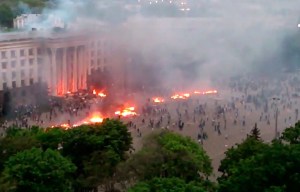
The Trade Union building of Odessa in flames (ITAR-TASS)

The Trade Union building of Odessa in flames (ITAR-TASS)

On Friday, at least 46 people, mostly anti-Kiev activists, were killed in the southern Ukrainian city of Odessa.  At least 39 died after being trapped in the Odessa House of Trade Unions which was reported to have been lit on fire by far-right football hooligans and activists from the far-right Kiev-affiliated group Right Sector (Praviy Sektor). Some were burned alive while others suffocated to death or jumped out the windows to escape.  At least three were reportedly shot dead. Close to 200 were injured with at least 25 in critical condition.

The massacre was the bloody culmination of clashes between supporters and opponents of the controversial Turchynov-Yatsenyuk government in Kiev. The supporters were primarily Right Sector and its allies, including far-right football hooligans known as the Ultras, who are said to have instigated the violence.  “Glory to Ukraine,” “Death to enemies,” and “Knife the Moskali” they chanted.

The city of Odessa has declared a three-day period of mourning on 3 May.  Russian President Putin has expressed “deep condolences” to the families of those who died.

The significance of this massacre to the ongoing crisis in Ukraine is threefold:

  1. It represents the worst violence of the Ukraine crisis since the events in February.
  2. It will likely further erode the credibility of the Turchynov-Yatsenyuk government throughout all regions of Ukraine.
  3. It has demonstrated that Russia, though harshly critical about the actions that took place in Odessa, has been nonetheless restrained in responding to this tragedy. This is very difficult for Moscow because of its anger over the overall situation as well as pressure from Russian hardliners who want Russia to invade Ukraine. Still, the Kremlin will likely continue to show restraint on the issue (at least for now) as the stakes of a direct intervention in Ukraine are too high. In the meantime, Kiev appears to be provoking Moscow to respond to events occurring in the Russophone regions. It is specifically using Right Sector to accomplish this.  Now headquartered in the southeastern town of Dnipropetrovsk, Right Sector activists have launched attacks on cities and towns in and throughout southeastern Ukraine.

The massacre is an especially tragic event for Odessa, a multicultural, cosmopolitan, and theatrical port city on the Black City. Renown for its humor, Odessa is blessed with a heritage of mixed Russian, Ukrainian, Jewish, and Mediterranean influences. Its people speak their own colorful dialect of Russian with smatterings of Ukrainian and Yiddish.  Yet, the May massacre will likely go down as yet another tragedy in Odessan history, a history that also includes several anti-Jewish pogroms, the Russian Revolution, the Russian Civil War, famine, Stalin’s Terror, World War II, and the horrors of the Holocaust. Yet as in these tragedies, the people of Odessa will likely turn to their quick wit, irreverence, and celebrated sense of humor to deal with this latest painful episode in their collective history.

How Moscow Views the Ukraine Crisis

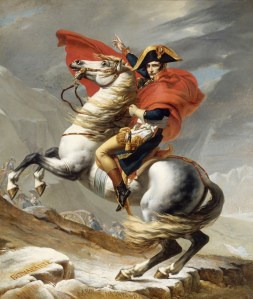
Bonaparte Crossing the Grand Saint-Bernard Pass by Jacques-Louis David, 1800.  The historical memory of the Western invasions of Russia (including the Napoleonic invasion of 1812) still affects Russian perceptions of the West today.

Bonaparte Crossing the Grand Saint-Bernard Pass by Jacques-Louis David, 1800. The historical memories of the West’s invasions of Russia (including the Napoleonic invasion of 1812) still loom large in the Russian consciousness.

Throughout the ongoing Ukraine crisis, few Western commentators and/or observers have considered Moscow’s view of the situation. In the Western media, the prevailing image is that Russia is an aggressor, intent on dominating its neighbors. Western influence is presented as “positive.” Russian influence as “negative.” Joining the EU is depicted as being a road to economic and social prosperity and NATO is offered as a defensive bulwark against the “terrible” Kremlin. Remarkably, at least in the United States, liberals and conservatives are singing the same song. Further, the discourse of “invasion,” “occupation,” “aggression,” and “World War III” is hardly diplomatic. How does anyone believe that negotiations can ensue when such language is thrown about?

By contrast, in Moscow, the view of the situation in Ukraine is entirely different. It perceives the West as encroaching on countries to which it has been very closely associated. Ukraine (the entire country, East, South, Central, and even West), along with Belarus, is viewed as a fraternal East Slavic nation to which Russia is intimately bound. The capital Kiev is regarded by all Russians as the “mother Russian city,” the common point of origin for all East Slavs. To view Kiev within the boundaries of the EU and NATO is more than just a violation of a sphere of influence.  To the Russians, it is almost sacrilege.

Meanwhile, it does not help that some of the most vocal advocates for Ukrainian membership in the EU and NATO come from countries that Russia perceives as historical invaders. They include Poland and Sweden, the co-founders of the Eastern Partnership program that sponsored the Ukraine-EU Association Agreement. Both countries have a history of animosity toward Russia, but it is Poland in particular that Moscow views as being one of the chief advocates for Western expansionism.

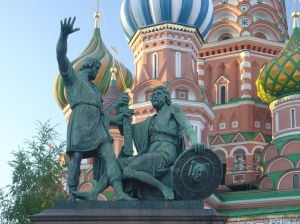
Minin and Pozharsky Statue in front of St. Basil's Cathedral, Moscow (Kotomka)

Minin and Pozharsky Statue in front of St. Basil’s Cathedral, Moscow (Kotomka)

We in the West regard Poland primarily as the victim of Russian aggression, particularly communism. We reflect on Russia’s participation in Poland’s partitions, its suppression of Polish uprisings, the Polish-Soviet War, the Molotov-Ribbentrop Pact, the Katyń massacre, and the establishment of communist Poland. Conversely, to a Russian with a sense of history, Poland is perceived as a historical invader, a country that during the Time of Troubles in Russia (1598-1613) supported the Tsar-pretender “False Dmitriy,” attempted to bring Catholicism to Orthodox Russia, and eventually invaded and occupied Moscow in 1609. That invasion was repelled in 1612 by the duo of Kuzma Minin and Dmitriy Pozharsky, whose statue stands today in front of St. Basil’s in Moscow.

Even in more recent times, Russians recall that it was Poland’s Marshal Piłsudski who, during the Polish-Soviet War of 1919-21, not only tried to ensure the freedom of Poland, but also sought to annex to Poland large swathes of Lithuania, Belarus, Ukraine, and Western Russia to restore the Polish-Lithuanian Commonwealth of old. Piłsudski is still admired by some in Poland today, including members of the political elite such as the late Polish President Lech Kaczyński and his twin brother, Jarosław. He is also greatly admired by former Georgian President Mikheil Saakashvili.

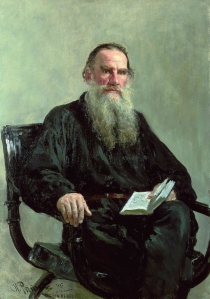
Russian author Leo Tolstoy in a portrait by Ilya Repin, 1887.

Russian author Leo Tolstoy in a portrait by Ilya Repin, 1887.

Russians likewise recall Polish participation in the Napoleonic invasion of Russia. In Leo Tolstoy’s War and Peace, it is the Polish legion that is depicted as being the most fanatically supportive of an expansion toward Russia, so much so that they drown in the River Viliya for Napoleon. Today, the Russians see very much the same thing, except that Napoleon is now replaced by NATO and that the Poles are now showing their loyalty, not by drowning in the Viliya, but by asking for NATO troops to be stationed in their country.

In another Tolstoyan parallel, Moscow also likely views the Ukrainians who protested on the Maidan as being the modern equivalents of the muzhiks of War and Peace. It was the muzhiks who rose up against their oppressive landlords for Napoleon, who they viewed as the embodiment of the French revolutionary ideals of liberté, égalité, et fraternité. Today though, the modern landlords are Ukraine’s corrupt political elite and oligarchs, while the liberal ideals of Napoleon and revolutionary France are today the liberal ideals of Brussels and the European Union. Moscow regards the latter ideals in 2014 just as they regarded Naopleon’s ideals in 1812 – that is, as false promises motivated only by geopolitical ambitions rather than by any genuine sense of altruism.

Given this, it would be wise to recall history before permitting the rhetoric to get too out of control.

German Federalism: An Example for Ukraine

German states (länder) of the German Federal Republic.

German states (länder) of the German Federal Republic.  German federalism is a successful model that Ukraine could follow as an example.

Federalism in Ukraine has been discussed in a previous entry on this publication, but now I wish to highlight a practical example that Ukraine could follow in this regard: Germany.

Germany is a state much like Ukraine with broad regional divisions. Catholics from Bavaria and the Rhineland are largely concentrated in the south and west respectively. Protestants are primarily concentrated in the northwest. The former East Germany, located in the northeast, is largely secular. Yet somehow all of these groups manage to get along in a single, federal state with a strong central government in Berlin. The states (länder) are self-governing with their local representatives directly elected by the people. Meanwhile, it is Berlin that regulates the foreign, economic, and security policy of the German Federal Republic as a totality.

The German example is one that Kiev could follow.  This would make each of Ukraine’s oblasti self-governing in the same way that the länder are in Germany.  Each would have their local governors elected directly by the people, not appointed by official Kiev. For example, if the people of Poltava oblast do not want to be represented by Svoboda, then why should Turchynov or Yatsenyuk appoint a Svoboda party member to represent them? The people of Poltava should instead elect their own governor who best reflects their views and interests, not some appointee from Svoboda.

Each would also be able to regulate their own language policy. Again, to use the example of Zakarpattia, that oblast could have Ukrainian and Rusyn as co-official languages with Hungarian, Romanian, and Russian as minority languages. In another example, the languages of the Odessa oblast could be Ukrainian and Russian co-official, with Bulgarian, Romanian, and Yiddish minority languages.

At the same time, it would be official Kiev that would regulate the country’s foreign, trade, economic, and defense policies. It would be the best of all worlds. The people would finally have a say in their government, and at the same time Kiev would still have the ultimate say on the most important issues. Following the German federal model like this would be a good model for Ukraine, especially in this time of crisis.

Who Are the Rusyns?

In the midst of the ongoing Ukraine crisis, one region of the country has been obscured from the spotlight. This is the westernmost Zakarpattia oblast, a mountainous region that shares four international boundaries with Poland, Slovakia, Hungary, and Romania. Located at the center of Europe, its capital is Uzhgorod, a city located literally on the border with Slovakia and which, architecturally, shares much in common with neighboring locales across the border such as Prešov and Košice. The majority of the local population is comprised of a group known as the Rusyns, a distinct East Slavic people. Most significantly, it is through this region that major energy pipelines pass from Russia, through Ukraine, and into the EU.
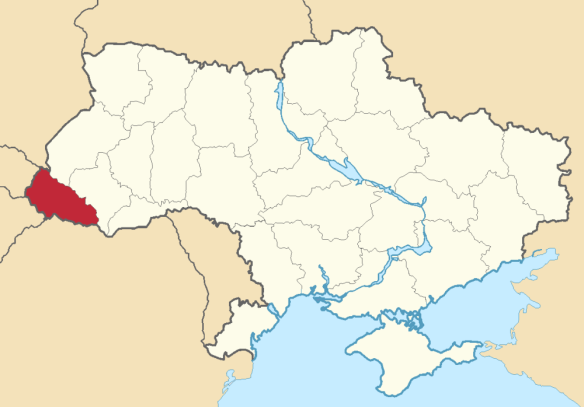
Location of the Zakarpattia Oblast within Ukraine.
Location of the Zakarpattia Oblast within Ukraine.

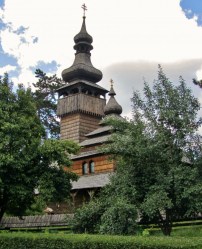
Church of Archangel Michael in the wooden style commonly seen in Zakarpattia (Sobory.ru)

Church of Archangel Michael in the wooden style commonly seen in Zakarpattia. (Sobory.ru)

Language, faith, and identity

The Rusyns derive their name from their self-designation “Rusyni” indicating “people of the Rus’ as in the old “Kievan Rus’.” At one point, the Russians, Ukrainians, and Belarusians all self-identified as “Rusyni” until they adopted their respective ethnonyms over time. In some cases, the residual use of the self-designation “Rusyni” in both Ukraine and Belarus lasted well into the early 20th century. The Rusyns are also known by other names too such as “Ruthenians,” a term which is also used to apply generally to all East Slavs (Russians, Ukrainians, and Belarusians). Indeed, “Ruthenia” is merely a Latin rendering of the name “Rus’,” though today it almost exclusively applies to Zakarpattia as a distinct region. More specific names for the people of this region include “Carpatho-Rusyns” or “Carpathian Ruthenians,” both of which designate the specific area in which these people live – the Carpathian Mountains. There are subgroups of Rusyns as well such as the Lemkos, Hutsuls, and Boykos.
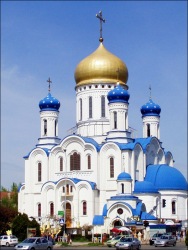
Cathedral of Christ the Savior, Uzhgorod

Orthodox Cathedral of Christ the Savior, Uzhgorod (Ukraine Trek)

In terms of faith, the Rusyns are largely members of the Byzantine Ruthenian Catholic Church (distinct from the Ukrainian Greek Catholic Church). In recent years, some Rusyns have also been gravitating toward Orthodox Christianity of the Moscow Patriarchate. In 2000, the Orthodox Cathedral of Christ the Savior was inaugurated in Uzhgorod. The church reflects common architectural styles found in much of Russia, Ukraine, and Belarus. Yet the more prominent architectural style that one finds throughout Zakarpattia is the simple, wooden church style.  Indeed, wood churches are a major art in this region and comprise an important part of the Rusyn culture, heritage, and identity.

The Rusyn homeland is primarily centered on the Zakarpattia Oblast of Ukraine, which encompasses the bulk of it. However, Rusyns also inhabit a few adjoining areas, notably portions of eastern Slovakia and southeastern border areas of Poland (particularly in the Subcarpathian Voivodeship). Geography is key here for it was the mountains that isolated the Rusyns from the other East Slavs and allowed them to develop their own unique culture and East Slavic language.
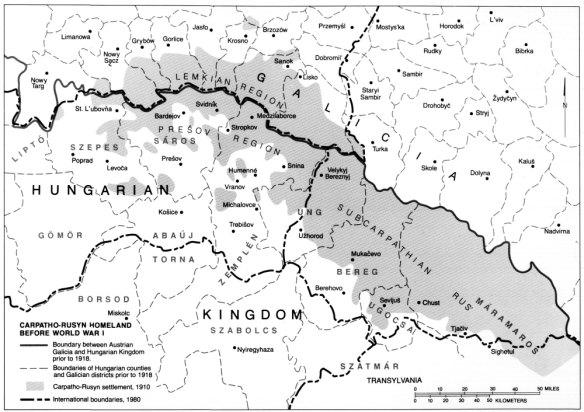
Map showing the full geographic extent of the Rusyn people in Central Europe. (carpathorusynsociety.org)

Map showing the full geographic extent of the Rusyn people in Central Europe, prior to World War I. (carpathorusynsociety.org)

In fact, it is interesting to observe precisely where the Rusyn language stands within the geographic and linguistic position of the Slavic languages. In the Czech Republic, one finds the West Slavic Czech language. When one reaches the eastern fringes of the historical Czech region of Moravia, the Moravian dialect gradually begins to transition into Slovak, a language that shares many affinities with Czech. The further east one travels in Slovakia, the more divergent the Slovak dialects become from the standard language. By the time one reaches the mountainous regions of Prešov and Košice, the eastern dialects of Slovak gradually begin to blend into an East Slavic language: Rusyn.

Rusyn is the linguistically dominant language of Ukraine’s Zakarpattia oblast. From Zakarpattia, Rusyn gradually transitions into standard Ukrainian in Galicia and Volhynia. However, by the time one reaches the Khmelnytskyi oblast, Ukrainian begins to change into Surzhyk, a mixed Russian-Ukrainian language. Then, as one moves further east to the Sumy and Kharkov oblasti, Surzhyk begins to blend into Russian, specifically the southern dialect of Russian. By the time one reaches Moscow, the language has evolved into standard Russian.
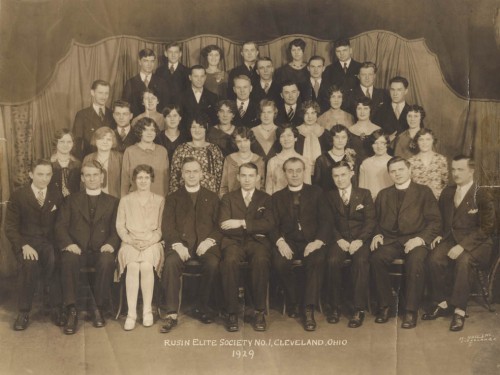
The Rusyn Elite Society in Cleveland, Ohio in 1929, one of many Rusyn immigrant associations in the United States. (Cleveland Cultural Gardens)
The Rusyn Elite Society in Cleveland, Ohio in 1929, one of many Rusyn immigrant associations in the United States. (Cleveland Cultural Gardens)

Andy Warhol

Andy Warhol

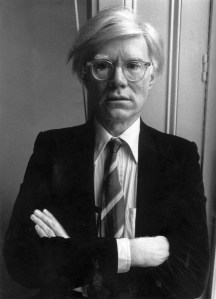
In the 19th century, significant numbers of Rusyns also moved further south from their historic homeland into the region of Pannonia. Their descendents are today the Rusyn minority in the former Yugoslavia, primarily Vojvodina, the autonomous region of northern Serbia where Rusyn is a co-official language, and in Slavonia and other regions of Croatia. Still more Rusyns emigrated to the United States and Canada in the 19th and early 20th centuries, settling in New York, New Jersey, Cleveland, Chicago, Detroit, and Minneapolis, as well as parts of southern Connecticut and the coalmining towns of western Pennsylvania. One of the most prominent Rusyn-Americans who is always mentioned in discussions on Rusyns is the eccentric pop artist Andy Warhol.

Historical overview

The origins of the Rusyns can be partially traced to the White Croats, an early Slavic tribe distantly related to the modern Croats of the former Yugoslavia.   The historical Rusyn homeland in Zakarpattia existed as a disputed borderland area between the Kievan Rus’ and the medieval Kingdom of Hungary.  Hungary’s administration of the region strengthened following the downfall of the Rus’ state.

For many subsequent centuries, Zakarpattia remained under Hungarian rule. Thus, within Austria-Hungary, the people here were ruled by the Hungarian monarchy, in contrast to their neighbors in Galicia who were ruled directly by the Austrians in Vienna. Under Hungarian influence, the locals adopted some Hungarian cultural attributes. For example, Hungarian Bogrács Gulyás is a staple of Rusyn cuisine. The Rusyns also adopted the Catholicism of their Hungarian and Slovak neighbors. In 1646, at the Union of Uzhgorod, the largely Orthodox Rusyns formally joined the Catholic Church under the Byzantine rite, forming the Byzantine Ruthenian Catholic Church.
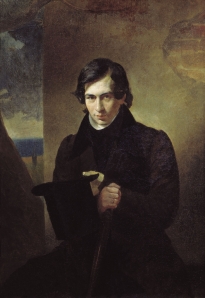
St. Petersburg-born Rusyn-Russian playwright Nestor Kukolnik (portrait by Karl Bryullov, 1836)

St. Petersburg-born Rusyn-Russian playwright Nestor Kukolnik (portrait by Karl Bryullov, 1836)

However, the Rusyns were far less receptive to being forcibly assimilated by the Hungarians. In the 18th and 19th centuries, a significant Russophile movement emerged in Zakarpattia in response to Hungarian cultural suppression and Magyarization. The great Rusyn writer and theologian Aleksandr Dukhnovich was active in this movement. Another was the academic Vasily Kukolnik whose St. Petersburg-born son, Nestor Kukolnik, would later become a prominent romantic Russian playwright. Russophile sentiment also existed in Galicia, though it was later supplemented by Ukrainian nationalism. By contrast, in Zakarpattia, the Russophile movement persisted even to the present-day. Indeed, many in the region still harbor affinities for Russia as evidenced by the closeness of elections here between pro-Russian and pro-Western candidates.

With the collapse of the Habsburg monarchy at the end of World War I, the West Ukrainian People’s Republic sought to claim Zakarpattia as part of its territory. However, it remained under Hungarian rule until 1919 when the Paris Peace Conference assigned it to Czechoslovakia. This was the result of a National Council led by Rusyn-American leader Grigory Žatkovich. Given the instability of Russia and Ukraine at the time, Žatkovich was advised by the Wilson administration that a Rusyn union with Czechoslovakia would be the only viable option for the territory’s future. Consequently, in 1918 Žatkovich signed the Philadelphia Agreement with Tomáš Masaryk, ensuring Rusyn autonomy in a future Czechoslovak state. The Treaty of St. Germain in 1919 reaffirmed this. However, actual political autonomy of the region proved to be less than that desired by the Rusyns of Zakarpattia, largely due to the inefficiency and bureaucracy in Prague. Žatkovich, who Masaryk appointed as governor to the region, eventually resigned in frustration.
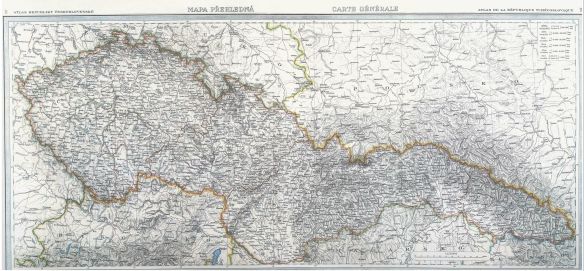
Map of interwar Czechoslovakia in 1935 with

Map of interwar Czechoslovakia in 1935 with “Podkarpatská Rus” (“Subcarpathian Rus”), the present-day Zakarpattia Oblast.

Another significant aspect of Zakarpattia’s union with Czechslovakia was the precise determination of the borders. The frontiers of Zakarpattia, as determined at the Paris Peace Conference and later at the Treaty of Trianon also included a substantial Hungarian minority in the southernmost portion of the region. Most of these Hungarians did not want to separate from Hungary nor were they interested in joining the new Czechoslovak state.

Following Hitler’s annexation of the German-inhabited Sudetenland in 1938, the remainder of Czechoslovakia was slowly dismembered. Germany moved to snatch the rest of the Czech lands while Slovakia became a German fascist puppet state ruled by the collaborator Jozef Tiso. Horthy’s Hungary then was given permission by Hitler to annex the Hungarian-inhabited areas of southern Slovakia in the First Vienna Award. The Nazis also granted Zakarpattia to Budapest as well. This left the region with no choice but to declare its independence. On March 15, 1939, the Rusyns moved to declare a Republic of Carpatho-Ukraine. Within one day, it was crushed by Horthy’s invading army and declared part of Hungary. Under Hungarian rule, the Rusyns were allowed to continue reading and writing in their language as long as it was pro-Hungarian in orientation. Those opposed to Hungarian rule sought to flee Zakarpattia across the mountains into Soviet Ukraine. Hoping to be welcomed by the Soviets, they were instead arrested by the NKVD for “illegally crossing into Soviet territory” and sent to Gulag labor camps. Meanwhile, during the war, Zakarpattia’s historic Jewish community suffered greatly. Most were deported to Nazi death camps and perished in the Holocaust.
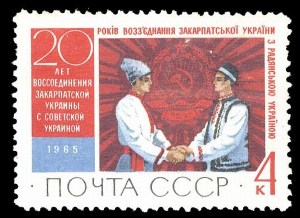
A Soviet-era stamp celebrating the 20th anniversary of Zakarpattia's 'reunification' with Soviet Ukraine.

A Soviet-era stamp celebrating the 20th anniversary of Zakarpattia’s “reunification” with Soviet Ukraine.

Zakarpattia remained part of Hungary for much of the war until it was liberated by Soviet troops in 1944. Throughout the war, Moscow promised the Western allies that it would restore Czechoslovakia’s pre-1938 borders. However, after the liberation of Zakarpattia, new considerations were drawn up and it was decided to incorporate the region into Soviet Ukraine instead. The decision was informed by both ethnic-historical and geopolitical considerations. With the Soviet incorporation of the region, all of the historic East Slav lands were now under the jurisdiction of a single state for the first time since the Kievan Rus’. Geopolitically, the region was also strategically significant, as it gave the Soviet Union a direct land boundary with Hungary. The cession was officially acknowledged by Czechoslovak President Edvard Beneš in June 1945. The borders of Zakarpattia remained virtually unchanged except for the new addition of the border city of Chop, an important railway juncture.

The incorporation of Zakarpattia into the Soviet Union brought about significant changes. The Soviets attempted to modernize the economy and to bring collectivization to the countryside. The Soviets also attempted to suppress the native Byzantine Ruthenian Catholic Church. Though instead of moving to repress religion, they sought to bring this church under the jurisdiction of the Russian Orthodox Church. This was met with limited success, though Orthodoxy in Zakarpattia has arguably experienced some activity since Ukraine’s independence.

The Soviets also inherited Zakarpattia’s community of Jehovah’s Witnesses, the result of missionary work in interwar Czechoslovakia.  The Soviets distrusted the Witnesses as a “non-traditional sect” and thus sought to limit their activities.  Yet, the Witnesses continued to pursue their beliefs regardless and earned a degree of respect in Soviet society for their “dissident” and “anti-Soviet” approach.
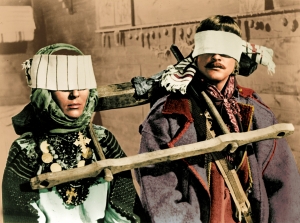
A still from Parajanov's Shadows of Forgotten Ancestors.

A still from Parajanov’s Shadows of Forgotten Ancestors.

Meanwhile, education and literacy were also promoted as was Russian-language instruction. Ethnic Russian teachers, workers, and supervisors from Moscow descended on the new region, creating a new Russian minority. They also were genuinely astounded by this unique and mountainous “lost province” that, in their view had been separated for so long from the “Russian motherland.” The fascination with Zakarpattia continued for much of the Soviet era and was even the subject of films and popular media. The great Soviet Armenian filmmaker Sergei Parajanov even made a film about Zakarpattia called Shadows of Forgotten Ancestors that met with critical acclaim internationally.

The Soviet nationalities’ policy also sought to promote the “Ukrainian” ethnonym among the Rusyn people of this region. The ethnonym has been largely adopted by the people, though most still speak the Rusyn language and adhere to their own cultural norms. The sense of uniqueness also persisted, though any debate about the Rusyn question was banned in the Soviet Union until glasnost. Under Gorbachev, discussion of the “Rusyn question” began to re-emerge and the Byzantine Ruthenian Catholic Church was rehabilitated. In 1991, voters in Zakarpattia overwhelmingly backed Gorbachev’s New Union Treaty. Later that year, Ukraine’s Kravchuk proposed a ballot on state sovereignty in Ukraine. This too was approved by voters in the region. However, more significantly, another provision on the ballot promising local autonomy passed by an even wider margin. Despite this vote, autonomy for the region was never granted.
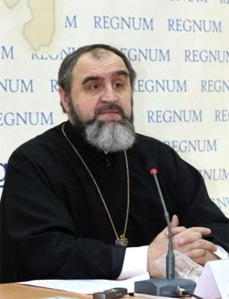
Fr. Dmitro Sydor

Fr. Dmitro Sydor

In 2008, some activists unsuccessfully attempted to declare a “Republic of Carpathian Ruthenia.” Those involved were later sent in for questioning by the Security Service of Ukraine for challenging “state integrity.” They included Fr. Dmitro Sydor, a Mukachevo-born priest of the Ukrainian Orthodox Church (Moscow Patriarchate) and chairman of the Congress of Carpathian Ruthenians. The main goal of the Congress is to achieve autonomy for the region. In March 2012, Sydor was found guilty for violation of the territorial integrity of Ukraine. He was sentenced to three years imprisonment with a suspended sentence of two years.

Politically, the region’s leanings have been mixed. As referenced earlier, Zakarpattia’s electoral politics is more like that of a Central Ukrainian than a Western Ukrainian region. The Party of Regions managed to carry Zakarpattia in the 2012 Ukrainian parliamentary election, contesting it heavily with Tymoshenko’s Batkivshchyna Party and the centrist United Center Party which draws its main base of voters from this region. In the 2010 presidential election, Tymoshenko won Zakarpattia, but by a very narrow margin against Yanukovych.

Meanwhile, the substantial Hungarian minority of Zakarpattia remains at a crossroads. Successive Hungarian governments have made a point to defend Magyar minority rights in neighboring countries. The Hungarians of Zakarpattia were no exception, and to this end, Hungary’s Viktor Orban supported of former Ukrainian President Yanukovych who placed great emphasis on protecting linguistic rights.

Since the Euromaidan revolution, the local Hungarian community has been uneasy and has viewed the influence of the far-right in the government as a serious concern. Among other things, local Hungarians were concerned about the initiative by the government (since abandoned) to scrap Ukraine’s regional language law.  Fortunately, in the wake of the unrest in Eastern Ukraine, the Turchynov-Yatsenyuk government has announced that it will allow for enhanced linguistic rights in the various oblasti.  Also, the Orban government in Budapest has opened the door in recent years for Hungarians abroad to receive Hungarian passports. This has been very significant for Hungarians in Zakarpattia, wary of nationalism in Ukraine and eager for jobs in the EU.

It is still unclear what full impact the Maidan revolution will have on the Rusyns. The region is currently governed by a member of the Batkivshchyna party appointed by the Turchynov-Yatsenyuk government. However, there is uncertainty with regard to how influential Kiev is in this region and how much support it has. It is very likely that most of the people here would favor a new federal constitution for Ukraine which would finally give them their long-desired autonomy. Yet, as always, what happens next remains to be seen.

UPDATE (13 June 2014): Watch rare footage of life in Zakarpattia/Carpathian Rus’ in interwar Czechoslovakia from the Czech National Film Archive here!

Who Governs What in Ukraine?

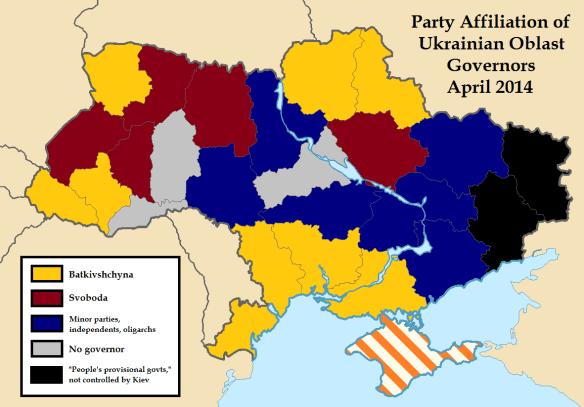
As events continue to unfold in Eastern Ukraine, there remains the question of who is governing the rest of the country. Following the overthrow of Yaukovych, the Turchynov-Yatsenyuk government appointed new regional governors across most of Ukraine. Their political affiliations are diverse and reflect the very hodge-podge and unstable nature of the present government. Herein is an oblast-by-oblast breakdown of who governs what in Ukraine, with an accompanying map. Overall, local leadership in the country can be broken down into five categories:

Party Affiliation of Ukrainian Oblast Governors, April 2014

Party Affiliation of Ukrainian Oblast Governors, April 2014

Batkivshchyna Party: The party of Turchynov, Yatsenyuk, and Tymoshenko governs eight oblasti. These include Volyn, Ivano-Frankivsk, and Zakarpattia in Western Ukraine, Chernihiv and Sumy in Central Ukraine, and Odessa, Nikolayev, and Kherson in Southern Ukraine. It is unclear how much authority Batkivshchyna wields in these regions. In Western Ukraine, the far-right group Right Sector was influential in Ivano-Frankivsk, where it has conducted fascist-style parades in March (though its credibility there is now reportedly on the decline). In Southern Ukraine, there is a growing movement in the Odessa oblast to overthrow the Batkivshchyna governor and to declare a “provisional people’s government” as was done in Donetsk and Luhansk in the Donbas. In the remote westernmost oblast of Zakarpattia, the Carpatho-Rusyns have been advocating regional autonomy since Ukraine’s independence in 1991. It is unclear what the current situation is there and how much genuine control Batkivshchyna has over this mountainous region.

Svoboda Party: The far-right Svoboda party is led by Oleh Tyahnybok who is known for his antisemitism, Russophobia, and admiration for wartime Nazi collaborator, Stepan Bandera. The Turchynov-Yatsenyuk government has granted Svoboda party members the governorship of five oblasti. These include three oblasti in Western Ukraine (Lviv, Ternopil, and Rivne) and two Central Ukrainian oblasti where Svoboda has historically had very little popular support (Zhytomyr and Poltava). It is unclear how much influence Svoboda’s militant ideological ally, Right Sector, has in these regions. However, it appears that there is some. Prior to his death in a shootout with police with the aid of the Kiev government’s interior ministry, Right Sector activist Oleksandr Muzychko seemed to have significant influence in the Svoboda-controlled Rivne oblast. This was particularly the case in the power vacuum that developed after Yanukovych fled the country following threats by Right Sector activists. A notorious war criminal, Russophobe, and antisemite, Muzychko (nicknamed Sashko Bilyi by his followers) was famously caught on video bullying and assaulting a local prosecutor in Rivne, shouting expletives at him, and threatening to pull him to Maidan with a rope around his neck.

It is unclear though if Muzychko’s assassination indicates a split between Svoboda and Right Sector. Though ideological allies, both seem to be vying for the position of “Ukraine’s true far-right.” To this end (and to seize power), both are attempting to expand their voter base by trying to appear “more moderate.” At first glance, this appearance of such a sudden embrace of centrism seems like a miracle akin to St. Paul falling off his horse on the Road to Damascus. Except, unlike St. Paul, there is nothing “saintly” about sinful scoundrels and antisemites like Muzychko, Oleh Tyahnybok, Dmytro Yarosh, and others whose politics can be best classified as “to the right of Genghis Khan.” These individuals and groups are just as extremist as they have always been. Western commentators must not be fooled. Israel certainly was not. In February, Right Sector attempted to persuade the Israeli ambassador to Ukraine that they were “not antisemetic.” Tel Aviv was unimpressed, so much so that it abstained from the UN vote on Crimea, much to the surprise and frustration of Washington.

Minor parties, independents, and oligarchs: In six more oblasti, the Kiev government has appointed minor party politicians, independent candidates, and oligarchs. These include the three Central oblasti of Kiev, Kirovograd, and Vinnytsia, the Eastern oblast of Kharkiv, and the two Southern oblasti of Zaporizhia and Dnipropetrovsk which once comprised the core of Nestor Makhno‘s breakaway anarchist “Free Territory” during the Russian Civil War of 1917-22. Two independent-oligarch governors were also appointed in the Donbas (Donetsk and Luhansk) but were overthrown in the recent unrest there. These Kiev-installed governors now effectively have no authority in these regions. Further, in the Kiev oblast, Right Sector has attempted to exercise some influence. In the Kiev suburb of Vasylkiv, Right Sector activists seized control of the town council amid protests shortly after Yanukovych’s overthrow. On the whole though, both Right Sector and Svoboda maintain much more influence in Western Ukraine. In regional elections, the far-right has always fared poorly in Central Ukraine.

No governors: Meanwhile, there are presently no governors at all in two Central Ukrainian oblasti (Cherkasy and Khmelnytsky) and one Western oblast (Chernivtsi).  Khmelnytsky and Chernivsti straddle the Central-West divide in terms of culture, language, and electoral politics.

Self-declared people’s provisional governments: In the Donbas, protests against the Turchynov-Yatsenyuk government have led to the declarations of “People’s Republics” with “provisional governments” in the oblasti of Donetsk and Luhansk. The Kiev-appointed governors have effectively lost authority in these regions which are practically controlled entirely by the rebels. Kiev claims that the rebels are “agents of Moscow.” Moscow disavows any involvement. In truth, there are Russians who are involved in the Eastern Ukrainian unrest, but these are not “government agents” but rather Russian nationalists who seek to assist their “compatriots” from across the border. On the whole though, much of the frustration leading to the unrest appears to have come from a genuine rejection of the Turchynov-Yatsenyuk government. To exclude any discontent among the people of Eastern Ukraine with the government in Kiev assumes that Ukraine and its Eastern oblasti specifically have no domestic concerns. In fact this is not the case. Kiev has been unable to assert control in this region. There was an attempt to do so this week by military means, prompting commentators’ fears of the start of a civil war. In the end, the troops from Kiev refused to fire on their East Ukrainian compatriots. Some simply drove away, while others defected to the rebels’ side. Meanwhile, there is a possibility that more “provisional governments” could appear in other Southeastern and even Central Ukrainian oblasti. Already in Odessa, there has been talk of a possible proclamation of an “Odessan People’s Republic” with “People’s Provisional Government of Odessa.”

A presidential election alone would not likely remedy this situation. Parliamentary elections, in which these distinct regions are properly represented, are a reasonable immediate solution to this current chaos.