Social Democracy, Not Nationalism, Is What Ukraine Needs

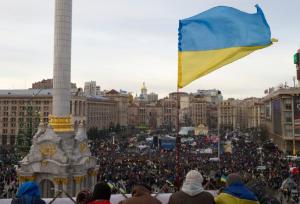
Ukrainian protestors in Kiev (AP/Ivan Sekretarev)

Ukrainian protestors in Kiev (AP/Ivan Sekretarev)

In a recent op-ed in The New Republic, Pulitzer Prize-winning author Anne Applebaum wrote that “nationalism is exactly what Ukraine needs” and that “the tiny group of nationalists in Ukraine… represent the country’s only hope of escaping apathy, rapacious corruption, and, eventually, dismemberment.”

I would respectfully beg to differ.

Nationalism is not what Ukraine needs.

The former Soviet Union has already had enough Gamsakhurdias, Tyahnyboks, and Zhirinovskys. Controversial individuals like these, claiming to act in the interests of “their nation,” cause too much instability and chaos. Their chauvinistic discourse, provocations, and insular ideologies only divide, not unite, people. Consequently, if nationalism is encouraged in Ukraine, it has a high likelihood of only dividing the country even more. Already extreme nationalist groups, like Right Sector (Praviy Sektor) and Svoboda, have alienated the majority of the people in the Southeast, a good number of people in the Center, and yes, even some in the West too. In fact, in the Southeast, events like the recent tragedy in Odessa or the shooting in Mariupol, have only fueled a strong rejection of these groups among locals.

Ms. Applebaum also conflates the concept of nationalism with more inclusive civic patriotism. However, no Western journalist can change the fact that groups such as Right Sector are indeed far-right organizations whose actions have proved to be divisive among Ukrainians. Thus, nationalism is far from the solution to the problem, especially if the ultimate objective is a united Ukraine.

So, what does Ukraine really need? First, it needs leadership.

The average Ukrainian might as well throw up his or her arms when observing the choices (or lack thereof) from which they have to choose. From corrupt oligarchs to far-right thugs, where is the choice?

A future leader of Ukraine must rise above rampant corruption, a self-centered political elite, and political extremists. Such a leader should also work to unite the country and take into account the different interests of all Ukrainians, whether they speak pure Ukrainian, Surzhyk, Carpatho-Rusyn, or Russian. Invoking divisive nationalist rhetoric will not serve to bring the people together. A true leader of Ukraine would be required to balance everybody’s views and outlook.

A future leader should also be an idealist, ready to work for reform. Not IMF-style “shock therapy” austerity reform, but real, genuine social reform. This would be social democracy.

What Ukraine, Russia, and all former Soviet countries need is not wild card, run-amuck capitalism in which wealth is concentrated in the hands of a few rich oligarchs and corrupt politicians. Instead, they need true, genuine social democratic systems. Such systems would ensure democratic rights, free elections, and free speech for all citizens. At the same time, capitalism would be controlled, balanced by a system of social welfare and social justice. After all, how can democracy truly be “democratic” if the majority of the population is disenfranchised? The people of Ukraine and the former USSR need a voice and social democracy can grant it to them.

Finally, attaining social democracy is also something that Ukrainians fundamentally must accomplish for themselves. Certainly, the EU cannot solve Ukraine’s problems. They are still dealing with a major financial crisis and have been unable to curb corruption and bad governance in new member states like Croatia, Hungary, Bulgaria, and Romania. If the EU was indeed the “panacea of democracy” as it is so often presented, then why do these countries still have corrupt and inefficient governments today?

Consequently, it is only up to Ukrainians to pull themselves together and to solve their own issues. Social democracy, not nationalism, can unite the country and move it forward.

Odessa: A Ukrainian Tragedy

Odessa's celebrated Potemkin Steps, once the scene of Sergei Eisenstein's famed 1925 Soviet classic, The Battleship Potemkin. (Palmyra.od.ua)

Odessa’s celebrated Potemkin Steps, once the scene of Sergei Eisenstein’s famed 1925 Soviet classic, The Battleship Potemkin. (Palmyra.od.ua)

Odessa is a beautiful, theatrical city, renown for its humor, wit, culture, and charm. Yet, at the same time, it is also a city that has experienced much pain and tragedy in its history. Since the horrors of World War II, who would have guessed that nearly 70 years later, the people of this celebrated “St. Petersburg of the south” would again have cause to mourn?

It is beyond doubt that the 2 May massacre in Odessa was a turning point for the crisis in Ukraine. Last Friday was a painful day of mourning for a country that is already on the brink of catastrophe. One might expect that such grief would lead toward greater unity within the country and perhaps pave the way for a rational, constructive dialogue toward peace.

Instead, the massacre has only hardened opinions in Ukraine. Throughout the southeast, including Odessa, popular anger and opposition to the Turchynov-Yatsenyuk government is currently on the rise. In Central Ukraine and Kiev, public opinion over the tragedy is divided. In Western Ukraine, while many have expressed sorrow for the deaths, the popular stance largely does not want to fully explore what happened in Odessa.  The involvement of the pro-Kiev activists is downplayed and “pro-Russian provocateurs” are blamed instead.  According to one observer in Western Ukraine, the reaction from some in the West on social media has been “less than compassionate” and “even hubristic.”  Further west, in the remote Rusyn-speaking oblast of Zakarpattia, popular reaction to the tragedy in Odessa is unclear.  Meanwhile, as tensions rise, Odessa’s historic Jewish community, which had been experiencing a cultural and religious revival in recent years (including a Yiddish language revival), is planning to evacuate the city en masse.

In the United States, mainstream media networks like ABC, CNN, and Fox have practically ignored the massacre. In the rare case that it is mentioned, the question of responsibility is always vague. Official Washington offered its condolences on Saturday in the same manner, without naming any perpetrators. Later, though the US Ambassador in Kiev Geoffrey Pyatt admitted in an interview with CNN that there was no evidence of a Russian role in the massacre.

Frank-Walter Steinmeier (Frank-walter-steinmeier.de)

Germany’s Frank-Walter Steinmeier has called for fresh talks to de-escalate the crisis.  (Frank-walter-steinmeier.de)

In Germany, opposition to the events in Ukraine as well as a desire for a resolution to the crisis are growing. One member of the ruling Christian Democrats stated that Germany “should stop being a servant of the Americans” and that confrontation with Russia over Ukraine was “blind to history and deaf to the other side.” Meanwhile, Germany’s Social Democrat Foreign Minister Frank-Walter Steinmeier called for a new round of Geneva talks.  A veteran diplomat, Steinmeier has stated that the new talks will “send a ‘strong political signal’ that previous agreements will be implemented.” The plan now has the backing of Chancellor Angela Merkel.

Russia’s response to Odessa has been remarkably reserved. Moscow condemned the massacre in very strong terms and the State Duma has demanded a probe into the tragedy. However, Russia has refrained from intervening directly in Ukraine, despite anger in Moscow and pressure by hardliners in the Kremlin to invade.

It is undeniably apparent that Right Sector and far-right football fans known as the “Ultras” were singularly responsible for what happened in Odessa. On YouTube, footage has emerged showing the nationalists starting the fire and later shooting anti-Kiev activists who attempted to leave the burning building.

The Turchynov-Yatsenyuk government has sought to downplay the massacre, instead expressing very general “sorrow” for the victims and emphasizing the clashes that preceded it between supporters and opponents of the government. In every case, they are quick to blame the initial clashes on “pro-Russian provocateurs.” During his visit to Odessa, Prime Minister Yatsenyuk reiterated the same script, though also blaming the security services for not stopping the violence.

Yatsenyuk also pledged a de-centralization of powers to the oblasti and to this end, a bill for a nationwide plebiscite on the issue has been registered at the Ukrainian Rada. Yet people living in Ukraine’s southeast are skeptical. The government has announced vaguely-worded “de-centralizations” in the past, but these were ultimately never realized. In a much less calculated move, the government has also dispatched a special all-volunteer battalion of Kiev’s National Guard to Odessa. It is doubtful that such a move will help de-escalate tensions and build confidence in this part of Ukraine. Opposition to the government runs high in Odessa.  Some have even gone so far as to refer to the massacre as an act of “genocide.” Meanwhile, the “anti-terrorist operation” continues in Eastern Ukraine, which is now effectively in a state of war with Kiev.

Overall, anxiety and apprehension remain high throughout Ukraine in the aftermath of the Odessa massacre. If social media is any indication, it demonstrates that people throughout the country have fundamentally different views and interpretations of the event. Dialogue is extremely important to restoring order and peace, but it is increasingly being supplemented by a discourse of “my interpretation is better than yours” and even worse “us vs. them.” In the backdrop of all this is a fast deteriorating socioeconomic situation and the near-bankruptcy of the country. Ukrainians together need to emerge with white flag in hand to set aside their differences and engage in a serious, meaningful dialogue to find solutions to their problems. War, no matter what, should never be an option.

The Myth of the European Panacea

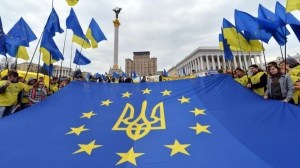
The EU flag was a prominent symbol of Ukraine's Euromaidan (img.pravda.com.ua)

The EU flag was a prominent symbol of Ukraine’s Euromaidan (img.pravda.com.ua)

Capitalism hit the former Soviet Union very hard in the 1990s. That was the Boris Yeltsin era of “shock therapy” wherein the economic ideas of Larry Summers, Jeffrey Sachs, and others transformed the countries of the former USSR from state-dominated economies with capitalist elements to the capitalism of the wild, unregulated sort. The results of such a severe and rapid transition were disastrous for these countries, socially, politically, and economically. The ramifications of those years are still felt throughout much of the former Soviet space today, both directly and indirectly.

In Russia itself, the “shock therapy” brand of capitalism was implemented with aid from American advisors such as Sachs and by “democratic” Russian “reformers” like Yegor Gaidar, Anatoly Chubais, and others.  Their subsequent “reforms” plunged approximately 75% of Russians into poverty and reversed many of the country’s hard-won 20th century achievements, becoming, in the words of Russian scholar Stephen F. Cohen of NYU, “the first nation ever to undergo actual demodernization in peacetime.” It changed public perceptions with regard to the West. If there were many Russians in 1991-92 who were supportive of the basic idea of having democracy, the years of “shock therapy” created a desire for much-needed “stabilnost” and caused many to view the West as primarily responsible for such a terrible economic catastrophe.

Similar rapid transitions to market economies occurred throughout the former Soviet sphere, leaving legacies of entrenched oligarchies, monopolies, economic disparity, poverty, bad business environments, and most of all, corruption. For the citizens of former Soviet states like Ukraine, Georgia, Moldova, and Armenia, the EU and its Eastern Partnership program appear to be effective remedies to finally “cure” their economies of these diseases once and for all. The reputation of the EU for its rules, regulations, and carrot-and-stick initiatives seemed to be a cure-all solution to many.

“Like hopeless alcoholics, we are trying to toss ourselves into a rehab, where caring Europeans will cure us from the addiction (in our case – corruption),” wrote the Armenian comedian Sergey Sargsyan. Indeed, corruption remains a very serious problem for all four of the Eastern Partnership states that sought deeper ties with the EU, with Georgia ranking 55, Armenia 94, Moldova 102, and Ukraine 144 on the 2013 Corruption Perceptions Index of 177 countries (CPI) by Transparency International.  The issue of corruption is especially serious in Ukraine where the oligarchy and the political elite, from Tymoshenko to Yanukovych, have robbed the country and its people into bankruptcy.  Consequently, the EU is viewed as a panacea, a “symbol” for the hope of a better future.  In the words of Mark Adomanis and Luka Orešković with regard to Ukraine specifically:

Given Ukraine’s omnipresent corruption, the lack of legal security and, most importantly, the country’s economic implosion, it is not surprising that many citizens would latch onto a symbol (“Europe”) that is associated with all of the things that the country itself lacks. Throughout Ukraine, Europe is popularly identified with economic prosperity, transparency, democracy, and the rule of law, with the possibility of living a “normal life” of dignity and material security.

In contrast to the EU, the Moscow-backed Eurasian Union at face-value appears to offer little, especially with regard to combating corruption. With a CPI ranking of 127, corruption is widespread in Russia, though the Kremlin does realize the gravity of the issue and has been trying to fix it in recent years. Still, the continued presence of corruption combined with oligarchic monopolies, has likewise made opportunities for independent businesses and entrepreneurs very difficult. Together, these issues stifle real economic growth and potential and pose a serious challenge to competition, innovation, and entrepreneurship. Additionally, the fact that much of Russia’s economy is also based on non-renewable natural resources has also raised very serious concerns.

“The main reason why many Armenians are not crazy about joining the Russian Customs Union is not the Russian people, culture, literature, or cuisine,” wrote the Armenian comedian Sergey Sargsyan. “The problem is corruption.”

Despite this, Russia is remarkably holding its own. The Kremlin managed to pay off much of its foreign debt from the 1990s. Moscow’s economy is also currently growing much faster than that of the EU. Additionally, the birthrate of the once “dying Russia” has also bounced back and is on the rise, not only in national autonomous republics like Chechnya, but also deep into the Slavic Russian heartland as well.

Still, is the EU a viable alternative solution to these countries’ economic woes?  It is true that the Europeans would undoubtedly implement their rules, regulations, and carrot-and-stick reforms on these countries. However, by placing their hopes on the EU, which is still limping along from the devastating 2008 Eurozone crisis, these countries are staking their fate on a supranational union that cannot bring them any serious promises of lasting economic prosperity and stability. In November 2013, the noted American Economist Paul Krugman wrote in The New York Times that his…

…joke slogan for Obama has been, ‘It’s not as bad as the Great Depression!’ But Europe can’t even claim that. At this point it’s just as bad as the Great Depression — and where European economies were recovering strongly by this point in the 30s, they’re stalling now. Doing worse than the 30s; that’s a remarkable achievement.

Indeed, by investing so much hope in an entity as economically unstable as the EU, the people of the ex-Soviet states “run the risk of being sorely disappointed with their ‘civilizational choice’” in the manner that ordinary Russians were sorely disappointed with capitalism in the Yeltsin era of the 1990s.  There is also no guarantee that the corruption issue has been completely solved either.  In Bulgaria and Romania for instance, corruption remains particularly widespread. Even more interesting, according to the 2013 CPI report, non-EU member Georgia actually ranked higher on transparency than not only Bulgaria and Romania, but other EU members such as Croatia, the Czech Republic, Slovakia, Italy, and Greece. Meanwhile, Armenia and Moldova rank higher than prospective EU member Albania! Further, according to Adomanis and Orešković:

The three most recent entrants to the EU (Bulgaria, Romania, and Croatia) have performed terribly since the onset of the financial crisis. Croatia, in particular, has seen no economic growth for the past seven years.  After many years of painstaking reform, per capita incomes in these countries are still less than 40% of West European averages. Even more alarmingly, these three countries have almost entirely stopped converging with the “old” EU members in the West.

In spite of all this, both politicians and citizens in the former Soviet Union seem completely sold on the vision of the “European paradise.” At Ukraine’s Maidan, some activists even believed that “in Europe there is no police brutality.” Apparently, they have never been to Greece, Spain, Portugal, Italy, Bulgaria, or France.

Joining the EU at this point will likely not bring about the long-desired dream of economic prosperity. In fact, it could become potentially destabilizing, especially for a country as large and diverse as Ukraine with an economy that, if not near bankruptcy, is already bankrupt.  That said, as unrest continues in Ukraine, ordinary Ukrainians must consider the question, “should we rely on the EU to help us out of our situation, or is up to us, the Ukrainians alone, to create a better future for ourselves?”

Russia Betrayed?: Voices of the Opposition: A Documentary Film

Here is a must-see prophetic film, especially in light on the continuing crisis in Ukraine.

Produced by Rosemarie Reed on the eve of the 1996 Russian presidential election, it is entitled Russia Betrayed?: Voices of the Opposition. The film includes interviews between Russian scholar Stephen F. Cohen and oppositionists Aleksandr Lebed, Aleksandr Rutskoi, Grigory Yavlinsky, and Gennady Zyuganov. Most interesting are the portions of the film that touch upon Russian foreign policy, Russian-American relations, and NATO expansion.

Watch the entire film in four parts below, presented with permission of the filmmaker:


How Moscow Views the Ukraine Crisis

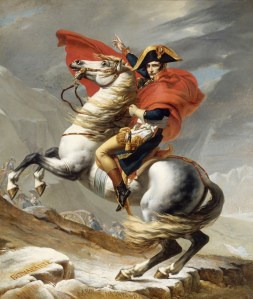
Bonaparte Crossing the Grand Saint-Bernard Pass by Jacques-Louis David, 1800.  The historical memory of the Western invasions of Russia (including the Napoleonic invasion of 1812) still affects Russian perceptions of the West today.

Bonaparte Crossing the Grand Saint-Bernard Pass by Jacques-Louis David, 1800. The historical memories of the West’s invasions of Russia (including the Napoleonic invasion of 1812) still loom large in the Russian consciousness.

Throughout the ongoing Ukraine crisis, few Western commentators and/or observers have considered Moscow’s view of the situation. In the Western media, the prevailing image is that Russia is an aggressor, intent on dominating its neighbors. Western influence is presented as “positive.” Russian influence as “negative.” Joining the EU is depicted as being a road to economic and social prosperity and NATO is offered as a defensive bulwark against the “terrible” Kremlin. Remarkably, at least in the United States, liberals and conservatives are singing the same song. Further, the discourse of “invasion,” “occupation,” “aggression,” and “World War III” is hardly diplomatic. How does anyone believe that negotiations can ensue when such language is thrown about?

By contrast, in Moscow, the view of the situation in Ukraine is entirely different. It perceives the West as encroaching on countries to which it has been very closely associated. Ukraine (the entire country, East, South, Central, and even West), along with Belarus, is viewed as a fraternal East Slavic nation to which Russia is intimately bound. The capital Kiev is regarded by all Russians as the “mother Russian city,” the common point of origin for all East Slavs. To view Kiev within the boundaries of the EU and NATO is more than just a violation of a sphere of influence.  To the Russians, it is almost sacrilege.

Meanwhile, it does not help that some of the most vocal advocates for Ukrainian membership in the EU and NATO come from countries that Russia perceives as historical invaders. They include Poland and Sweden, the co-founders of the Eastern Partnership program that sponsored the Ukraine-EU Association Agreement. Both countries have a history of animosity toward Russia, but it is Poland in particular that Moscow views as being one of the chief advocates for Western expansionism.

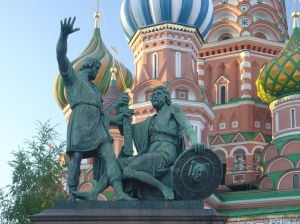
Minin and Pozharsky Statue in front of St. Basil's Cathedral, Moscow (Kotomka)

Minin and Pozharsky Statue in front of St. Basil’s Cathedral, Moscow (Kotomka)

We in the West regard Poland primarily as the victim of Russian aggression, particularly communism. We reflect on Russia’s participation in Poland’s partitions, its suppression of Polish uprisings, the Polish-Soviet War, the Molotov-Ribbentrop Pact, the Katyń massacre, and the establishment of communist Poland. Conversely, to a Russian with a sense of history, Poland is perceived as a historical invader, a country that during the Time of Troubles in Russia (1598-1613) supported the Tsar-pretender “False Dmitriy,” attempted to bring Catholicism to Orthodox Russia, and eventually invaded and occupied Moscow in 1609. That invasion was repelled in 1612 by the duo of Kuzma Minin and Dmitriy Pozharsky, whose statue stands today in front of St. Basil’s in Moscow.

Even in more recent times, Russians recall that it was Poland’s Marshal Piłsudski who, during the Polish-Soviet War of 1919-21, not only tried to ensure the freedom of Poland, but also sought to annex to Poland large swathes of Lithuania, Belarus, Ukraine, and Western Russia to restore the Polish-Lithuanian Commonwealth of old. Piłsudski is still admired by some in Poland today, including members of the political elite such as the late Polish President Lech Kaczyński and his twin brother, Jarosław. He is also greatly admired by former Georgian President Mikheil Saakashvili.

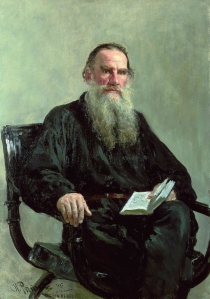
Russian author Leo Tolstoy in a portrait by Ilya Repin, 1887.

Russian author Leo Tolstoy in a portrait by Ilya Repin, 1887.

Russians likewise recall Polish participation in the Napoleonic invasion of Russia. In Leo Tolstoy’s War and Peace, it is the Polish legion that is depicted as being the most fanatically supportive of an expansion toward Russia, so much so that they drown in the River Viliya for Napoleon. Today, the Russians see very much the same thing, except that Napoleon is now replaced by NATO and that the Poles are now showing their loyalty, not by drowning in the Viliya, but by asking for NATO troops to be stationed in their country.

In another Tolstoyan parallel, Moscow also likely views the Ukrainians who protested on the Maidan as being the modern equivalents of the muzhiks of War and Peace. It was the muzhiks who rose up against their oppressive landlords for Napoleon, who they viewed as the embodiment of the French revolutionary ideals of liberté, égalité, et fraternité. Today though, the modern landlords are Ukraine’s corrupt political elite and oligarchs, while the liberal ideals of Napoleon and revolutionary France are today the liberal ideals of Brussels and the European Union. Moscow regards the latter ideals in 2014 just as they regarded Naopleon’s ideals in 1812 – that is, as false promises motivated only by geopolitical ambitions rather than by any genuine sense of altruism.

Given this, it would be wise to recall history before permitting the rhetoric to get too out of control.

Abashidze-Karasin Meeting Today

Georgia's Special Representative for Relations with Russia Zurab Abashidze (Tabula)

Georgia’s Special Representative for Relations with Russia Zurab Abashidze (Tabula)

Today, Georgia’s special envoy to Russia, Zurab Abashidze, will meet with his Russian counterpart Grigory Karasin in Prague to discuss bilateral relations between the two countries and to lay the groundwork for a future meeting between Russian President Vladimir Putin and the Georgian political leadership, the first such meeting since 2008.  The Abashidze-Karasin summit was  originally scheduled for March 4-5 but was postponed twice.

The stakes are relatively high for both Tbilisi and Moscow. From a geostrategic perspective, Moscow specifically needs Georgia as part of its planned Eurasian Customs Union. Not only would it geographically link Russia with prospective Eurasian Union member Armenia, but it would also discourage further Western efforts to expand its geopolitical and energy interests into former Soviet territory. Political circles in the West, and particularly Washington, view Georgia as a critical part of its efforts to gain access to natural gas and oil reserves in the Caspian basin and Central Asia.

Moscow views this expansion as a threat to its security. Consequently, Russia has been reaching out to Georgia in recent months. Its efforts include both Medvedev’s August  invitation to Tbilisi to join the Eurasian Union and Putin’s friendly comments toward Georgians during his December press conference. In the meantime, the West has been also reaching out to Georgia, expanding the presence of the EU and NATO, and taking advantage of the fact that Georgia has not yet fully restored its relationship with Russia.

Bidzina Ivanishvili (RFE/RL/Mzia Saganelidze)

Bidzina Ivanishvili (RFE/RL/Mzia Saganelidze)

The post-Saakashvili Georgian Dream government kept the pursuit of the both the EU and NATO on the table, likely as leverage in its relations with Moscow. The major force behind the party, billionaire Bidzina Ivanishvili, is a patriot in his own right who can be best described as neither pro-Western nor pro-Russian, but pro-Georgian. Whoever can offer Ivanishvili, and by extension Georgia, the best deal, Tbilisi will accept. So far, the West recently increased its efforts to bring Georgia fully into its camp. It has moved up the date of Georgia’s planned signing of the EU Association Agreement to June and has discussed the possibility of granting Georgia a NATO MAP (Membership Action Plan) at the next NATO summit in Wales in September. Yet, unlike his predecessor Saakashvili, Ivanishvili and his party have not ruled out the Russian option completely.  In September 2013, just six days after neighboring Armenia formally reversed its course on its EU Association Agreement in favor of Eurasian Union membership, Ivanishvili announced that Georgia too may consider joining the Moscow-backed union “if it will be advantageous for our country.”

In plain Georgian, this means that if Moscow wants to see Georgia join its Eurasian Customs Union, then Georgia needs to be enticed to join. Tbilisi will not accept any solution that would involve forgoing claims to its breakaway territories, Abkhazia and South Ossetia. Significantly, Ivanishvili and others in his Georgian Dream party have placed more emphasis on Georgian unity than any other issue. For Georgians, the unity of their state, including all of its historic and ethnically distinct regions is a top priority, even more so than EU or NATO membership.

Irakli Gabribashvili (Government.ge)

Irakli Gabribashvili (Government.ge)

In a December interview with Eduard Shevardnadze’s granddaughter Sophie Shevardnadze on the Moscow-backed news service RT, Georgia’s new Prime Minister Irakli Gabribashvili, expressed his sadness at the present situation vis-a-vis Georgia’s breakaway regions. While acknowledging the mistakes of Georgia’s earlier post-Soviet governments, Gabribashvili stated “we are hurt because our Abkhazian and Ossetian brothers no longer live with us.” He also stated that “if, as a hope – I am quite optimistic about this issue – the Russian government decides one day to reset relations with Georgia by means of peaceful conflict resolution, it will be the best case scenario.”

Consequently, only a peace deal between Georgia and its breakaways involving a federal solution would be the best possible outcome, satisfying all parties in the dispute. Such a solution would ensure Moscow’s security in the region, the unity of the Georgian state, and, most importantly, the ethnic rights of the Abkhaz and the Ossetes.

However, if Moscow tries to entice Georgia to join the Eurasian Union without any incentive for a peace deal on its breakaway regions, then the situation could become very dangerous. If Tbilisi were to make a U-turn on the EU and NATO without any significant concessions from Moscow, then Euromaidan-style civil unrest could break out in Georgia, led by Saakashvili’s party, the United National Movement (UNM). Kiev-style violence and unrest is especially concerning for a country like Georgia, which experienced a very violent civil war in the 1990s. If the UNM were to launch a revolt in Tbilisi, succeed in overthrowing the potentially friendly Georgian Dream government, and replacing it with a staunchly pro-Western nationalist government, then it would be a geopolitical nightmare for Moscow.

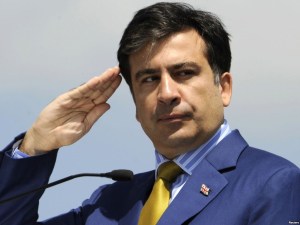
Former Georgian President Mikheil Saakashvili (Reuters)

Mikheil Saakashvili (Reuters)

Already the Georgian government is taking precautions in the case of such an eventuality. Prosecutions and questionings of UNM lawmakers and activists, including former President Saakashvili, on various unresolved controversies have increased in recent weeks. Also, Georgia’s Interior Ministry recently spoke of concerns with regard to UNM launching a Maidan-style revolution. Prime Minister Garibashvili has responded by declaring that “no one will dare to stir destabilization in this country while we are in the government” and that “if anyone has any such desire or attempt, they will be strictly punished.”  Indeed, in light of the recent Ukraine crisis, the UNM has become increasingly aggressive, nationalistic, and Russophobic, calling for sanctions against Russia by Georgia, an end to any diplomatic communication with Moscow, and for denial of “Russian aggression against Georgia” to be criminalized. From his base in Ukraine as an advisor to the Yatsenyuk government, Saakashvili has been particularly provocative, not only against his traditional enemy Russian President Putin, but also his domestic arch-rival Ivanishvili and the Georgian Dream government, which Saakashvili dismisses as “completely worthless.”

Certainly, the UNM could try to launch a Maidan-style revoltion even if Moscow does grant Tbilisi concessions on Abkhazia and South Ossetia. However, its effectiveness would be greatly diluted given its already declining popularity and the fact that a peace resolution on the two breakaways would seriously undermine their credibility even further among the Georgian public. Conversely, if Moscow attempted to entice Georgia into the Eurasian Union with no concessions on the breakaways, it would create an angry backlash in Georgian society on which the UNM could easily capitalize to launch a “Georgian Maidan” in Tbilisi. Saakashvili might even take advantage of this to restore his political career and return to the Georgian presidency in a coup d’état.

Given this, Russia has to very cautious and very prudent. The recognition of Abkhazia and South Ossetia back in 2008 has served its purpose by discrediting and neutralizing Saakashvili and by illustrating to the West the potential dangers of the Kosovo precedent.  Now Moscow has to consider its strategic priorities.  Specifically, Russia must ensure its security in the region as well as the overall stability of the Caucasus.

If Moscow can entice Tbilisi into its Eurasian Union, then this would be a major diplomatic success. If not, Russia will continue to be vulnerable to Western expansionism, not just in the Caucasus but in Central Asia as well.  Much of this depends on the outcome of tomorrow’s meeting as well as any future meeting between the Georgian and Russian leaderships. Already there are some concerns because a Georgian TV crew was detained yesterday for accidentally crossing the border into breakaway South Ossetia. Given Moscow’s concerns regarding Georgia, releasing these journalists should be a top priority, which in turn would build trust and confidence between both sides.

Conversations with Gorbachev: A Documentary Film

In light of the recent Ukraine crisis, there has been a renewed interest in the events surrounding the final years of the Soviet Union. This 1994 documentary, Conversations with Gorbachev, by Rosemarie Reed helps shed light on those events, from the first-hand perspective of former Soviet President Mikhail Gorbachev, interviewed by Professor of Russian and Soviet Studies at NYU and Princeton Dr. Stephen F. Cohen.

It also includes Gorbachev’s insights on reintegration in the post-Soviet space and his support for the basic concept for a Eurasian Customs Union of former Soviet republics. When Dr. Cohen asks him “what do you think will be the reaction in the United States if any kind of new ‘larger Russia’ union, confederation, association begins to emerge?”, Gorbachev responds “But why? But why? But why is it that Washington ought to decide what relations there should be between the former republics of the Soviet Union?”

Watch the entire film in four parts below, presented with permission of the filmmaker:


How to Defuse the Ukraine Crisis

Below are ten basic provisions that I believe may ameliorate not only the Ukraine crisis but also the broader tension that currently exists between Russia and the West. Not all readers will agree entirely with these positions, but hopefully they will become a starting point from which to defuse the situation, proceed forward, and create mutually friendly, not hostile, relations among all parties:

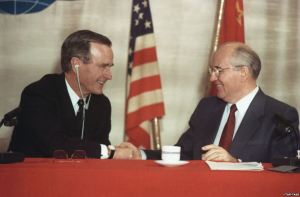
George H.W. Bush and Mikhail Gorbachev in Malta in December 1989 (ITAR-TASS).  The Bush administration informally promised Gorbachev that NATO would not expand "one inch" beyond East Germany.  The promise was never fulfilled.  To defuse the ongoing Ukraine crisis, a formal, written promise not to expand NATO by Washington to Moscow would do much to build mutual trust and confidence between both countries.

George H.W. Bush and Mikhail Gorbachev in Malta in December 1989 (ITAR-TASS). The Bush administration informally promised Gorbachev that NATO would not expand “one inch” beyond East Germany. The promise was never fulfilled. To defuse the Ukraine crisis, a formal, written promise not to expand NATO by Washington to Moscow would do much to build mutual trust and confidence between both countries.

1. The West and Russia should drop any mutual sanctions or restrictions against one another.

2. In order to encourage mutual trust, Moscow and Washington should make an unambiguous, official agreement prohibiting further expansion and encroachment of NATO into the former Soviet republics. Such an agreement must be clearly articulated in a written document, unlike the informal promise not to expand NATO made by US officials to former Soviet President Gorbachev in the 1990s.

3. The United States must promise to cancel the planned missile defense shield in Poland and the Czech Republic.

4. The United States should recognize Russia’s interests in the former Soviet states, including at least verbal support by Washington for the Moscow-based Eurasian Union, provided that it does not expand beyond the boundaries of the former Soviet states.

5. On Crimea, Washington, Brussels, and Kiev should recognize and accept Russia’s incorporation of the peninsula. This may be a difficult step to take, but the West and the Yatsenyuk government have to acknowledge that the area is demographically and historically Russian, and that it is home to Russia’s Black Sea Fleet. Moscow will not reverse this action and any attempts to force Russia to do so would be counterproductive. Therefore, Washington, Brussels, and Kiev should recognize the reality that Crimea is effectively part of Russia.

6. On Ukraine, both Moscow and Washington should express a desire to see Ukraine proper united and indivisible, and to adopt either an oblast-by-oblast federal system or a decentralized unitary system. Ukraine should declare military neutrality and should pursue integration into the Eurasian Customs Union based on Ukraine’s logical and historic economic ties with Russia; notwithstanding the fact that the EU economy currently cannot manage Ukraine. If Brussels were to bring in Ukraine, it would seriously threaten the stability and unity of the EU and would unravel the progress made over the decades of forging a united Europe. Both Russia and the EU should cooperate on helping Ukraine to strengthen its economy and state institutions by challenging the stranglehold of the Ukrainian oligarchs.

7. Given the fact that many Moldovan citizens are already EU citizens via Romanian passports, and that Moldova is becoming increasingly integrated with the EU, Moscow should recognize Moldova’s pro-European orientation.  In turn, Chișinău should relinquish its claims to Transnistria.  Depending on the situation in Ukraine and the will of the people of Transnistria, the latter could then reunite with the former as part of the multiethnic, Russophone Odessa Oblast. The new division would occur along the River Dniester, with all Moldovan-controlled areas on the right bank of the river being ceded to Transnistria, and all Transnistrian-controlled areas on the left bank being ceded to Moldova. The remaining Moldovan state would proceed with EU integration, but would declare military neutrality and disavow any intention of reunification with Romania.  Its relationship with the latter would then become akin to the relationship shared between Germany and Austria.  Such a resolution would alleviate ethnic concerns within Moldova, particularly with the Gagauz.

8. On Georgia, Moscow should promote (with the support of Washington) a federal solution for Georgia as well, making Abkhazia and South Ossetia federal states within a unified Georgian republic. The process for this should follow roughly along the lines of the proposed plan that I posted earlier. Like Ukraine, this new united Georgian federal state should declare military neutrality and, for economic, historical, and geographic reasons, should integrate into the Eurasian Customs Union.

9. On Armenia and Karabakh, the solution to this particular issue should be in the principle of self-determination for the Karabakh Armenians, though this is just an opinion. The aggressive and threatening rhetoric and actions from official Baku have only alienated the Karabakh people. Notably, Baku has also consistently denied basic human rights to its own ethnic Azerbaijani citizens. Thus, such a regime could not be trusted to rule over the people of this region. Aside from this, in order for there to be a realistic and lasting solution to this problem, Azerbaijan must open its borders with Armenia and civil society contacts must be enhanced. Armenians and Azerbaijanis can get along, but not when they do not see or communicate with one another. In their common humanity, they will find that peace and coexistence are possible, but the borders must be open first. Turkey too must open its border with Armenia.

10. Both sides should agree on a gradual convergence of the West and Russia (along with the former Soviet states) in economic, political, and military spheres, thus ensuring that all parties are on the same page with regard to the future of the post-Soviet space and post-Cold War world in general. There are so many more important priorities that need to be solved in the world (Iran, North Korea, Syria, etc.). Russia and the West need to cooperate on these issues and must not be in conflict. Further, such a solution would effectively help to realize the long-term goal of a united and indivisible Europe. It would also go a long way toward building trust with Moscow, thus creating the conditions for Russia to deepen its democratic development endogenously.

Crimea and Karabakh: A Precedent in the Caucasus?

Map of Armenia and the self-proclaimed Nagorny Karabakh Republic (NKR) in the Caucasus

Map of Armenia and the self-proclaimed Nagorny Karabakh Republic (NKR) in the Caucasus

Previous posts on this publication have been devoted to Ukraine, Georgia, and Moldova. Today’s post shifts the focus on Georgia’s southern neighbor, Armenia. Like Georgia, Armenia shares a very strong sense of national pride, related to its unique art and culture as well as its centuries-old history. Also like the Georgians, Armenians are independent-minded and are generally adverse to Russian imperialism, though, again like their Georgian counterparts, they are also fond of the Russian culture and people. Indeed, Armenia is an ancient Christian country with a long tradition of statehood. The Christian faith arrived here via two of the original twelve apostles of Christ and in AD 301, Armenia became the first nation to officially adopt Christianity as its national faith. This had a profound impact on the development of Armenia’s cultural and literary traditions and resulted in the creation of the unique Armenian alphabet invented in the 5th century and written horizontally from left-to-right, thus indicating a Western orientation. At the same time, similar developments also profoundly affected Georgia, which also adopted a unique alphabet with a left-to-right directionality.

Armenia, along with Georgia, Ukraine, and Moldova, was one of four countries that actively participated in the Brussels-backed EaP.  Yet, on September 3, 2013, Yerevan made a sudden volte-face on signing its Association Agreement deal with the EU (basically the same deal that Ukraine later refused in November). Instead, it opted for membership in Moscow’s Eurasian Union. This shocked many commentators, who at the time viewed Armenia’s signing of the EU Association Agreement as a foregone conclusion. Many observers, both inside and outside of Armenia, quickly concluded that the Armenia’s President Serj Sargsyan was pressured by Russian President Vladimir Putin to join the Eurasian Union.

Armenia's Serj Sargsyan and Russia's Vladimir Putin immediately after their 3 September meeting.

Armenia’s Serj Sargsyan and Russia’s Vladimir Putin immediately after their 3 September meeting.

However, I believe that it is more plausible to conclude that Sargsyan managed to squeeze out the best possible terms for Eurasian Union membership from the Kremlin. This would explain the body language between the two leaders when the decision was announced. Sargsyan was visibly pleased, as if he had received something, whereas Putin looked somewhat satisfied, though also as if Sargsyan had extracted major concessions out of him. Sargsyan has stated publicly to the Armenian media that he managed to secure “major concessions” from the Russian leader. What these concessions are is not yet known. However, they must have been quite substantial since Armenia was willing to sell the remaining 20% share of its gas sector to Russia’s Gazprom and guarantee that this agreement would remain unchanged until 2043. This action remains controversial with both within the Armenian parliament and on the streets of Yerevan, where Armenian students have launched demonstrations against it. The vote to validate the deal was boycotted by the opposition in the Armenian parliament. Still, though, the basic idea of joining the Eurasian Union has been broadly endorsed by all sectors of the Armenian political elite, including one of Sargsyan’s most vocal critics, former President Levon Ter-Petrosyan. Though Sargsyan has not yet announced the benefits of Eurasian Union membership for Armenia, they are likely tied to security concerns stemming from the dispute with Azerbaijan over Nagorny Karabakh.

Oleh Tyahnybok, leader of Ukraine's far-right Svoboda party (zbroya.info)

Oleh Tyahnybok, leader of Ukraine’s far-right Svoboda party (zbroya.info)

Then in yet another more recent shocking move, on March 27 Armenia voted with Moscow against a UN Resolution condemning the incorporation of Crimea into Russia. Earlier, Yerevan seemed to have at least partially endorsed the Crimean move, with Sargsyan phoning Putin and hailing it as “yet another example of realization of peoples’ right to self-determination through a free expression of will.” The latter caused a slight rupture in Ukrainian-Armenian relations.  Oleh Tyahnybok, the leader of the far-right Svoboda party, urged the recall of Kiev’s ambassador to Yerevan, a demand with which the Yatsenyuk government eventually complied. What is behind Armenia’s pro-Russian posturing on Crimea? Is it under pressure from Moscow with regard to security and energy ties? Possibly. However, a far more likely scenario is that the Armenians actually see a precedent in Crimea for Nagorny Karabakh.

The famed 13th century Gandzasar Monastery in Karabakh.

The famed 13th century Armenian Gandzasar Monastery in Nagorny Karabakh (Gandzasar.com)

So what exactly is Nagorny Karabakh and why does Armenia attach such importance to it? Nagorny Karabakh is a disputed, mountainous region sandwiched between Armenia and Azerbaijan. Its very name is a testament to its checkered history with “nagorny” being Russian for “mountainous,” “kara” being Turkish for “black,” and “bakh” being Farsi for “garden.”  The current Armenian President Sargsyan is a native of Karabakh as was his predecessor Robert Kocharyan. De jure Karabakh is recognized internationally as being part of Azerbaijan. De facto the region is a self-proclaimed independent state, closely tied with Armenia. Yet no state, including Armenia, presently recognizes it internationally.  The landscape of Karabakh is littered with old, historic Armenian churches and monuments. Its local population is comprised entirely of ethnic Armenians who speak their own distinct musical dialect, heavily influenced by Russian and Farsi with significant remnants of the old Classical Armenian or grabar (the Armenian equivalent of what Old Slavic is to Russian or Ukrainian or what Latin is to Italian).  The dialect is so unique that even native Armenian speakers have difficulty understanding it.  The Karabakh Armenians are known as a strongly independent mountain people and are said to be “more Armenian than Armenians.” Many prominent Armenian military figures that fought in the armies of Tsarist Russia and the USSR came from Karabakh. During World War II, a significant number were renown for their bravery in the war.

We Are Our Mountains (also known as Tatik u Papik (Grandma and Grandpa) in Armenian), a statue that is widely regarded as a symbol of Karabakh's identity.  It was completed by the sculptor Sargis Baghdasaryan in 1967. (Barev Armenia.com)

We Are Our Mountains (also known as Tatik u Papik (Grandma and Grandpa) in Armenian), a statue that is widely regarded as a symbol of Karabakh’s identity. It was completed by the sculptor Sargis Baghdasaryan in 1967 and is located near Stepanakert, the capital of the self-proclaimed Nagorny Karabakh Republic. (Barev Armenia.com)

The area of Nagorny Karabakh, known as “Artsakh” in Armenian, is of particular significance to Armenians historically and culturally. Historically, it formed one of the easternmost provinces of the Kingdom of Armenia.  Along with the province of Utik, Artsakh was disputed at times with the neighboring Caucasian Albanians, a Christian people, unrelated to the Albanians of the Balkans, whose core homeland encompassed significant portions of modern Azerbaijan east of the Kura River, west of the Absheron and Shirvan, and south of the Greater Caucasus range. In the Middle Ages, the Kingdom of Armenia enjoyed significant prosperity under the Bagratuni dynasty which also had a branch ruling in neighboring Georgia. This kingdom collapsed amid Armenian infighting, Byzantine opportunism, and invasions by the Seljuk Turks. It was only the province of Artsakh (today’s Nagorny Karabakh) along with the neighboring region of Syunik (today the southermost province of Armenia) that managed to maintain some level of independence and autonomy. Together, these two regions became to Armenia what Piedmont-Sardinia became to Italy. To Armenians, they became a center for national liberation and unification.

18th Century Armenian diplomat Israel Ori

18th Century Armenian diplomat Israel Ori sought the aid of Peter the Great to free Armenia and Georgia from Persian suzerainty.

By the 18th century, both regions were still governed by Armenian nobles and were under Persian suzerainty with Artsakh now known by the name of “Khachen.” The local Armenian nobility was eager to secure protection from a Christian power and thus sought aid from Imperial Russia. The diplomat Israel Ori was especially notable in this regard. A noble from Sisian in the Syunik region, Ori secured an audience with Tsar Peter the Great, in which he detailed the persecution of the Armenian and Georgian people who lived under the sphere of Persia and under the rule of the Ottoman Empire. Peter, already interested in gaining access to the silk and spices of Persia, Central Asia, and India, now found an additional reason to expand Russia into the Caucasus. He readily agreed with Ori’s proposal and sent a delegation to Etchmiadzin, the seat of the Armenian Apostolic Church (then under Persian rule).

Davit Bek as portrayed by Hrachia Nersisyan for the 1944 Soviet Armenian feature of the same name.  The film was meant to foster patriotic feelings among Armenians during the time of the Nazi invasion of the USSR.

Davit Bek as portrayed by Hrachia Nersisyan for the 1944 Soviet Armenian feature of the same name. The film (the Armenian equivalent to Eisenstein’s Aleksandr Nevsky) was meant to foster patriotic feelings among Armenians during the time of the Nazi invasion of the USSR.

Unfortunately, Ori died in 1711 and thus was unable to see his dream realized. Yet, he nevertheless laid the groundwork for Russia’s intervention in the region. The movement for the liberation of the Caucasus from Persia continued under the Armenian Catholicos Asdvadzadur as well as the Georgian King Vakhtang VI the Scholar (whose descendent would later be Prince Pyotr Bagration, the great hero of the Napoleonic War). Having soundly defeated the Swedes in the Great Northern War in 1721, Peter finally set his sights on the Caucasus. The time seemed perfect as Persia had descended into a civil war. Vakhtang camped in Ganja (in present-day Azerbaijan) with a Georgian-Armenian force 40,000 strong awaiting Peter’s army. He hoped that the Tsar would liberate Georgia and Armenia from the Persian and Ottoman yoke. However, Peter’s Caspian and Caucasian campaigns against Persia proved disastrous and the Russian aid never arrived. Feeling threatened by Russia and taking advantage of internal turmoil in Persia, the Ottoman Empire intervened to violently attack the Georgians and Armenians for entertaining the idea of Russian aid. However, Davit Bek, an Armenian rebel leader of noble stock in the service of the Georgian court managed to hold off the Turks until his death in 1728.  In 1736, Nader Shah reasserted Persian authority over the region and reaffirmed the autonomy of the Armenian princes, who had assisted Persia in expelling the Ottomans.

Following the death of Nader Shah in 1747, the regional autonomies of Khachen and Syunik lasted until 1750 when both were incorporated by a local Muslim Khan into the neighboring Karabakh Khanate with the aid of an Armenian prince. This was a consequence of the fact that the region had since become engulfed in infighting among its different Armenian noble families. The local nomadic Turkic Muslim population (the predecessors of today’s Azerbaijanis) saw an economic connection between the lowland Karabakh area that they had known within their khanate and the highland Khachen principality. They used both areas alternatively for seasonal grazing of their sheep. The incorporation of highland Khachen into the Karabakh Khanate only reinforced this perception of economic unity with Lowland Karabakh among the Turkic nomads. Henceforth, the Armenian region of Khachen gradually became known as “Highland Karabakh” in contrast with the neighboring lowland areas located entirely within present-day Azerbaijan that had been already known as Karabakh.

Eventually, the Russians managed to secure a foothold in the region with the annexation of Georgia in 1800. Then in 1813, St. Petersburg renewed its assault on Persia, seizing Baku and the Caspian coastline and further inland, Highland Karabakh and Syunik (also known by now by the name of “Zangezur” after the area’s distinct mountain range). It was not until 1828 that Russia managed to acquire the remainder of the present-day Armenian republic with Yerevan and Etchmiadzin. Yet, the dates here are significant for Highland Karabakh remained administratively outside of the confines of the Erivan (Yerevan) guberniya (province) within the Russian Empire.

The remants of the Armenian quarter of Susha after the pogrom of March 1920.

The remnants of the Armenian quarter of Susha after the pogrom of March 1920 (US National Archives).

With the collapse of Russian power in the region following the Russian Revolution of 1917 and the Russian Civil War, the Caucasus at first attempted to unite into a single Transcaucasian Federation. This attempt at unity failed between both the external ambitions of the Ottoman Empire and internal divisions among the Caucasus peoples. The federation was dissolved and three new states emerged: Armenia, Georgia, and Azerbaijan. Armenia was constantly under threat from the Ottomans who had initiated a systematic campaign of genocide against their Armenian population in 1915 in which 1.5 million Armenians perished. A large number of starving refugees from the genocide poured into the newly-independent republic and the government in Yerevan had few resources to deal with them. The new republic also faced territorial disputes. The dispute over Highland Karabakh with neighboring Azerbaijan proved especially contentious. Ethnic violence engulfed the region. A Karabakh Armenian uprising in March 1920 was violently crushed by Azerbaijani forces and an anti-Armenian pogrom ensued in the town of Shusha (also known as Shushi).

By the time of the region’s Sovietization, the area passed into provisional Azerbaijani control, though this was deeply resented by the local Armenians. Meanwhile, the Armenian Republic itself was absorbed by the Bolsheviks in 1920, with Moscow ceding some portions, including the Armenian national symbol Mount Ararat and the ruins of the historic medieval Armenian capital Ani, to now-Kemalist Turkey.  The Bolshevik presence in Armenia was met with significant resistance in Syunik.  In 1921, the Armenian mountaineers of this region fled to the highlands and launched a major revolt against Soviet rule. The situation was so intensely out of control that the Soviet military was called in to establish order.  To placate the Armenians and to subdue the rebels, the Soviets periodically promised that the region of Highland Karabakh would be incorporated into Soviet Armenia.

In the end, the Soviets managed to crush the rebellion. The highland mountaineers of Syunik fled across the border into neighboring Iran. The crushing of the rebellion literally occurred just as the Kavburo was voting to determine whether or not Highland Karabakh should become part of Soviet Armenia. Initially the delegates voted in favor of this but when the fortunes changed on the ground in Syunik, the Soviet Azerbaijani leader Narimanov managed to convince his colleagues that there was no need to make Highland Karabakh part of Armenia anymore. He further threatened Soviet leaders with a possible cessation of oil supplies from Baku. Eager to avoid this and to quickly resolve territorial issues to maintain their control in the region, the Bolsheviks acceded to Narimanov’s demand. Hence the decision was reversed and Highland Karabakh was granted to Soviet Azerbaijan provided that it be granted autonomy in order to satisfy the local Armenian population. Such a decision was never accepted by the Armenian locals who wanted to be part of Soviet Armenia.

Yerevan 1988

Yerevan 1988

Throughout the Soviet era, the Karabakh Armenians periodically petitioned Moscow for the area to be reassigned to Armenia with no success. When Mikhail Gorbachev initiated his policy of glasnost (political openness) in the late 1980s, the Karabakh Armenians seized the opportunity. Petitions, accompanied by peaceful protests in both Armenia and Karabakh, requested that the Soviet leader transfer the region to Armenia. By February 1988, the demonstrations in Yerevan had grown to as many as one million people (about one third of the Armenian population). Fists raised, the protestors shouted slogans such as “Ka-ra-bakh” and “Hay-as-stan” (the Armenian name for Armenia). In addition to Karabakh, the protests also focused on other issues as well, notably environmental concerns such as clean air and the controversial Metsamor Nuclear Power Plant. The leaders of the demonstrations were a group of individuals known as the “Karabakh Committee.” However, unlike Zviad Gamsakhurdia in Georgia, the leaders of the Karabakh Committee like Levon Ter-Petrosyan, Vazgen Manukyan, Ashot Manucharyan, Hambartsum Galtsyan, and others were not national chauvinists but liberals influenced by progressive Thaw-era Soviet values.

Memorial to the Armenian Earthquake Victims, Washington, D.C. (Panoramio)

Memorial to the Armenian Earthquake Victims, Washington, D.C. (Panoramio)

Unfortunately, the situation turned violent when anti-Armenian pogroms broke out in the Azerbaijani city of Sumgait. The protests in Armenia and Karabakh became even more impassioned and tension between Armenians and Azerbaijanis only continued to rise. Soon, all Armenians from Azerbaijan left for Armenia and all Azerbaijanis left Armenia for Azerbaijan. The horrible earthquake in Armenia in December 1988 only seemed to compound the crisis. Measuring a magnitude of 6.8 on the Richter scale, between 25,000 to 50,000 people died and as many as 130,000 were injured. Azerbaijan also instigated a total blockade against Armenia and Karabakh, preventing the delivery of crucial relief aid to Armenian earthquake victims. Meanwhile, Moscow’s perceived inaction on the crisis by local Armenians fueled the growth of a national secessionist movement in Armenia by 1990.

Armenian Refugees from Karabakh.  The conflict over the disputed territory displaced hundreds of thousands of civilians on both sides. (BBC World News)

Armenian Refugees from Karabakh. The conflict over the disputed territory displaced hundreds of thousands of civilians on both sides. (BBC)

By the time both Armenia and Azerbaijan achieved independence from the USSR in 1991, the conflict over Karabakh had erupted into a full-scale war. The war left tens of thousands of people dead or displaced on both sides. Though the Karabakh Armenians managed to secure their own de facto independence and a “buffer zone” of territory connecting them to Armenia proper, Turkey joined a blockade against Armenia and Karabakh. This precipitated a grave energy crisis that was only compounded by economic difficulties and a large number of IDPs from the war and the 1988 earthquake. The borders with Turkey and Azerbaijan remain closed and the situation has remained very tense since. Consequently, a Russian military base in Armenia, located on the Turkish-Armenian border plays a major role as a guarantor for stability and security in the region.

Azerbaijani President Ilham Aliyev

Azerbaijani President Ilham Aliyev

Meanwhile, exploiting its oil resources, Azerbaijan has increased its military spending in recent years and has been empowered to be even more nationalistic. President Ilham Aliyev’s controversial statements have raised serious concern in Yerevan. In speeches and messages, he has referred to Armenia as a “country of no value,” stated that “Armenians are guests in Yerevan,” and that the Karabakh Armenians should accept Azerbaijani rule or be forced to emigrate. Official Baku likewise refuses to allow individuals bearing Armenian surnames to enter their country (even if they are not citizens of Armenia) and has maintained the blockade against Armenia, preventing crucial civil society and people-to-people contacts so important to a lasting peace.

In September 2012, Aliyev declared Ramil Safarov a “National Hero.” Safarov killed a young Armenian man in his sleep with an axe during a NATO Partnership for Peace seminar. In February 2013, an Azerbaijani author, Akram Aylisli, who has called for peace and dialogue in the Karabakh dispute, was threatened by officials affiliated with Azerbaijan’s ruling political party who have called for a bounty on the author’s ear for $15,000 and who have staged public book burnings of his works. Indeed, the level of anti-Armenian sentiment prompted one popular Russian-Jewish television journalist to draw parallels between the official Azerbaijani attitude toward Armenians and that of Nazi Germany toward the Jews. All of this has only evoked painful memories among Armenians about the tragic 1915 Genocide and has only fueled greater distrust between Armenians and Azerbaijanis. It also has reinforced the need for Russian security in the region.

Now with the Crimea united with Russia, many in both Armenia and Karabakh see the potential possibility for a direct reunification between their two entities in the case of a future Azerbaijani attack. The precedent of the incorporation of Crimea into Russia via a democratic plebiscite has certainly buoyed hopes in Karabakh for the region’s eventual reunification with Armenia, even if Yerevan-based analysts have emphasized that the two situations are entirely different. Meanwhile, official Baku has been noticeably quiet in the midst of all of this. What will happen next remains to be seen.

Moldova and Transnistria: An Overview

Updated and revised on 20 September 2016 with additional information, including the economic and political roots of the Transnistrian conflict (in addition to the historical factors). Please note that this entry was originally written in April 2014 and thus does not cover subsequent political developments in Moldova, such as the rise of the Euroskeptical and pro-Moscow Party of Socialists and Patria-Rodina bloc. It also does not cover subsequent events in Ukraine, such as Mikheil Saakashvili’s appointment to the governorship of the Odessa Oblast.
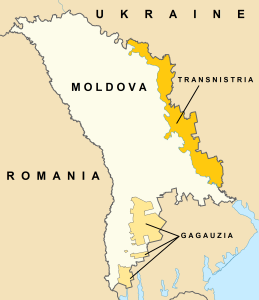
Map of Moldova, Transnistria, and Gagauzia

Map of Moldova, Transnistria, and Gagauzia

Moldova and its breakaway region of Transnistria have been in the news a lot lately. I will attempt to give some historical background to this complex borderland in my analysis below.

The EU’s Eastern Partnership (EaP) program included within its scope the six countries of the former Soviet west. These were Belarus, Moldova, and Ukraine in Eastern Europe and Armenia, Azerbaijan, and Georgia in the Caucasus. Of the six, Belarus and Azerbaijan expressed little interest in the project. However, the remaining four states – Armenia, Georgia, Moldova, and Ukraine – actively participated in it. The motives of these states’ involvement in the EaP varies. In the cases of Armenia, Georgia, and Ukraine, the leaderships of these countries used the geopolitical competition between Russia and the West to get the best terms for their countries. Armenia’s Sargsyan and Georgia’s Ivanishvili have both played this chess game especially well as their countries have a history of playing Great Powers off of each other to their own advantage. In this respect, they are neither categorically “pro-Russian” nor “pro-Western,” but rather “pro-Armenian” and “pro-Georgian” respectively. Ukraine’s Yanukovych attempted to play this game too but proved far less decisive and pragmatic than his Caucasian counterparts. Meanwhile, the leadership of Moldova has pursued an entirely different path. It seeks to fully free itself from Moscow’s orbit and to integrate into the EU regardless.
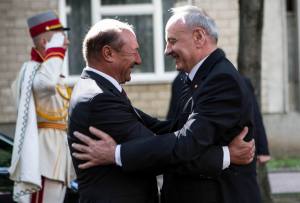
Romanian President Traian Băsescu (left) and Moldovan President Nicolae Timofti (right) in Chișinău in July 2014 (President of Romania)

Romanian President Traian Băsescu (left) and Moldovan President Nicolae Timofti (right) in Chișinău in July 2014 (President of Romania)

Indeed, if there is one state out of all the EaP countries that is thoroughly committed to Europe and sincerely interested in leaving Moscow’s orbit once and for all, it is Moldova. The leadership in Chișinău, under President Timofti and Prime Minister Leancă, is entirely committed to the idea of firm and total European integration. Additionally, out of all the EaP states, Moldova is arguably in the best position to become a candidate for EU accession geographically, politically, and economically, making it an “easy pill to swallow” by EU standards. Within the EaP, Moldova also represents a very unique case because their main backer within the EU is Romania. Romanian President Traian Băsescu has lobbied hard for Moldova’s integration into the bloc and would never allow his ethnic Latin Vlach cousins to end up outside of the EU. In the early 1990s, Romania was the first country to recognize Moldova’s independence. It also has allowed for Moldovan citizens to obtain Romanian passports. This has caused a large flow of Moldovans to enter the EU “through the back door.”

Historical background
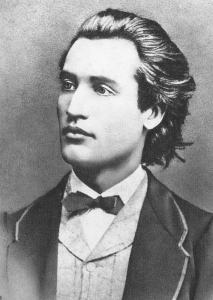
Mihai Eminescu in Prague in 1869

Mihai Eminescu in Prague, 1869

The reasons for the close Romanian-Moldovan relationship are both ethnic and historical. Moldova corresponds almost exactly to the historical Romanian region of Bessarabia, located between the Dniester and Prut rivers. The majority of its population are ethnic Romanians, who speak Romanian. The colors on the Moldovan flag are almost exactly the same as those on the Romanian flag. Likewise, both countries consider the Romanian poet Mihai Eminescu to be their national poet. Along with a good portion of eastern Romania, Bessarabia had once formed a major portion of the old Vlach-speaking principality of Moldavia. In 1812, it was annexed by the Russian Empire, but after the 1917 Russian Revolution, the region’s local leaders formed a National Council (Sfatul Ţării) and voted to join the Kingdom of Romania in 1918. It remained a part of Greater Romania for much of the interwar period.

As a challenge to Romania’s control of Bessarabia, the Bolsheviks created the Moldavian Autonomous Soviet Socialist Republic (ASSR) in 1924 in Soviet Ukraine. Most of the territory of the Moldavian ASSR corresponds to the now-breakaway region of Transnistria. Inhabited primarily by a mixed population of East Slavs and Romanians, this territory was never part of Bessarabia or the historic principality of Moldavia. The Soviets instead used the region as a means of arguing that the Moldovans were not a branch of Romanians but an entirely unique people.

“Scholars from the West, in particular the German ethnographer Gustav Weigand, had noted earlier in the century that Romanian-speakers in Bessarabia and Bukovina spoke a dialect distinct from those in the Romanian kingdom,” wrote historian Charles King in his excellent overview, The Moldovans, “but these differences were no more striking than regional variations inside Romania itself. In the MASSR, however, these distinctions were imbued with political meaning.” These dialectal differences served as the basis for the creation of a new “Moldovan” language, which, despite its Cyrillic alphabet, was virtually identical to Romanian.
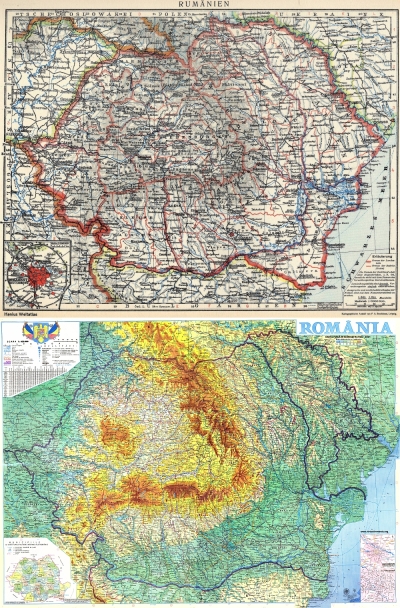
Maps of Romania and Moldova. The top map from 1926 shows "Greater Romania" including Moldova within its borders. The bottom map from 2001 shows the present-day boundaries of Romania and Moldova.

Maps of Romania and Moldova. The top map from 1926 shows the interwar Kingdom of Romania including Moldova within its borders. The bottom map from 2001 shows the present-day boundaries of Romania and Moldova.

In June 1940, the USSR annexed Bessarabia as part of the Molotov-Ribbentrop Pact. Most of the area was united with much of the old Moldavian ASSR (modern Transnistria) to form the new “Moldovan SSR.” When the Nazis invaded the Soviet Union during World War II, Romania under the fascist leadership of Ion Antonescu joined the German war effort. The Romanian forces not only regained Bessarabia from the Soviets but pressed on further east to take all of the territory between the Dniester and Southern Bug rivers, including the historic city of Odessa. The new territory, administered by Romania, was called “Transnistria.” Hitler granted it to Antonesu as compensation for giving Transylvania to Horthy’s Hungary in the Second Vienna Award. The Romanian administration of this “Transnistria” was very brutal for the local population, especially for the Jews. When the tide turned in the war, the region was recovered by the Soviets along with Romanian-speaking Bessarabia. By the end of the war, the 1940 borders between the Soviet Union and Romania were now reestablished.

With the onset of perestroika, nationalist elites in Moldova began to gain power and sought to reunite their republic with Romania. However, political concerns prevented this from occurring. Reunification was especially rejected by the people of Transnistria who bristled at the new nationalistic rhetoric from Chișinău.  In contrast to the nationalist elites gaining influence in the capital, the Transnistrians argued that they had never been part of historic Bessarabia.  Many also still had memories of the brutal wartime administration of Transnistria by Antonesu’s Romania. “The Transnistrian war was in no sense about ancient hatreds between eastern Latinity and Slavdom,” wrote King, “but history did play an important role.”

No less significant to the conflict were economic, social, and political factors.  Whereas most of Moldova west of the Dniester was largely rural and agricultural, Transnistria was mostly urban and industrial.  Moreover, after the war, the region became an important industrial center in the Soviet economy and played a significant role in the Soviet military industrial complex.  “After 1945,” wrote King, “Transnistria became a central component of the Soviet defense sector and its heavy industry.  Some four-fifths of the region’s population was employed in industry, construction, and the service sector.”

The industrialization of Transnistria in the Soviet era also fueled the migration of East Slavs into the region, thus making it more distinct from the rest of Moldova and more “Soviet.”  “Internal immigrants arrived to work in the new factories, increasing the Russian and Ukrainian portions of the population,” wrote King.  “The key issue… was not how Russian the region became after the war, but how quintessentially Soviet… The primary loyalty of individuals in the region was not to Russia – even though most spoke Russian and had ties to the Russian republic – but to the Soviet Union.”

Attempts at centralization by the nationalist government in Chișinău only exacerbated the differences with Transnistria.  “Soviet” elites in the latter began reacting to the nationalist elites in Chișinău.  “Already in the late 1980s,” wrote King, “there developed a dynamic that would culminate in full-scale war by 1992: Every move in Chișinău that pulled the republic further away from Moscow was met by a countermove in Transnistria that drew the region itself farther away from Chișinău.”  This eventually led to Transnistria militarily breaking away from Chișinău to form its own self-proclaimed republic in 1992.

Moldovan elites were likewise concerned about the Gagauz, a unique group of Turkic-speaking Orthodox Christian people whose homeland straddles the southern boundaries between Moldova and Ukraine. After the Soviet collapse, the Gagauz “made common cause with the Transnistrians” but did not go so far as to proclaim their own independent republic. Still, in December 1994, Chișinău granted them their own autonomous unit in the south known as Gagauzia. The situation has been stable and the Gagauz have likewise been granted the right to secede if Moldova decides to reunite with Romania. Chișinău offered a similar deal to Transnistria, but there has been no resolution on this to date.

In the 2000s, the head of the Moldovan Communist Party, Vladimir Voronin was elected President of the country, the first such case in the former USSR. Though claiming to be supportive of European integration, Voronin, a highly Russified Moldovan, also sought to expand ties with Russia. However, his administration did little to improve the lives of everyday Moldovans, and poverty and corruption remained major problems. A victory for the Communist Party in Moldova’s April 2009 parliamentary election, though hailed as free and fair by European observers, sparked major protests and civil unrest. Student demonstrators clashed with police, stormed the parliament, and carried the flags of Romania and the European Union, chanting slogans like “We are Romanians!” and “Down with Communism!” At least five students died because of the riots. President Voronin responded by placing the blame for the unrest on Bucharest, which denied any involvement. Three months later, Moldovan state prosecutor Valeriu Gurbulea confirmed that Romania had nothing to do with the protests.
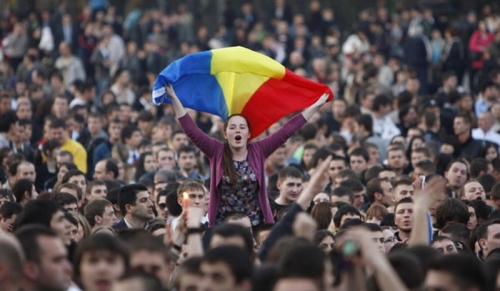
Protests in Chișinău, April 2009 (Reuters/Gleb Garanich)

Protests in Chișinău, April 2009 (Reuters/Gleb Garanich)

Though successful in the April 2009 elections, the newly elected parliament was unable to elect a President in June. Consequently, Voronin had to dissolve parliament, thus paving the way for snap parliamentary elections in July 2009. This election brought to power a new governing coalition of liberal political parties collectively known as the Alliance for European Integration (AEI). Voronin resigned from the presidency in September but the AEI was unable to elect a president until March 2012, when the independent judge Nicolae Timofti was finally voted into office.

As their name implies, the top priority of the AEI and its successor the Pro-European Coalition (PEC) has been EU integration and EU membership. It took advantage of Moldova’s position with the Polish-Swedish EaP initiative and quickly emerged as the most progressive ex-Soviet state in terms of EU reforms. Among other things, the AEI advanced the issue of visa liberalization in Moldova. On April 3, 2014, it was announced that there will now be a visa-free regime between Moldova and the EU’s Schengen Area. Moldova also confirmed the final version of its Association Agreement with the EU at the November 2013 Vilnius Summit to be signed in June 2014.

Further, under the AEI and PEC, Chișinău also moved increasingly closer toward Romania. In December 2009, the AEI announced that it would be removing the barbed wire fence separating their country from Romania. On December 5, 2013, the PEC recognized Romanian as the official language of the Moldovan republic. This move was welcomed by Romania’s Traian Băsescu who has long favored reunification with Moldova. On the eve on the Vilnius Summit, he stated:
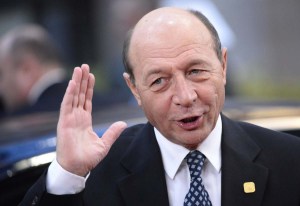
Romanian President Traian Băsescu (AFP/Getty/Lionel Bonaventure)

Romanian President Traian Băsescu (AFP/Getty/Lionel Bonaventure)

When a nation has the opportunity to be together, it should not give up. It may not happen straightaway, but it will happen one day, because blood is thicker than water. I think this is the right time to say that we have this objective, if Moldovan people want this. I am convinced that if Moldova wants to unite, then Romania will accept.

He also stated that after joining the EU and NATO, Romania’s third priority must be reunification with Moldova, though given official Chișinău’s concerns with ethnic minorities such as the Gagauz, it would likely be less enthusiastic about taking such a step.

Băsescu further cautioned that “the big risk for Moldova would be a treatment with arrogance by EU – be aware, I use the word with responsibility – which would not take into account the electoral realities in Moldova.” Moldova still faces many challenges to its EU road, both domestic and foreign. Internally, Vladimir Voronin and the Communist Party advocate a strongly pro-Russian stance, ultimately favoring membership in the Eurasian Customs Union. The Communists adhere to a strong Moldovenist position, advocating a unique “Moldovan” identity and firmly rejecting the idea that the “Moldovan language” is in fact the Romanian language. “Moldova can become a European country only by joining the Customs Union,” the 72-year-old Voronin told a crowd of largely elderly anti-EU activists from the Communist Party.
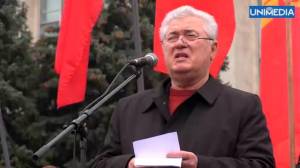
Vladimir Voronin (Unimedia)

Vladimir Voronin (Unimedia)

However, Voronin and the Communists are not a spent force. As Băsescu alludes, they have a substantial following within Moldova. Though they lost the July 2009 parliamentary election to the AEI coalition, the Communists still garnered 44.69% of the vote. They poll especially well in the north of the country and also among the substantial East Slavic minority of Moldova proper, which numbers about 14% of the total population. They also do well among the Gagauz in the south who fear that closer relations with Romania could threaten their hard-won autonomous status. Consequently, the possibility of Moldova’s pro-EU coalition losing to the communists is very real for Moldova in terms of its future geopolitical orientation. Still, for the immediate future, this risk is mitigated by the fact that Moldova’s next parliamentary election will not be held until November 2014, several months after Chișinău is set to sign the final version of its Association Agreement with the EU in June 2014.

There are also external challenges. Like Ukraine and Armenia, Moldova too is heavily dependent on Russian energy. It currently imports all of its natural gas from Russia, though the newly-inaugurated Iași-Ungheni pipeline with Romania promises to undermine this total dependence. A wine-producing country, Moldova also exports 28% of its wine production to Russia (for comparison, 47% of Chișinău’s exports go to the EU). A recent embargo by Moscow of Moldovan wine, due to an alleged trace of plastic contamination found in barrels of devin, has been a serious issue for the country. Some claim that the ban was politically motivated as a means of pressuring Chișinău to change its pro-EU geopolitical orientation, an assertion that Moscow has flatly denied. In addition, as many as half a million Moldovans are estimated to work illegally in Russia. Significantly, approximately the same number have Romanian passports and have departed the country to work in Western Europe, with Traian Băsescu provocatively claiming the number to be much higher, up to 1.5 million.
A Gagauz Woman Casts Her Ballot in February 2014 Referendum in Gagauzia (Valtenia Ursu/RFE/RL)

A Gagauz Woman Casts Her Ballot in the February 2014 Referendum in Gagauzia (Valtenia Ursu/RFE/RL)

However, Moscow’s biggest cards to play with regard to Chisinău’s EU ambitions are its distinct ethnic regions of Gagauzia and Transnistria. Gagauzia is not a breakaway region but rather an autonomous unit comprised almost entirely of ethnic Gagauz. Though content with remaining part of Moldova, the Gagauz are concerned about how joining the EU could affect their future, especially given Romania’s involvement. Recently, the Gagauz leadership held a referendum in February 2014 that rejected the country’s pro-EU aspirations and reaffirmed its right to secede from Moldova in the case of reunification with Romania. Though condemned by the Moldovan court as “unconstitutional,” this referendum was clearly intended as a warning to Chișinău against the possibility of a future reunification with Romania in which the Gagauz autonomy might be threatened. For the record, ex-communist Romania has consistently refused to grant autonomous status for any ethnic minority in its country including, most notably, the ethnic Hungarians of the Székely Land. Traian Băsescu himself has ruled out any possibility of a future Hungarian autonomy. Following the referendum, the pro-EU Moldovan government sought to reassure the Gagauz that a reunification with Bucharest was not imminent, and that the EU will actively work to better guarantee their minority rights. Whether or not the Gagauz will be adequately convinced of Moldova’s European choice remains to be seen. If left unresolved, this issue could devolve into a very serious crisis.
Aleksandr Lebed in Tiraspol, the capital of Transnistria, during the 1992 war.

Aleksandr Lebed in Tiraspol, the capital of Transnistria, during the 1992 war.

Most significantly of all, there is the unresolved conflict over Transnistria. The majority of Transnistria’s population is East Slavic (Russians, Ukrainians, and Belarusians who collectively make up 60% in total according to the 2004 census) and Russian is the dominant language. Politically, the pro-Russian orientation is strong here and is reinforced by the presence of the Russian 14th Army (now known as the Operational Group of Russian Forces in Moldova). Aleksandr Lebed, the Bonapartist Russian strongman from the 1990s, played a key role in Transnistria’s 1992 war of independence from Moldova proper. He viewed himself as the liberator of Transnistria from the “fascists” and “ideological heirs of Antonesu” in Chisinău. He is regarded as a hero here.

Towards a potential solution

While Moldova is officially committed to returning Transnistria under its rule, it is unclear what benefit this would bring to the country as a whole. For one thing, Transnistria does not have a deep historical relationship with Moldova. Even the poet Eminescu in his famous work Doina spoke of the Romanian nation as only stretching “from the Dniester to the Tisza.” Unlike Georgia’s conflicts with Abkhazia and South Ossetia, in which the Georgians attach deep emotional and historical significance to their breakaway regions, the same really cannot be said for Transnistria and Moldova. Transnistria was attached to Moldova proper in 1940 and thus was only associated with it for 52 years until its secession in 1992. Compare that to the Georgian-Abkhazian or Georgian-Ossetian relationships which extend back several centuries into history.

Indeed, most Moldovans, according to various opinion polls, are indifferent toward Transnistria. For the vast majority, the issue ranks as the ninth or tenth priority for the population of Moldova proper. Fewer than two percent consider the issue to be the most pressing, while “five percent consider it second, well behind issues such as poverty, crime, or inflation.” According to one observer, “this stands in striking contrast to the much higher preoccupation with frozen conflicts in other post-Soviet countries such as Azerbaijan and Georgia.”

In addition to this, Transnistria can be viewed as more of a major economic liability for Chișinău than a benefit. Though Moldova currently owes virtually no debt for its gas imports from Russia, Transnistria owes approximately $4 billion to Gazprom. Moscow presently holds Chișinău accountable for this debt. The only way to get rid of it would be for Moldova to entirely relinquish its claims to the disputed territory.
Transnistrian President Yevgeny Shevchuk. An ethnic Ukrainian and anti-corruption activist, Shevchuk is keen on forging closer ties with Moscow.

Transnistrian President Yevgeny Shevchuk. An ethnic Ukrainian and anti-corruption activist, Shevchuk is keen on forging closer ties with Moscow.

Meanwhile, Transnistria’s current President Yevgeny Shevchuk, while not the Kremlin’s choice in the Transnistrian election, has continued to maintain strong ties with Moscow. An ethnic Ukrainian, Shevchuk studied in both Ukraine and Russia and was elected as a reformer committed to challenging corruption and oligarchy, not as an advocate for reunification with Moldova. After his election in 2012, he immediately met with Sergei Ivanov, one of Putin’s closest associates and an influential member of his inner-circle. He also advocated that Transnistria adopt the Russian ruble and Russian laws, with the ultimate aim of Transnistria joining the Eurasian Union.

Observing this scenario, it seems that while Moldova proper is increasingly moving closer toward the EU, Transnistria is moving very much in the opposite direction toward the Eurasian Union. A potential, logical, and peaceful solution to this problem would be the formal separation of these two entities from each other. Moldova’s pro-EU leadership could recognize Transnistria and relinquish all claims to it, while working with the authorities in Tiraspol to delineate the border between the two states.  Given Transnistria’s limited viability as an independent entity, Moscow could work with Tiraspol and Ukraine to consider the possibility of reuniting the former with the latter.   A solution like this would satisfy Transnistria’s pro-“Soviet” and pro-Slavic sentiments and would absolve Moldova of any lingering debt to Gazprom. It would also help reduce any sort of ill feelings in Ukraine toward Moscow for its recent incorporation of Crimea.  However, such a resolution is entirely contingent on the people and the elites of Moldova and Transnistria and on how the situation in Ukraine develops.  It could only work if a new government more amiable toward Moscow and Tiraspol emerges in Kiev.

It also should be noted that Moldova proper is of marginal significance to Moscow. The country is poor, landlocked, and Romanian-speaking, with few natural resources and very little geostrategic value. It is already very much integrated with the EU and a sizeable number of its citizens already have Romanian/EU passports. Additionally, the inauguration of the Iași-Ungheni pipeline will likely substantially reduce Moldovan energy dependence on Moscow. Thus, the best and most logical solution to the ongoing Transnistria problem would be its split from the Moldovan state and its eventual reunification with Ukraine.