How Moscow Views the Ukraine Crisis

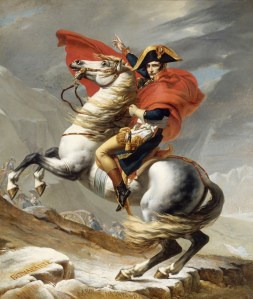
Bonaparte Crossing the Grand Saint-Bernard Pass by Jacques-Louis David, 1800.  The historical memory of the Western invasions of Russia (including the Napoleonic invasion of 1812) still affects Russian perceptions of the West today.

Bonaparte Crossing the Grand Saint-Bernard Pass by Jacques-Louis David, 1800. The historical memories of the West’s invasions of Russia (including the Napoleonic invasion of 1812) still loom large in the Russian consciousness.

Throughout the ongoing Ukraine crisis, few Western commentators and/or observers have considered Moscow’s view of the situation. In the Western media, the prevailing image is that Russia is an aggressor, intent on dominating its neighbors. Western influence is presented as “positive.” Russian influence as “negative.” Joining the EU is depicted as being a road to economic and social prosperity and NATO is offered as a defensive bulwark against the “terrible” Kremlin. Remarkably, at least in the United States, liberals and conservatives are singing the same song. Further, the discourse of “invasion,” “occupation,” “aggression,” and “World War III” is hardly diplomatic. How does anyone believe that negotiations can ensue when such language is thrown about?

By contrast, in Moscow, the view of the situation in Ukraine is entirely different. It perceives the West as encroaching on countries to which it has been very closely associated. Ukraine (the entire country, East, South, Central, and even West), along with Belarus, is viewed as a fraternal East Slavic nation to which Russia is intimately bound. The capital Kiev is regarded by all Russians as the “mother Russian city,” the common point of origin for all East Slavs. To view Kiev within the boundaries of the EU and NATO is more than just a violation of a sphere of influence.  To the Russians, it is almost sacrilege.

Meanwhile, it does not help that some of the most vocal advocates for Ukrainian membership in the EU and NATO come from countries that Russia perceives as historical invaders. They include Poland and Sweden, the co-founders of the Eastern Partnership program that sponsored the Ukraine-EU Association Agreement. Both countries have a history of animosity toward Russia, but it is Poland in particular that Moscow views as being one of the chief advocates for Western expansionism.

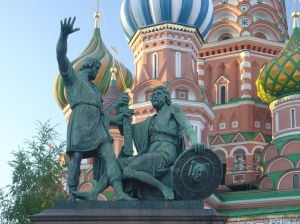
Minin and Pozharsky Statue in front of St. Basil's Cathedral, Moscow (Kotomka)

Minin and Pozharsky Statue in front of St. Basil’s Cathedral, Moscow (Kotomka)

We in the West regard Poland primarily as the victim of Russian aggression, particularly communism. We reflect on Russia’s participation in Poland’s partitions, its suppression of Polish uprisings, the Polish-Soviet War, the Molotov-Ribbentrop Pact, the Katyń massacre, and the establishment of communist Poland. Conversely, to a Russian with a sense of history, Poland is perceived as a historical invader, a country that during the Time of Troubles in Russia (1598-1613) supported the Tsar-pretender “False Dmitriy,” attempted to bring Catholicism to Orthodox Russia, and eventually invaded and occupied Moscow in 1609. That invasion was repelled in 1612 by the duo of Kuzma Minin and Dmitriy Pozharsky, whose statue stands today in front of St. Basil’s in Moscow.

Even in more recent times, Russians recall that it was Poland’s Marshal Piłsudski who, during the Polish-Soviet War of 1919-21, not only tried to ensure the freedom of Poland, but also sought to annex to Poland large swathes of Lithuania, Belarus, Ukraine, and Western Russia to restore the Polish-Lithuanian Commonwealth of old. Piłsudski is still admired by some in Poland today, including members of the political elite such as the late Polish President Lech Kaczyński and his twin brother, Jarosław. He is also greatly admired by former Georgian President Mikheil Saakashvili.

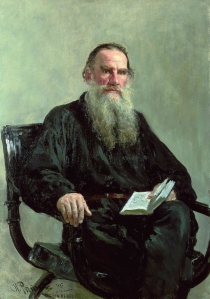
Russian author Leo Tolstoy in a portrait by Ilya Repin, 1887.

Russian author Leo Tolstoy in a portrait by Ilya Repin, 1887.

Russians likewise recall Polish participation in the Napoleonic invasion of Russia. In Leo Tolstoy’s War and Peace, it is the Polish legion that is depicted as being the most fanatically supportive of an expansion toward Russia, so much so that they drown in the River Viliya for Napoleon. Today, the Russians see very much the same thing, except that Napoleon is now replaced by NATO and that the Poles are now showing their loyalty, not by drowning in the Viliya, but by asking for NATO troops to be stationed in their country.

In another Tolstoyan parallel, Moscow also likely views the Ukrainians who protested on the Maidan as being the modern equivalents of the muzhiks of War and Peace. It was the muzhiks who rose up against their oppressive landlords for Napoleon, who they viewed as the embodiment of the French revolutionary ideals of liberté, égalité, et fraternité. Today though, the modern landlords are Ukraine’s corrupt political elite and oligarchs, while the liberal ideals of Napoleon and revolutionary France are today the liberal ideals of Brussels and the European Union. Moscow regards the latter ideals in 2014 just as they regarded Naopleon’s ideals in 1812 – that is, as false promises motivated only by geopolitical ambitions rather than by any genuine sense of altruism.

Given this, it would be wise to recall history before permitting the rhetoric to get too out of control.

German Federalism: An Example for Ukraine

German states (länder) of the German Federal Republic.

German states (länder) of the German Federal Republic.  German federalism is a successful model that Ukraine could follow as an example.

Federalism in Ukraine has been discussed in a previous entry on this publication, but now I wish to highlight a practical example that Ukraine could follow in this regard: Germany.

Germany is a state much like Ukraine with broad regional divisions. Catholics from Bavaria and the Rhineland are largely concentrated in the south and west respectively. Protestants are primarily concentrated in the northwest. The former East Germany, located in the northeast, is largely secular. Yet somehow all of these groups manage to get along in a single, federal state with a strong central government in Berlin. The states (länder) are self-governing with their local representatives directly elected by the people. Meanwhile, it is Berlin that regulates the foreign, economic, and security policy of the German Federal Republic as a totality.

The German example is one that Kiev could follow.  This would make each of Ukraine’s oblasti self-governing in the same way that the länder are in Germany.  Each would have their local governors elected directly by the people, not appointed by official Kiev. For example, if the people of Poltava oblast do not want to be represented by Svoboda, then why should Turchynov or Yatsenyuk appoint a Svoboda party member to represent them? The people of Poltava should instead elect their own governor who best reflects their views and interests, not some appointee from Svoboda.

Each would also be able to regulate their own language policy. Again, to use the example of Zakarpattia, that oblast could have Ukrainian and Rusyn as co-official languages with Hungarian, Romanian, and Russian as minority languages. In another example, the languages of the Odessa oblast could be Ukrainian and Russian co-official, with Bulgarian, Romanian, and Yiddish minority languages.

At the same time, it would be official Kiev that would regulate the country’s foreign, trade, economic, and defense policies. It would be the best of all worlds. The people would finally have a say in their government, and at the same time Kiev would still have the ultimate say on the most important issues. Following the German federal model like this would be a good model for Ukraine, especially in this time of crisis.

Who Are the Rusyns?

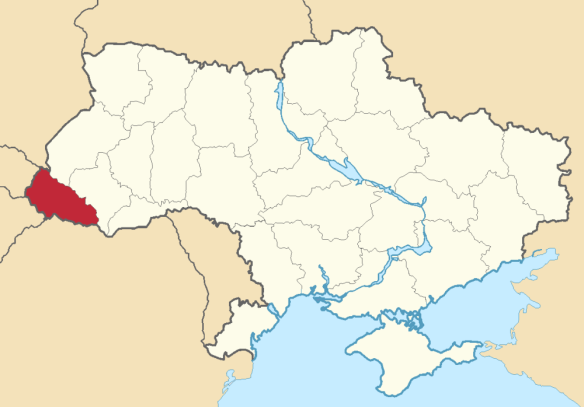
In the midst of the ongoing Ukraine crisis, one region of the country has been obscured from the spotlight. This is the westernmost Zakarpattia oblast, a mountainous region that shares four international boundaries with Poland, Slovakia, Hungary, and Romania. Located at the center of Europe, its capital is Uzhgorod, a city located literally on the border with Slovakia and which, architecturally, shares much in common with neighboring locales across the border such as Prešov and Košice. The majority of the local population is comprised of a group known as the Rusyns, a distinct East Slavic people. Most significantly, it is through this region that major energy pipelines pass from Russia, through Ukraine, and into the EU.

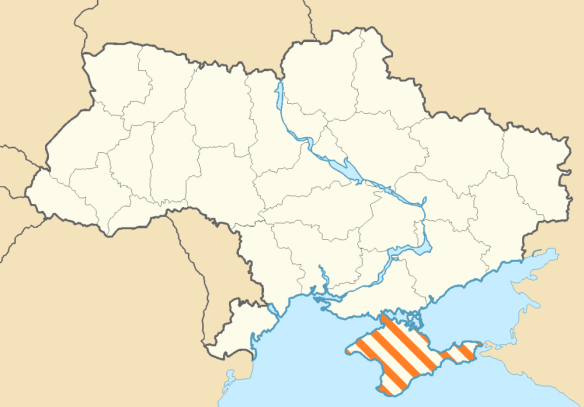
Location of the Zakarpattia Oblast within Ukraine.

Location of the Zakarpattia Oblast within Ukraine.

Church of Archangel Michael in the wooden style commonly seen in Zakarpattia (Sobory.ru)

Church of Archangel Michael in the wooden style commonly seen in Zakarpattia. (Sobory.ru)

Language, faith, and identity

The Rusyns derive their name from their self-designation “Rusyni” indicating “people of the Rus’ as in the old “Kievan Rus’.” At one point, the Russians, Ukrainians, and Belarusians all self-identified as “Rusyni” until they adopted their respective ethnonyms over time. In some cases, the residual use of the self-designation “Rusyni” in both Ukraine and Belarus lasted well into the early 20th century. The Rusyns are also known by other names too such as “Ruthenians,” a term which is also used to apply generally to all East Slavs (Russians, Ukrainians, and Belarusians). Indeed, “Ruthenia” is merely a Latin rendering of the name “Rus’,” though today it almost exclusively applies to Zakarpattia as a distinct region. More specific names for the people of this region include “Carpatho-Rusyns” or “Carpathian Ruthenians,” both of which designate the specific area in which these people live – the Carpathian Mountains. There are subgroups of Rusyns as well such as the Lemkos, Hutsuls, and Boykos.

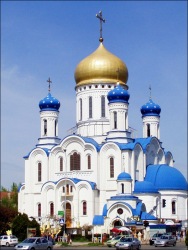
Cathedral of Christ the Savior, Uzhgorod

Orthodox Cathedral of Christ the Savior, Uzhgorod (Ukraine Trek)

In terms of faith, the Rusyns are largely members of the Byzantine Ruthenian Catholic Church (distinct from the Ukrainian Greek Catholic Church). In recent years, some Rusyns have also been gravitating toward Orthodox Christianity of the Moscow Patriarchate. In 2000, the Orthodox Cathedral of Christ the Savior was inaugurated in Uzhgorod. The church reflects common architectural styles found in much of Russia, Ukraine, and Belarus. Yet the more prominent architectural style that one finds throughout Zakarpattia is the simple, wooden church style.  Indeed, wood churches are a major art in this region and comprise an important part of the Rusyn culture, heritage, and identity.

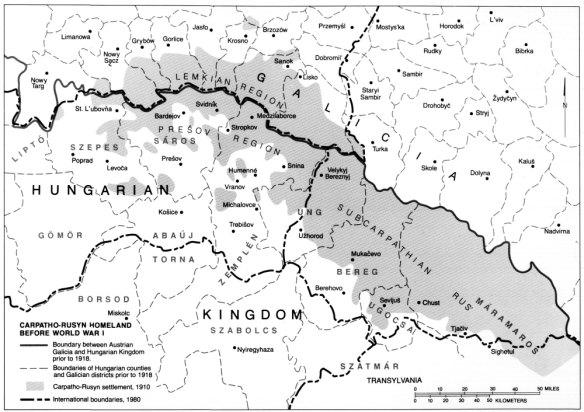
The Rusyn homeland is primarily centered on the Zakarpattia Oblast of Ukraine, which encompasses the bulk of it. However, Rusyns also inhabit a few adjoining areas, notably portions of eastern Slovakia and southeastern border areas of Poland (particularly in the Subcarpathian Voivodeship). Geography is key here for it was the mountains that isolated the Rusyns from the other East Slavs and allowed them to develop their own unique culture and East Slavic language.

Map showing the full geographic extent of the Rusyn people in Central Europe. (carpathorusynsociety.org)

Map showing the full geographic extent of the Rusyn people in Central Europe, prior to World War I. (carpathorusynsociety.org)

In fact, it is interesting to observe precisely where the Rusyn language stands within the geographic and linguistic position of the Slavic languages. In the Czech Republic, one finds the West Slavic Czech language. When one reaches the eastern fringes of the historical Czech region of Moravia, the Moravian dialect gradually begins to transition into Slovak, a language that shares many affinities with Czech. The further east one travels in Slovakia, the more divergent the Slovak dialects become from the standard language. By the time one reaches the mountainous regions of Prešov and Košice, the eastern dialects of Slovak gradually begin to blend into an East Slavic language: Rusyn.

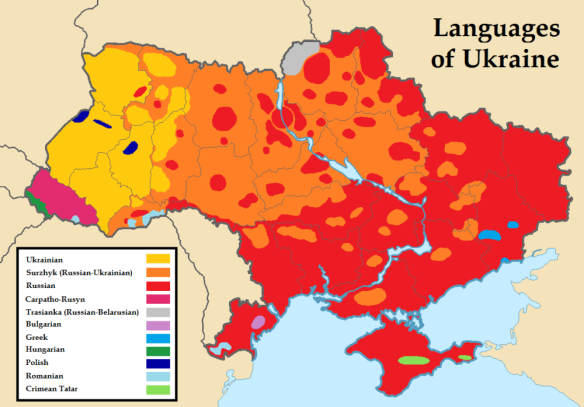
Rusyn is the linguistically dominant language of Ukraine’s Zakarpattia oblast. From Zakarpattia, Rusyn gradually transitions into standard Ukrainian in Galicia and Volhynia. However, by the time one reaches the Khmelnytskyi oblast, Ukrainian begins to change into Surzhyk, a mixed Russian-Ukrainian language. Then, as one moves further east to the Sumy and Kharkov oblasti, Surzhyk begins to blend into Russian, specifically the southern dialect of Russian. By the time one reaches Moscow, the language has evolved into standard Russian.

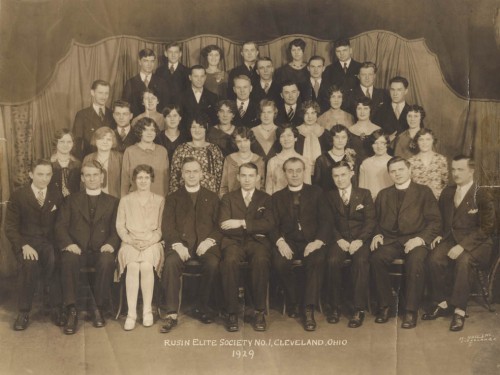
The Rusyn Elite Society in Cleveland, Ohio in 1929, one of many Rusyn immigrant associations in the United States. (Cleveland Cultural Gardens)

The Rusyn Elite Society in Cleveland, Ohio in 1929, one of many Rusyn immigrant associations in the United States. (Cleveland Cultural Gardens)

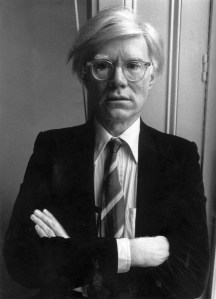
Andy Warhol

Andy Warhol

In the 19th century, significant numbers of Rusyns also moved further south from their historic homeland into the region of Pannonia. Their descendents are today the Rusyn minority in the former Yugoslavia, primarily Vojvodina, the autonomous region of northern Serbia where Rusyn is a co-official language, and in Slavonia and other regions of Croatia. Still more Rusyns emigrated to the United States and Canada in the 19th and early 20th centuries, settling in New York, New Jersey, Cleveland, Chicago, Detroit, and Minneapolis, as well as parts of southern Connecticut and the coalmining towns of western Pennsylvania. One of the most prominent Rusyn-Americans who is always mentioned in discussions on Rusyns is the eccentric pop artist Andy Warhol.

Historical overview

The origins of the Rusyns can be partially traced to the White Croats, an early Slavic tribe distantly related to the modern Croats of the former Yugoslavia.   The historical Rusyn homeland in Zakarpattia existed as a disputed borderland area between the Kievan Rus’ and the medieval Kingdom of Hungary.  Hungary’s administration of the region strengthened following the downfall of the Rus’ state.

For many subsequent centuries, Zakarpattia remained under Hungarian rule. Thus, within Austria-Hungary, the people here were ruled by the Hungarian monarchy, in contrast to their neighbors in Galicia who were ruled directly by the Austrians in Vienna. Under Hungarian influence, the locals adopted some Hungarian cultural attributes. For example, Hungarian Bogrács Gulyás is a staple of Rusyn cuisine. The Rusyns also adopted the Catholicism of their Hungarian and Slovak neighbors. In 1646, at the Union of Uzhgorod, the largely Orthodox Rusyns formally joined the Catholic Church under the Byzantine rite, forming the Byzantine Ruthenian Catholic Church.

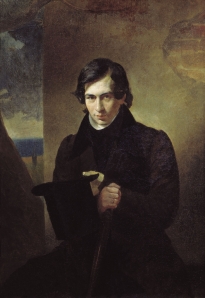
St. Petersburg-born Rusyn-Russian playwright Nestor Kukolnik (portrait by Karl Bryullov, 1836)

St. Petersburg-born Rusyn-Russian playwright Nestor Kukolnik (portrait by Karl Bryullov, 1836)

However, the Rusyns were far less receptive to being forcibly assimilated by the Hungarians. In the 18th and 19th centuries, a significant Russophile movement emerged in Zakarpattia in response to Hungarian cultural suppression and Magyarization. The great Rusyn writer and theologian Aleksandr Dukhnovich was active in this movement. Another was the academic Vasily Kukolnik whose St. Petersburg-born son, Nestor Kukolnik, would later become a prominent romantic Russian playwright. Russophile sentiment also existed in Galicia, though it was later supplemented by Ukrainian nationalism. By contrast, in Zakarpattia, the Russophile movement persisted even to the present-day. Indeed, many in the region still harbor affinities for Russia as evidenced by the closeness of elections here between pro-Russian and pro-Western candidates.

With the collapse of the Habsburg monarchy at the end of World War I, the West Ukrainian People’s Republic sought to claim Zakarpattia as part of its territory. However, it remained under Hungarian rule until 1919 when the Paris Peace Conference assigned it to Czechoslovakia. This was the result of a National Council led by Rusyn-American leader Grigory Žatkovich. Given the instability of Russia and Ukraine at the time, Žatkovich was advised by the Wilson administration that a Rusyn union with Czechoslovakia would be the only viable option for the territory’s future. Consequently, in 1918 Žatkovich signed the Philadelphia Agreement with Tomáš Masaryk, ensuring Rusyn autonomy in a future Czechoslovak state. The Treaty of St. Germain in 1919 reaffirmed this. However, actual political autonomy of the region proved to be less than that desired by the Rusyns of Zakarpattia, largely due to the inefficiency and bureaucracy in Prague. Žatkovich, who Masaryk appointed as governor to the region, eventually resigned in frustration.

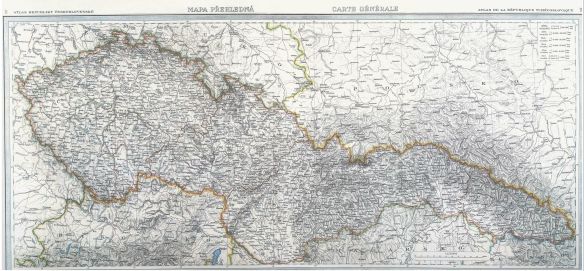
Map of interwar Czechoslovakia in 1935 with

Map of interwar Czechoslovakia in 1935 with “Podkarpatská Rus” (“Subcarpathian Rus”), the present-day Zakarpattia Oblast.

Another significant aspect of Zakarpattia’s union with Czechslovakia was the precise determination of the borders. The frontiers of Zakarpattia, as determined at the Paris Peace Conference and later at the Treaty of Trianon also included a substantial Hungarian minority in the southernmost portion of the region. Most of these Hungarians did not want to separate from Hungary nor were they interested in joining the new Czechoslovak state.

Following Hitler’s annexation of the German-inhabited Sudetenland in 1938, the remainder of Czechoslovakia was slowly dismembered. Germany moved to snatch the rest of the Czech lands while Slovakia became a German fascist puppet state ruled by the collaborator Jozef Tiso. Horthy’s Hungary then was given permission by Hitler to annex the Hungarian-inhabited areas of southern Slovakia in the First Vienna Award. The Nazis also granted Zakarpattia to Budapest as well. This left the region with no choice but to declare its independence. On March 15, 1939, the Rusyns moved to declare a Republic of Carpatho-Ukraine. Within one day, it was crushed by Horthy’s invading army and declared part of Hungary. Under Hungarian rule, the Rusyns were allowed to continue reading and writing in their language as long as it was pro-Hungarian in orientation. Those opposed to Hungarian rule sought to flee Zakarpattia across the mountains into Soviet Ukraine. Hoping to be welcomed by the Soviets, they were instead arrested by the NKVD for “illegally crossing into Soviet territory” and sent to Gulag labor camps. Meanwhile, during the war, Zakarpattia’s historic Jewish community suffered greatly. Most were deported to Nazi death camps and perished in the Holocaust.

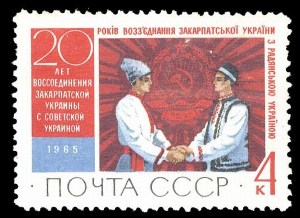
A Soviet-era stamp celebrating the 20th anniversary of Zakarpattia's 'reunification' with Soviet Ukraine.

A Soviet-era stamp celebrating the 20th anniversary of Zakarpattia’s “reunification” with Soviet Ukraine.

Zakarpattia remained part of Hungary for much of the war until it was liberated by Soviet troops in 1944. Throughout the war, Moscow promised the Western allies that it would restore Czechoslovakia’s pre-1938 borders. However, after the liberation of Zakarpattia, new considerations were drawn up and it was decided to incorporate the region into Soviet Ukraine instead. The decision was informed by both ethnic-historical and geopolitical considerations. With the Soviet incorporation of the region, all of the historic East Slav lands were now under the jurisdiction of a single state for the first time since the Kievan Rus’. Geopolitically, the region was also strategically significant, as it gave the Soviet Union a direct land boundary with Hungary. The cession was officially acknowledged by Czechoslovak President Edvard Beneš in June 1945. The borders of Zakarpattia remained virtually unchanged except for the new addition of the border city of Chop, an important railway juncture.

The incorporation of Zakarpattia into the Soviet Union brought about significant changes. The Soviets attempted to modernize the economy and to bring collectivization to the countryside. The Soviets also attempted to suppress the native Byzantine Ruthenian Catholic Church. Though instead of moving to repress religion, they sought to bring this church under the jurisdiction of the Russian Orthodox Church. This was met with limited success, though Orthodoxy in Zakarpattia has arguably experienced some activity since Ukraine’s independence.

The Soviets also inherited Zakarpattia’s community of Jehovah’s Witnesses, the result of missionary work in interwar Czechoslovakia.  The Soviets distrusted the Witnesses as a “non-traditional sect” and thus sought to limit their activities.  Yet, the Witnesses continued to pursue their beliefs regardless and earned a degree of respect in Soviet society for their “dissident” and “anti-Soviet” approach.

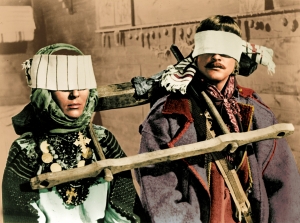
A still from Parajanov's Shadows of Forgotten Ancestors.

A still from Parajanov’s Shadows of Forgotten Ancestors.

Meanwhile, education and literacy were also promoted as was Russian-language instruction. Ethnic Russian teachers, workers, and supervisors from Moscow descended on the new region, creating a new Russian minority. They also were genuinely astounded by this unique and mountainous “lost province” that, in their view had been separated for so long from the “Russian motherland.” The fascination with Zakarpattia continued for much of the Soviet era and was even the subject of films and popular media. The great Soviet Armenian filmmaker Sergei Parajanov even made a film about Zakarpattia called Shadows of Forgotten Ancestors that met with critical acclaim internationally.

The Soviet nationalities’ policy also sought to promote the “Ukrainian” ethnonym among the Rusyn people of this region. The ethnonym has been largely adopted by the people, though most still speak the Rusyn language and adhere to their own cultural norms. The sense of uniqueness also persisted, though any debate about the Rusyn question was banned in the Soviet Union until glasnost. Under Gorbachev, discussion of the “Rusyn question” began to re-emerge and the Byzantine Ruthenian Catholic Church was rehabilitated. In 1991, voters in Zakarpattia overwhelmingly backed Gorbachev’s New Union Treaty. Later that year, Ukraine’s Kravchuk proposed a ballot on state sovereignty in Ukraine. This too was approved by voters in the region. However, more significantly, another provision on the ballot promising local autonomy passed by an even wider margin. Despite this vote, autonomy for the region was never granted.

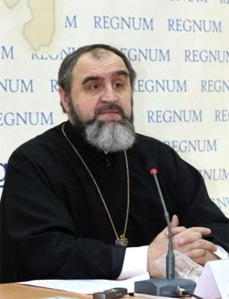
Fr. Dmitro Sydor

Fr. Dmitro Sydor

In 2008, some activists unsuccessfully attempted to declare a “Republic of Carpathian Ruthenia.” Those involved were later sent in for questioning by the Security Service of Ukraine for challenging “state integrity.” They included Fr. Dmitro Sydor, a Mukachevo-born priest of the Ukrainian Orthodox Church (Moscow Patriarchate) and chairman of the Congress of Carpathian Ruthenians. The main goal of the Congress is to achieve autonomy for the region. In March 2012, Sydor was found guilty for violation of the territorial integrity of Ukraine. He was sentenced to three years imprisonment with a suspended sentence of two years.

Politically, the region’s leanings have been mixed. As referenced earlier, Zakarpattia’s electoral politics is more like that of a Central Ukrainian than a Western Ukrainian region. The Party of Regions managed to carry Zakarpattia in the 2012 Ukrainian parliamentary election, contesting it heavily with Tymoshenko’s Batkivshchyna Party and the centrist United Center Party which draws its main base of voters from this region. In the 2010 presidential election, Tymoshenko won Zakarpattia, but by a very narrow margin against Yanukovych.

Meanwhile, the substantial Hungarian minority of Zakarpattia remains at a crossroads. Successive Hungarian governments have made a point to defend Magyar minority rights in neighboring countries. The Hungarians of Zakarpattia were no exception, and to this end, Hungary’s Viktor Orban supported of former Ukrainian President Yanukovych who placed great emphasis on protecting linguistic rights.

Since the Euromaidan revolution, the local Hungarian community has been uneasy and has viewed the influence of the far-right in the government as a serious concern. Among other things, local Hungarians were concerned about the initiative by the government (since abandoned) to scrap Ukraine’s regional language law.  Fortunately, in the wake of the unrest in Eastern Ukraine, the Turchynov-Yatsenyuk government has announced that it will allow for enhanced linguistic rights in the various oblasti.  Also, the Orban government in Budapest has opened the door in recent years for Hungarians abroad to receive Hungarian passports. This has been very significant for Hungarians in Zakarpattia, wary of nationalism in Ukraine and eager for jobs in the EU.

It is still unclear what full impact the Maidan revolution will have on the Rusyns. The region is currently governed by a member of the Batkivshchyna party appointed by the Turchynov-Yatsenyuk government. However, there is uncertainty with regard to how influential Kiev is in this region and how much support it has. It is very likely that most of the people here would favor a new federal constitution for Ukraine which would finally give them their long-desired autonomy. Yet, as always, what happens next remains to be seen.

UPDATE (13 June 2014): Watch rare footage of life in Zakarpattia/Carpathian Rus’ in interwar Czechoslovakia from the Czech National Film Archive here!

Who Governs What in Ukraine?

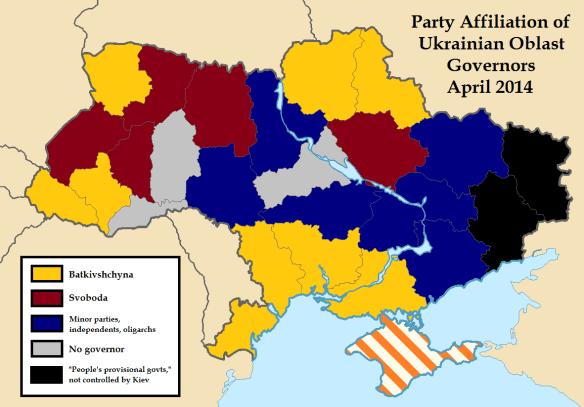
As events continue to unfold in Eastern Ukraine, there remains the question of who is governing the rest of the country. Following the overthrow of Yaukovych, the Turchynov-Yatsenyuk government appointed new regional governors across most of Ukraine. Their political affiliations are diverse and reflect the very hodge-podge and unstable nature of the present government. Herein is an oblast-by-oblast breakdown of who governs what in Ukraine, with an accompanying map. Overall, local leadership in the country can be broken down into five categories:

Party Affiliation of Ukrainian Oblast Governors, April 2014

Party Affiliation of Ukrainian Oblast Governors, April 2014

Batkivshchyna Party: The party of Turchynov, Yatsenyuk, and Tymoshenko governs eight oblasti. These include Volyn, Ivano-Frankivsk, and Zakarpattia in Western Ukraine, Chernihiv and Sumy in Central Ukraine, and Odessa, Nikolayev, and Kherson in Southern Ukraine. It is unclear how much authority Batkivshchyna wields in these regions. In Western Ukraine, the far-right group Right Sector was influential in Ivano-Frankivsk, where it has conducted fascist-style parades in March (though its credibility there is now reportedly on the decline). In Southern Ukraine, there is a growing movement in the Odessa oblast to overthrow the Batkivshchyna governor and to declare a “provisional people’s government” as was done in Donetsk and Luhansk in the Donbas. In the remote westernmost oblast of Zakarpattia, the Carpatho-Rusyns have been advocating regional autonomy since Ukraine’s independence in 1991. It is unclear what the current situation is there and how much genuine control Batkivshchyna has over this mountainous region.

Svoboda Party: The far-right Svoboda party is led by Oleh Tyahnybok who is known for his antisemitism, Russophobia, and admiration for wartime Nazi collaborator, Stepan Bandera. The Turchynov-Yatsenyuk government has granted Svoboda party members the governorship of five oblasti. These include three oblasti in Western Ukraine (Lviv, Ternopil, and Rivne) and two Central Ukrainian oblasti where Svoboda has historically had very little popular support (Zhytomyr and Poltava). It is unclear how much influence Svoboda’s militant ideological ally, Right Sector, has in these regions. However, it appears that there is some. Prior to his death in a shootout with police with the aid of the Kiev government’s interior ministry, Right Sector activist Oleksandr Muzychko seemed to have significant influence in the Svoboda-controlled Rivne oblast. This was particularly the case in the power vacuum that developed after Yanukovych fled the country following threats by Right Sector activists. A notorious war criminal, Russophobe, and antisemite, Muzychko (nicknamed Sashko Bilyi by his followers) was famously caught on video bullying and assaulting a local prosecutor in Rivne, shouting expletives at him, and threatening to pull him to Maidan with a rope around his neck.

It is unclear though if Muzychko’s assassination indicates a split between Svoboda and Right Sector. Though ideological allies, both seem to be vying for the position of “Ukraine’s true far-right.” To this end (and to seize power), both are attempting to expand their voter base by trying to appear “more moderate.” At first glance, this appearance of such a sudden embrace of centrism seems like a miracle akin to St. Paul falling off his horse on the Road to Damascus. Except, unlike St. Paul, there is nothing “saintly” about sinful scoundrels and antisemites like Muzychko, Oleh Tyahnybok, Dmytro Yarosh, and others whose politics can be best classified as “to the right of Genghis Khan.” These individuals and groups are just as extremist as they have always been. Western commentators must not be fooled. Israel certainly was not. In February, Right Sector attempted to persuade the Israeli ambassador to Ukraine that they were “not antisemetic.” Tel Aviv was unimpressed, so much so that it abstained from the UN vote on Crimea, much to the surprise and frustration of Washington.

Minor parties, independents, and oligarchs: In six more oblasti, the Kiev government has appointed minor party politicians, independent candidates, and oligarchs. These include the three Central oblasti of Kiev, Kirovograd, and Vinnytsia, the Eastern oblast of Kharkiv, and the two Southern oblasti of Zaporizhia and Dnipropetrovsk which once comprised the core of Nestor Makhno‘s breakaway anarchist “Free Territory” during the Russian Civil War of 1917-22. Two independent-oligarch governors were also appointed in the Donbas (Donetsk and Luhansk) but were overthrown in the recent unrest there. These Kiev-installed governors now effectively have no authority in these regions. Further, in the Kiev oblast, Right Sector has attempted to exercise some influence. In the Kiev suburb of Vasylkiv, Right Sector activists seized control of the town council amid protests shortly after Yanukovych’s overthrow. On the whole though, both Right Sector and Svoboda maintain much more influence in Western Ukraine. In regional elections, the far-right has always fared poorly in Central Ukraine.

No governors: Meanwhile, there are presently no governors at all in two Central Ukrainian oblasti (Cherkasy and Khmelnytsky) and one Western oblast (Chernivtsi).  Khmelnytsky and Chernivsti straddle the Central-West divide in terms of culture, language, and electoral politics.

Self-declared people’s provisional governments: In the Donbas, protests against the Turchynov-Yatsenyuk government have led to the declarations of “People’s Republics” with “provisional governments” in the oblasti of Donetsk and Luhansk. The Kiev-appointed governors have effectively lost authority in these regions which are practically controlled entirely by the rebels. Kiev claims that the rebels are “agents of Moscow.” Moscow disavows any involvement. In truth, there are Russians who are involved in the Eastern Ukrainian unrest, but these are not “government agents” but rather Russian nationalists who seek to assist their “compatriots” from across the border. On the whole though, much of the frustration leading to the unrest appears to have come from a genuine rejection of the Turchynov-Yatsenyuk government. To exclude any discontent among the people of Eastern Ukraine with the government in Kiev assumes that Ukraine and its Eastern oblasti specifically have no domestic concerns. In fact this is not the case. Kiev has been unable to assert control in this region. There was an attempt to do so this week by military means, prompting commentators’ fears of the start of a civil war. In the end, the troops from Kiev refused to fire on their East Ukrainian compatriots. Some simply drove away, while others defected to the rebels’ side. Meanwhile, there is a possibility that more “provisional governments” could appear in other Southeastern and even Central Ukrainian oblasti. Already in Odessa, there has been talk of a possible proclamation of an “Odessan People’s Republic” with “People’s Provisional Government of Odessa.”

A presidential election alone would not likely remedy this situation. Parliamentary elections, in which these distinct regions are properly represented, are a reasonable immediate solution to this current chaos.

How to Defuse the Ukraine Crisis

Below are ten basic provisions that I believe may ameliorate not only the Ukraine crisis but also the broader tension that currently exists between Russia and the West. Not all readers will agree entirely with these positions, but hopefully they will become a starting point from which to defuse the situation, proceed forward, and create mutually friendly, not hostile, relations among all parties:

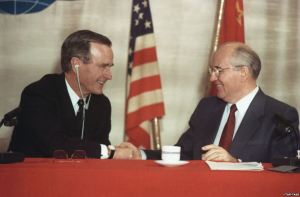
George H.W. Bush and Mikhail Gorbachev in Malta in December 1989 (ITAR-TASS).  The Bush administration informally promised Gorbachev that NATO would not expand "one inch" beyond East Germany.  The promise was never fulfilled.  To defuse the ongoing Ukraine crisis, a formal, written promise not to expand NATO by Washington to Moscow would do much to build mutual trust and confidence between both countries.

George H.W. Bush and Mikhail Gorbachev in Malta in December 1989 (ITAR-TASS). The Bush administration informally promised Gorbachev that NATO would not expand “one inch” beyond East Germany. The promise was never fulfilled. To defuse the Ukraine crisis, a formal, written promise not to expand NATO by Washington to Moscow would do much to build mutual trust and confidence between both countries.

1. The West and Russia should drop any mutual sanctions or restrictions against one another.

2. In order to encourage mutual trust, Moscow and Washington should make an unambiguous, official agreement prohibiting further expansion and encroachment of NATO into the former Soviet republics. Such an agreement must be clearly articulated in a written document, unlike the informal promise not to expand NATO made by US officials to former Soviet President Gorbachev in the 1990s.

3. The United States must promise to cancel the planned missile defense shield in Poland and the Czech Republic.

4. The United States should recognize Russia’s interests in the former Soviet states, including at least verbal support by Washington for the Moscow-based Eurasian Union, provided that it does not expand beyond the boundaries of the former Soviet states.

5. On Crimea, Washington, Brussels, and Kiev should recognize and accept Russia’s incorporation of the peninsula. This may be a difficult step to take, but the West and the Yatsenyuk government have to acknowledge that the area is demographically and historically Russian, and that it is home to Russia’s Black Sea Fleet. Moscow will not reverse this action and any attempts to force Russia to do so would be counterproductive. Therefore, Washington, Brussels, and Kiev should recognize the reality that Crimea is effectively part of Russia.

6. On Ukraine, both Moscow and Washington should express a desire to see Ukraine proper united and indivisible, and to adopt either an oblast-by-oblast federal system or a decentralized unitary system. Ukraine should declare military neutrality and should pursue integration into the Eurasian Customs Union based on Ukraine’s logical and historic economic ties with Russia; notwithstanding the fact that the EU economy currently cannot manage Ukraine. If Brussels were to bring in Ukraine, it would seriously threaten the stability and unity of the EU and would unravel the progress made over the decades of forging a united Europe. Both Russia and the EU should cooperate on helping Ukraine to strengthen its economy and state institutions by challenging the stranglehold of the Ukrainian oligarchs.

7. Given the fact that many Moldovan citizens are already EU citizens via Romanian passports, and that Moldova is becoming increasingly integrated with the EU, Moscow should recognize Moldova’s pro-European orientation.  In turn, Chișinău should relinquish its claims to Transnistria.  Depending on the situation in Ukraine and the will of the people of Transnistria, the latter could then reunite with the former as part of the multiethnic, Russophone Odessa Oblast. The new division would occur along the River Dniester, with all Moldovan-controlled areas on the right bank of the river being ceded to Transnistria, and all Transnistrian-controlled areas on the left bank being ceded to Moldova. The remaining Moldovan state would proceed with EU integration, but would declare military neutrality and disavow any intention of reunification with Romania.  Its relationship with the latter would then become akin to the relationship shared between Germany and Austria.  Such a resolution would alleviate ethnic concerns within Moldova, particularly with the Gagauz.

8. On Georgia, Moscow should promote (with the support of Washington) a federal solution for Georgia as well, making Abkhazia and South Ossetia federal states within a unified Georgian republic. The process for this should follow roughly along the lines of the proposed plan that I posted earlier. Like Ukraine, this new united Georgian federal state should declare military neutrality and, for economic, historical, and geographic reasons, should integrate into the Eurasian Customs Union.

9. On Armenia and Karabakh, the solution to this particular issue should be in the principle of self-determination for the Karabakh Armenians, though this is just an opinion. The aggressive and threatening rhetoric and actions from official Baku have only alienated the Karabakh people. Notably, Baku has also consistently denied basic human rights to its own ethnic Azerbaijani citizens. Thus, such a regime could not be trusted to rule over the people of this region. Aside from this, in order for there to be a realistic and lasting solution to this problem, Azerbaijan must open its borders with Armenia and civil society contacts must be enhanced. Armenians and Azerbaijanis can get along, but not when they do not see or communicate with one another. In their common humanity, they will find that peace and coexistence are possible, but the borders must be open first. Turkey too must open its border with Armenia.

10. Both sides should agree on a gradual convergence of the West and Russia (along with the former Soviet states) in economic, political, and military spheres, thus ensuring that all parties are on the same page with regard to the future of the post-Soviet space and post-Cold War world in general. There are so many more important priorities that need to be solved in the world (Iran, North Korea, Syria, etc.). Russia and the West need to cooperate on these issues and must not be in conflict. Further, such a solution would effectively help to realize the long-term goal of a united and indivisible Europe. It would also go a long way toward building trust with Moscow, thus creating the conditions for Russia to deepen its democratic development endogenously.

Federalism in Ukraine: How It Would Best Work

Several commentators and analysts have recently proposed the idea of a federal Ukrainian state as a means of balancing power between the more Ukrainophone West and Russophone Southeast. Such an idea could potentially work, but only if implemented on an oblast-by-oblast level, not on a broad regional level. The reason for this is that each individual oblast within Ukraine has its own unique nuances and circumstances which must be seriously considered.

Oblasts of Ukraine, 2014

Oblasts of Ukraine, 2014

For example, there is the far-western Zakarpattia Oblast. This mountainous region has been typically classified as being part of “Western Ukraine,” and indeed geographically, this is the case. However, as I wrote in an earlier analysis, the people here are so unique that many view themselves as a different East Slavic ethnic group entirely, known as Rusyns or Carpatho-Rusyns. They were promised autonomy by Ukraine’s first post-Soviet President Lenoid Kravchuk in the 1990s, but it was never implemented. There are also sizeable ethnic minorities here, particularly Hungarians, Romanians, Russians, Slovaks, and Gypsies. The region’s voting patterns tend to be more like that of a region in Central Ukraine rather than Western Ukraine, with close contests between pro-Russian and pro-Western candidates. A region with such a diverse and complex character as Zakarpattia would benefit greatly from federalism. It would gain better representation in Kiev and its unique concerns would receive much better attention.

Federalism would likewise benefit the Russophone regions of Ukraine’s Southeast. An example that comes to mind in this regard is the cosmopolitan Southeastern oblast of Odessa. Linguistically Russophone with smatterings of Surzhyk, this region is not only home to Ukrainians and Russians but also sizeable communities of Jews, Greeks, Armenians, Bulgarians, Romanians, Gagauz, Gypsies, and others. A federal structure of government would guarantee representation for Odessa’s mosaic of multiculturalism (with an emphasis on “culture” as this, between literature, theatre, and humor, is a truly Odessan specialty).

Further, other regions in the mixed Surzhyk-Russophone Central Ukraine would also benefit. I earlier highlighted unique oblasts such as Sumy and Kirovohrad with very sizeable Russophone populations and highly competitive elections between pro-Russian and pro-Western candidates. Federalism would give the people of these and other oblasts in the more mixed Central Ukraine a better voice in Kiev as well.

Given this, one must acknowledge that despite its potential benefits, federalism can be a difficult system to both design and implement. It requires consensus and balance of the kind that is currently not present in Ukrainian politics, especially in the present Yatsenyuk government. In fact, rising tensions behind the scenes between Washington and Moscow may only serve to complicate the situation further.

However, bearing that in mind, one can be cautiously hopeful for a future federal solution in Ukraine. It is a solution that can bring the country together and can avert a major crisis such as a potential partition or conflict. A partition of Ukraine would be especially troublesome, particularly given the mixed character of Central Ukraine. If hostilities were to erupt between the West and Southeast, the Center could become divided by loyalties between the two, with divisions even running through families. Meanwhile, in a potential partition or conflict, the unique region of Zakarpattia may even takes its own path.

That said, the best way to avert such a potential scenario would be to find a way to better represent the diverse population of Ukraine and to guarantee the balance-of-power. Such a solution can be found in federalism, provided that it be a federal system implemented on an oblast-by-oblast basis.

Moldova and Transnistria: An Overview

Updated and revised on 20 September 2016 with additional information, including the economic and political roots of the Transnistrian conflict (in addition to the historical factors). Please note that this entry was originally written in April 2014 and thus does not cover subsequent political developments in Moldova, such as the rise of the Euroskeptical and pro-Moscow Party of Socialists and Patria-Rodina bloc. It also does not cover subsequent events in Ukraine, such as Mikheil Saakashvili’s appointment to the governorship of the Odessa Oblast.
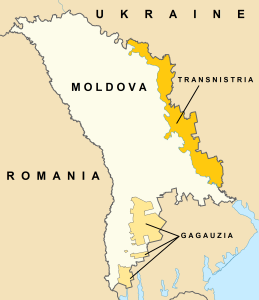
Map of Moldova, Transnistria, and Gagauzia

Map of Moldova, Transnistria, and Gagauzia

Moldova and its breakaway region of Transnistria have been in the news a lot lately. I will attempt to give some historical background to this complex borderland in my analysis below.

The EU’s Eastern Partnership (EaP) program included within its scope the six countries of the former Soviet west. These were Belarus, Moldova, and Ukraine in Eastern Europe and Armenia, Azerbaijan, and Georgia in the Caucasus. Of the six, Belarus and Azerbaijan expressed little interest in the project. However, the remaining four states – Armenia, Georgia, Moldova, and Ukraine – actively participated in it. The motives of these states’ involvement in the EaP varies. In the cases of Armenia, Georgia, and Ukraine, the leaderships of these countries used the geopolitical competition between Russia and the West to get the best terms for their countries. Armenia’s Sargsyan and Georgia’s Ivanishvili have both played this chess game especially well as their countries have a history of playing Great Powers off of each other to their own advantage. In this respect, they are neither categorically “pro-Russian” nor “pro-Western,” but rather “pro-Armenian” and “pro-Georgian” respectively. Ukraine’s Yanukovych attempted to play this game too but proved far less decisive and pragmatic than his Caucasian counterparts. Meanwhile, the leadership of Moldova has pursued an entirely different path. It seeks to fully free itself from Moscow’s orbit and to integrate into the EU regardless.
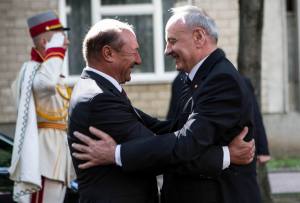
Romanian President Traian Băsescu (left) and Moldovan President Nicolae Timofti (right) in Chișinău in July 2014 (President of Romania)

Romanian President Traian Băsescu (left) and Moldovan President Nicolae Timofti (right) in Chișinău in July 2014 (President of Romania)

Indeed, if there is one state out of all the EaP countries that is thoroughly committed to Europe and sincerely interested in leaving Moscow’s orbit once and for all, it is Moldova. The leadership in Chișinău, under President Timofti and Prime Minister Leancă, is entirely committed to the idea of firm and total European integration. Additionally, out of all the EaP states, Moldova is arguably in the best position to become a candidate for EU accession geographically, politically, and economically, making it an “easy pill to swallow” by EU standards. Within the EaP, Moldova also represents a very unique case because their main backer within the EU is Romania. Romanian President Traian Băsescu has lobbied hard for Moldova’s integration into the bloc and would never allow his ethnic Latin Vlach cousins to end up outside of the EU. In the early 1990s, Romania was the first country to recognize Moldova’s independence. It also has allowed for Moldovan citizens to obtain Romanian passports. This has caused a large flow of Moldovans to enter the EU “through the back door.”

Historical background
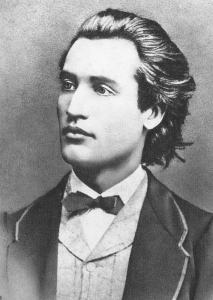
Mihai Eminescu in Prague in 1869

Mihai Eminescu in Prague, 1869

The reasons for the close Romanian-Moldovan relationship are both ethnic and historical. Moldova corresponds almost exactly to the historical Romanian region of Bessarabia, located between the Dniester and Prut rivers. The majority of its population are ethnic Romanians, who speak Romanian. The colors on the Moldovan flag are almost exactly the same as those on the Romanian flag. Likewise, both countries consider the Romanian poet Mihai Eminescu to be their national poet. Along with a good portion of eastern Romania, Bessarabia had once formed a major portion of the old Vlach-speaking principality of Moldavia. In 1812, it was annexed by the Russian Empire, but after the 1917 Russian Revolution, the region’s local leaders formed a National Council (Sfatul Ţării) and voted to join the Kingdom of Romania in 1918. It remained a part of Greater Romania for much of the interwar period.

As a challenge to Romania’s control of Bessarabia, the Bolsheviks created the Moldavian Autonomous Soviet Socialist Republic (ASSR) in 1924 in Soviet Ukraine. Most of the territory of the Moldavian ASSR corresponds to the now-breakaway region of Transnistria. Inhabited primarily by a mixed population of East Slavs and Romanians, this territory was never part of Bessarabia or the historic principality of Moldavia. The Soviets instead used the region as a means of arguing that the Moldovans were not a branch of Romanians but an entirely unique people.

“Scholars from the West, in particular the German ethnographer Gustav Weigand, had noted earlier in the century that Romanian-speakers in Bessarabia and Bukovina spoke a dialect distinct from those in the Romanian kingdom,” wrote historian Charles King in his excellent overview, The Moldovans, “but these differences were no more striking than regional variations inside Romania itself. In the MASSR, however, these distinctions were imbued with political meaning.” These dialectal differences served as the basis for the creation of a new “Moldovan” language, which, despite its Cyrillic alphabet, was virtually identical to Romanian.
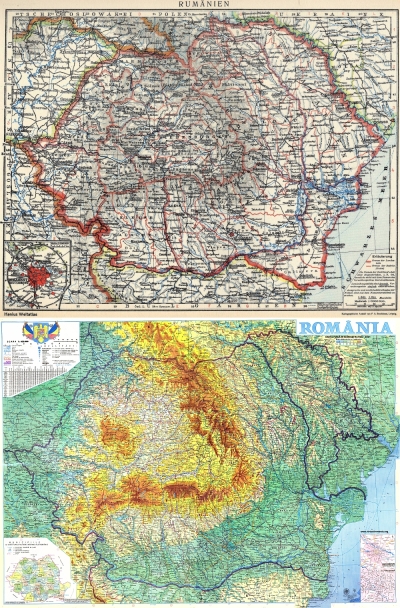
Maps of Romania and Moldova. The top map from 1926 shows "Greater Romania" including Moldova within its borders. The bottom map from 2001 shows the present-day boundaries of Romania and Moldova.

Maps of Romania and Moldova. The top map from 1926 shows the interwar Kingdom of Romania including Moldova within its borders. The bottom map from 2001 shows the present-day boundaries of Romania and Moldova.

In June 1940, the USSR annexed Bessarabia as part of the Molotov-Ribbentrop Pact. Most of the area was united with much of the old Moldavian ASSR (modern Transnistria) to form the new “Moldovan SSR.” When the Nazis invaded the Soviet Union during World War II, Romania under the fascist leadership of Ion Antonescu joined the German war effort. The Romanian forces not only regained Bessarabia from the Soviets but pressed on further east to take all of the territory between the Dniester and Southern Bug rivers, including the historic city of Odessa. The new territory, administered by Romania, was called “Transnistria.” Hitler granted it to Antonesu as compensation for giving Transylvania to Horthy’s Hungary in the Second Vienna Award. The Romanian administration of this “Transnistria” was very brutal for the local population, especially for the Jews. When the tide turned in the war, the region was recovered by the Soviets along with Romanian-speaking Bessarabia. By the end of the war, the 1940 borders between the Soviet Union and Romania were now reestablished.

With the onset of perestroika, nationalist elites in Moldova began to gain power and sought to reunite their republic with Romania. However, political concerns prevented this from occurring. Reunification was especially rejected by the people of Transnistria who bristled at the new nationalistic rhetoric from Chișinău.  In contrast to the nationalist elites gaining influence in the capital, the Transnistrians argued that they had never been part of historic Bessarabia.  Many also still had memories of the brutal wartime administration of Transnistria by Antonesu’s Romania. “The Transnistrian war was in no sense about ancient hatreds between eastern Latinity and Slavdom,” wrote King, “but history did play an important role.”

No less significant to the conflict were economic, social, and political factors.  Whereas most of Moldova west of the Dniester was largely rural and agricultural, Transnistria was mostly urban and industrial.  Moreover, after the war, the region became an important industrial center in the Soviet economy and played a significant role in the Soviet military industrial complex.  “After 1945,” wrote King, “Transnistria became a central component of the Soviet defense sector and its heavy industry.  Some four-fifths of the region’s population was employed in industry, construction, and the service sector.”

The industrialization of Transnistria in the Soviet era also fueled the migration of East Slavs into the region, thus making it more distinct from the rest of Moldova and more “Soviet.”  “Internal immigrants arrived to work in the new factories, increasing the Russian and Ukrainian portions of the population,” wrote King.  “The key issue… was not how Russian the region became after the war, but how quintessentially Soviet… The primary loyalty of individuals in the region was not to Russia – even though most spoke Russian and had ties to the Russian republic – but to the Soviet Union.”

Attempts at centralization by the nationalist government in Chișinău only exacerbated the differences with Transnistria.  “Soviet” elites in the latter began reacting to the nationalist elites in Chișinău.  “Already in the late 1980s,” wrote King, “there developed a dynamic that would culminate in full-scale war by 1992: Every move in Chișinău that pulled the republic further away from Moscow was met by a countermove in Transnistria that drew the region itself farther away from Chișinău.”  This eventually led to Transnistria militarily breaking away from Chișinău to form its own self-proclaimed republic in 1992.

Moldovan elites were likewise concerned about the Gagauz, a unique group of Turkic-speaking Orthodox Christian people whose homeland straddles the southern boundaries between Moldova and Ukraine. After the Soviet collapse, the Gagauz “made common cause with the Transnistrians” but did not go so far as to proclaim their own independent republic. Still, in December 1994, Chișinău granted them their own autonomous unit in the south known as Gagauzia. The situation has been stable and the Gagauz have likewise been granted the right to secede if Moldova decides to reunite with Romania. Chișinău offered a similar deal to Transnistria, but there has been no resolution on this to date.

In the 2000s, the head of the Moldovan Communist Party, Vladimir Voronin was elected President of the country, the first such case in the former USSR. Though claiming to be supportive of European integration, Voronin, a highly Russified Moldovan, also sought to expand ties with Russia. However, his administration did little to improve the lives of everyday Moldovans, and poverty and corruption remained major problems. A victory for the Communist Party in Moldova’s April 2009 parliamentary election, though hailed as free and fair by European observers, sparked major protests and civil unrest. Student demonstrators clashed with police, stormed the parliament, and carried the flags of Romania and the European Union, chanting slogans like “We are Romanians!” and “Down with Communism!” At least five students died because of the riots. President Voronin responded by placing the blame for the unrest on Bucharest, which denied any involvement. Three months later, Moldovan state prosecutor Valeriu Gurbulea confirmed that Romania had nothing to do with the protests.
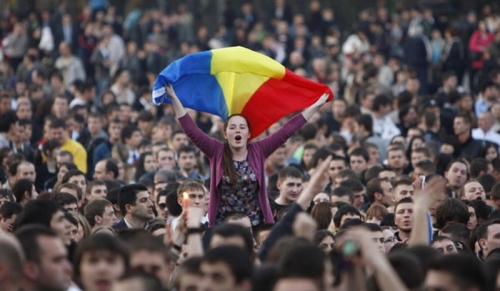
Protests in Chișinău, April 2009 (Reuters/Gleb Garanich)

Protests in Chișinău, April 2009 (Reuters/Gleb Garanich)

Though successful in the April 2009 elections, the newly elected parliament was unable to elect a President in June. Consequently, Voronin had to dissolve parliament, thus paving the way for snap parliamentary elections in July 2009. This election brought to power a new governing coalition of liberal political parties collectively known as the Alliance for European Integration (AEI). Voronin resigned from the presidency in September but the AEI was unable to elect a president until March 2012, when the independent judge Nicolae Timofti was finally voted into office.

As their name implies, the top priority of the AEI and its successor the Pro-European Coalition (PEC) has been EU integration and EU membership. It took advantage of Moldova’s position with the Polish-Swedish EaP initiative and quickly emerged as the most progressive ex-Soviet state in terms of EU reforms. Among other things, the AEI advanced the issue of visa liberalization in Moldova. On April 3, 2014, it was announced that there will now be a visa-free regime between Moldova and the EU’s Schengen Area. Moldova also confirmed the final version of its Association Agreement with the EU at the November 2013 Vilnius Summit to be signed in June 2014.

Further, under the AEI and PEC, Chișinău also moved increasingly closer toward Romania. In December 2009, the AEI announced that it would be removing the barbed wire fence separating their country from Romania. On December 5, 2013, the PEC recognized Romanian as the official language of the Moldovan republic. This move was welcomed by Romania’s Traian Băsescu who has long favored reunification with Moldova. On the eve on the Vilnius Summit, he stated:
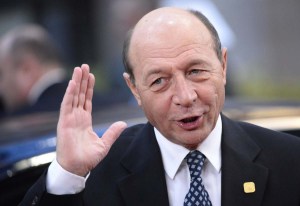
Romanian President Traian Băsescu (AFP/Getty/Lionel Bonaventure)

Romanian President Traian Băsescu (AFP/Getty/Lionel Bonaventure)

When a nation has the opportunity to be together, it should not give up. It may not happen straightaway, but it will happen one day, because blood is thicker than water. I think this is the right time to say that we have this objective, if Moldovan people want this. I am convinced that if Moldova wants to unite, then Romania will accept.

He also stated that after joining the EU and NATO, Romania’s third priority must be reunification with Moldova, though given official Chișinău’s concerns with ethnic minorities such as the Gagauz, it would likely be less enthusiastic about taking such a step.

Băsescu further cautioned that “the big risk for Moldova would be a treatment with arrogance by EU – be aware, I use the word with responsibility – which would not take into account the electoral realities in Moldova.” Moldova still faces many challenges to its EU road, both domestic and foreign. Internally, Vladimir Voronin and the Communist Party advocate a strongly pro-Russian stance, ultimately favoring membership in the Eurasian Customs Union. The Communists adhere to a strong Moldovenist position, advocating a unique “Moldovan” identity and firmly rejecting the idea that the “Moldovan language” is in fact the Romanian language. “Moldova can become a European country only by joining the Customs Union,” the 72-year-old Voronin told a crowd of largely elderly anti-EU activists from the Communist Party.
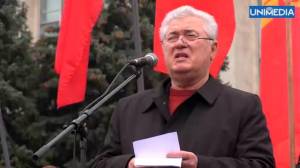
Vladimir Voronin (Unimedia)

Vladimir Voronin (Unimedia)

However, Voronin and the Communists are not a spent force. As Băsescu alludes, they have a substantial following within Moldova. Though they lost the July 2009 parliamentary election to the AEI coalition, the Communists still garnered 44.69% of the vote. They poll especially well in the north of the country and also among the substantial East Slavic minority of Moldova proper, which numbers about 14% of the total population. They also do well among the Gagauz in the south who fear that closer relations with Romania could threaten their hard-won autonomous status. Consequently, the possibility of Moldova’s pro-EU coalition losing to the communists is very real for Moldova in terms of its future geopolitical orientation. Still, for the immediate future, this risk is mitigated by the fact that Moldova’s next parliamentary election will not be held until November 2014, several months after Chișinău is set to sign the final version of its Association Agreement with the EU in June 2014.

There are also external challenges. Like Ukraine and Armenia, Moldova too is heavily dependent on Russian energy. It currently imports all of its natural gas from Russia, though the newly-inaugurated Iași-Ungheni pipeline with Romania promises to undermine this total dependence. A wine-producing country, Moldova also exports 28% of its wine production to Russia (for comparison, 47% of Chișinău’s exports go to the EU). A recent embargo by Moscow of Moldovan wine, due to an alleged trace of plastic contamination found in barrels of devin, has been a serious issue for the country. Some claim that the ban was politically motivated as a means of pressuring Chișinău to change its pro-EU geopolitical orientation, an assertion that Moscow has flatly denied. In addition, as many as half a million Moldovans are estimated to work illegally in Russia. Significantly, approximately the same number have Romanian passports and have departed the country to work in Western Europe, with Traian Băsescu provocatively claiming the number to be much higher, up to 1.5 million.
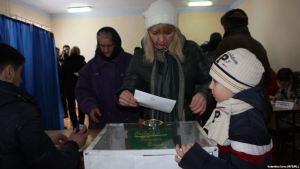
A Gagauz Woman Casts Her Ballot in February 2014 Referendum in Gagauzia (Valtenia Ursu/RFE/RL)

A Gagauz Woman Casts Her Ballot in the February 2014 Referendum in Gagauzia (Valtenia Ursu/RFE/RL)

However, Moscow’s biggest cards to play with regard to Chisinău’s EU ambitions are its distinct ethnic regions of Gagauzia and Transnistria. Gagauzia is not a breakaway region but rather an autonomous unit comprised almost entirely of ethnic Gagauz. Though content with remaining part of Moldova, the Gagauz are concerned about how joining the EU could affect their future, especially given Romania’s involvement. Recently, the Gagauz leadership held a referendum in February 2014 that rejected the country’s pro-EU aspirations and reaffirmed its right to secede from Moldova in the case of reunification with Romania. Though condemned by the Moldovan court as “unconstitutional,” this referendum was clearly intended as a warning to Chișinău against the possibility of a future reunification with Romania in which the Gagauz autonomy might be threatened. For the record, ex-communist Romania has consistently refused to grant autonomous status for any ethnic minority in its country including, most notably, the ethnic Hungarians of the Székely Land. Traian Băsescu himself has ruled out any possibility of a future Hungarian autonomy. Following the referendum, the pro-EU Moldovan government sought to reassure the Gagauz that a reunification with Bucharest was not imminent, and that the EU will actively work to better guarantee their minority rights. Whether or not the Gagauz will be adequately convinced of Moldova’s European choice remains to be seen. If left unresolved, this issue could devolve into a very serious crisis.
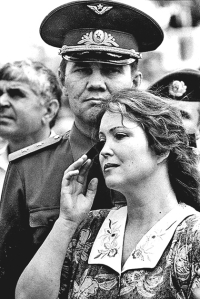
Aleksandr Lebed in Tiraspol, the capital of Transnistria, during the 1992 war.

Aleksandr Lebed in Tiraspol, the capital of Transnistria, during the 1992 war.

Most significantly of all, there is the unresolved conflict over Transnistria. The majority of Transnistria’s population is East Slavic (Russians, Ukrainians, and Belarusians who collectively make up 60% in total according to the 2004 census) and Russian is the dominant language. Politically, the pro-Russian orientation is strong here and is reinforced by the presence of the Russian 14th Army (now known as the Operational Group of Russian Forces in Moldova). Aleksandr Lebed, the Bonapartist Russian strongman from the 1990s, played a key role in Transnistria’s 1992 war of independence from Moldova proper. He viewed himself as the liberator of Transnistria from the “fascists” and “ideological heirs of Antonesu” in Chisinău. He is regarded as a hero here.

Towards a potential solution

While Moldova is officially committed to returning Transnistria under its rule, it is unclear what benefit this would bring to the country as a whole. For one thing, Transnistria does not have a deep historical relationship with Moldova. Even the poet Eminescu in his famous work Doina spoke of the Romanian nation as only stretching “from the Dniester to the Tisza.” Unlike Georgia’s conflicts with Abkhazia and South Ossetia, in which the Georgians attach deep emotional and historical significance to their breakaway regions, the same really cannot be said for Transnistria and Moldova. Transnistria was attached to Moldova proper in 1940 and thus was only associated with it for 52 years until its secession in 1992. Compare that to the Georgian-Abkhazian or Georgian-Ossetian relationships which extend back several centuries into history.

Indeed, most Moldovans, according to various opinion polls, are indifferent toward Transnistria. For the vast majority, the issue ranks as the ninth or tenth priority for the population of Moldova proper. Fewer than two percent consider the issue to be the most pressing, while “five percent consider it second, well behind issues such as poverty, crime, or inflation.” According to one observer, “this stands in striking contrast to the much higher preoccupation with frozen conflicts in other post-Soviet countries such as Azerbaijan and Georgia.”

In addition to this, Transnistria can be viewed as more of a major economic liability for Chișinău than a benefit. Though Moldova currently owes virtually no debt for its gas imports from Russia, Transnistria owes approximately $4 billion to Gazprom. Moscow presently holds Chișinău accountable for this debt. The only way to get rid of it would be for Moldova to entirely relinquish its claims to the disputed territory.
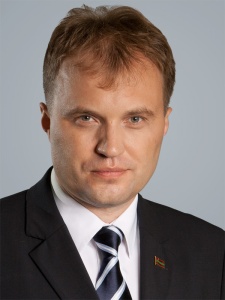
Transnistrian President Yevgeny Shevchuk. An ethnic Ukrainian and anti-corruption activist, Shevchuk is keen on forging closer ties with Moscow.

Transnistrian President Yevgeny Shevchuk. An ethnic Ukrainian and anti-corruption activist, Shevchuk is keen on forging closer ties with Moscow.

Meanwhile, Transnistria’s current President Yevgeny Shevchuk, while not the Kremlin’s choice in the Transnistrian election, has continued to maintain strong ties with Moscow. An ethnic Ukrainian, Shevchuk studied in both Ukraine and Russia and was elected as a reformer committed to challenging corruption and oligarchy, not as an advocate for reunification with Moldova. After his election in 2012, he immediately met with Sergei Ivanov, one of Putin’s closest associates and an influential member of his inner-circle. He also advocated that Transnistria adopt the Russian ruble and Russian laws, with the ultimate aim of Transnistria joining the Eurasian Union.

Observing this scenario, it seems that while Moldova proper is increasingly moving closer toward the EU, Transnistria is moving very much in the opposite direction toward the Eurasian Union. A potential, logical, and peaceful solution to this problem would be the formal separation of these two entities from each other. Moldova’s pro-EU leadership could recognize Transnistria and relinquish all claims to it, while working with the authorities in Tiraspol to delineate the border between the two states.  Given Transnistria’s limited viability as an independent entity, Moscow could work with Tiraspol and Ukraine to consider the possibility of reuniting the former with the latter.   A solution like this would satisfy Transnistria’s pro-“Soviet” and pro-Slavic sentiments and would absolve Moldova of any lingering debt to Gazprom. It would also help reduce any sort of ill feelings in Ukraine toward Moscow for its recent incorporation of Crimea.  However, such a resolution is entirely contingent on the people and the elites of Moldova and Transnistria and on how the situation in Ukraine develops.  It could only work if a new government more amiable toward Moscow and Tiraspol emerges in Kiev.

It also should be noted that Moldova proper is of marginal significance to Moscow. The country is poor, landlocked, and Romanian-speaking, with few natural resources and very little geostrategic value. It is already very much integrated with the EU and a sizeable number of its citizens already have Romanian/EU passports. Additionally, the inauguration of the Iași-Ungheni pipeline will likely substantially reduce Moldovan energy dependence on Moscow. Thus, the best and most logical solution to the ongoing Transnistria problem would be its split from the Moldovan state and its eventual reunification with Ukraine.

How the West Got Moscow’s Eurasian Union Wrong

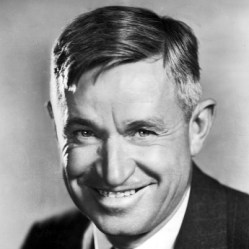
Will Rogers (Biography)

Will Rogers (Biography)

Will Rogers, the noted American entertainer and radio personality, once famously joked that “Russia is a country that no matter what you say about it, it’s true.” This holds true today, especially in the Western press.

One example of this is the Russian initiative to form the Eurasian Union, a supranational union comprised of former Soviet republics. This has been largely criticized in the West as either a “New Russian Empire” or a “New Soviet Union.” In 2012, former US Secretary of State Hillary Clinton referred to the project as a “move to re-Sovietise the region.” While acknowledging that the Eurasian Union will not be called “the Soviet Union,” she also stressed “let’s make no mistake about it. We know what the goal is and we are trying to figure out effective ways to slow down or prevent it.” Timothy Synder, the author of Bloodlands: Europe Between Hitler and Stalin, went even further in his denunciation of the concept, referring to it as the realization of the anti-liberal neo-fascist Eurasianist schemes of Aleksandr Dugin. He specifically cited Dugin as “the ideological source of the Eurasian Union” and that his work constitutes “the creed of a number of people in the Putin administration.”

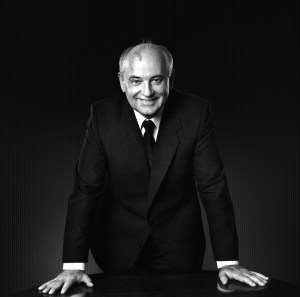
Beyond the headlines, though, what exactly is the Eurasian Union? Is it truly an anti-Western conspiracy of neo-fascists, Bolsheviks, and boogie men opposing liberal ideals worldwide which, like Soviet communism, needs to be “contained?” Or rather is it a supranational liberal economic union promoting free trade and open borders with the former Soviet republics who already share close historical, economic, and cultural links with Russia? For the answer to this question, one must turn to the history of the Eurasian Union idea. Indeed, if one explores the history of the Eurasian Union concept, one discovers that its originator was not Aleksandr Dugin, but in fact, Mikhail Gorbachev.

Mikhail Gorbachev

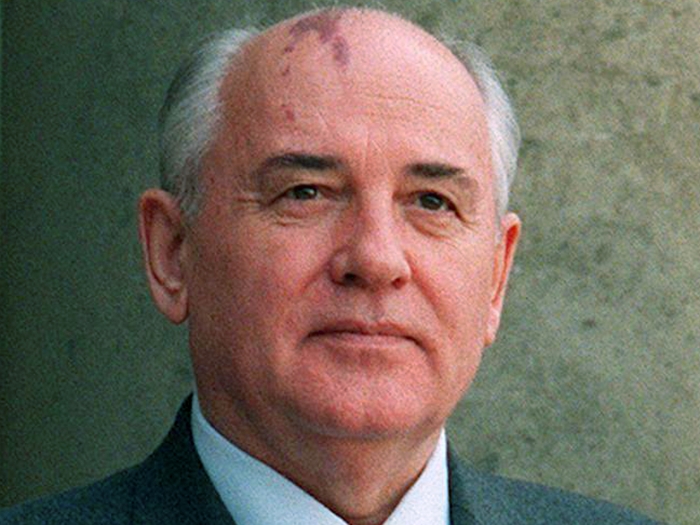
Mikhail Gorbachev

As the Soviet system and Soviet communism was collapsing in the early 1990s, then-Soviet President Gorbachev took a bold step that is often overlooked: he proposed the basic framework for a reformed Soviet state. The new state would be a non-communist democratic federation (under Gorbachev, the Communist Party already began to lose its monopoly on power in 1989, a fact that became official with his creation of the Soviet Presidency in March 1990).

Gorbachev anticipated a referendum in which Soviet voters would be given the choice to vote on the establishment of this new state in March 1991. This referendum on a New Union Treaty was approved by the vast majority of Soviet citizens, including those in then-Soviet Ukraine, who favored it by 82%. It should be noted that a significant number of West Ukrainian activists had boycotted Gorbachev’s referendum, but even if one were to include the boycotted votes as “no” votes, then the overwhelming majority of Ukrainians still favored Gorbachev’s new union by a wide margin. Additionally, the only other Soviet republics that boycotted the referendum were the three Baltic states (which sought independence), Moldova (which sought to reunify with Romania), Armenia (which was frustrated with Moscow over its indecision on Nagorny Karabakh), and Georgia (under the influence of nationalist dissident leader Zviad Gamsakhurdia). Other than this, the referendum passed overwhelmingly.

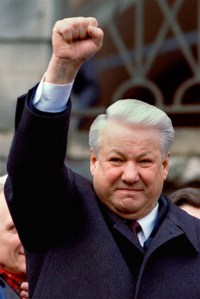
Boris Yeltsin

Boris Yeltsin

Despite the fact that the referendum was favored by the vast majority of Soviet citizens, it was never implemented. In August 1991, communist hardliners, who bristled at Gorbachev’s glasnost, put the Soviet leader under house arrest in Crimea. In the end, the putschists were faced down by the leader of the then-Soviet Russian republic, Boris Yeltsin and the coup collapsed. Following the coup, Gorbachev sought to pursue the establishment of the new union that the majority of Soviet citizens favored in the March referendum. However, Yeltsin insisted on a confederation of states as opposed to a state federation. Gorbachev was initially opposed, fearing that a confederation would lead to disaster. However, in the end, Gorbachev relented and backed the confederation proposal.

However, even the idea of a confederation was not realized. Without Gorbachev, Yeltsin, along with Ukraine’s Lenoid Kravchuk and Belarus’ Stanislav Shushkevich, formally dissolved the Soviet state at meeting in the Belavezha Forest. Gorbachev lost his position and the 15 Soviet republics were now formally independent states, with some, like the Baltics, Armenia, and Georgia, proposing independence referendums earlier. However, Yeltsin apparently did not want to totally severe Russia’s ties with the other former Soviet states (now known as the “near abroad”). Indeed, the Belavezha Accords also gave birth to the Commonwealth of Independent States (CIS), a loose association of 12 of the 15 former Soviet republics (understandably, the Baltics for historical reasons did not participate).

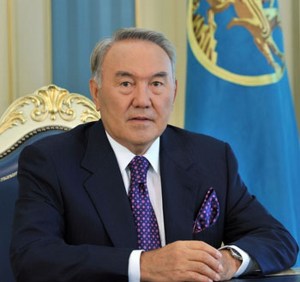
Nursultan Nazarbayev

Nursultan Nazarbayev

During his administration, Yeltsin never formally lost sight of maintaining Russia’s links with the former Soviet states, despite major problems in Russia itself (most of which were arguably the result of his own policies). In 1992, the Collective Security Treaty Organization (CSTO) was formed, initiating a sort of military alliance among the various ex-Soviet states. Two years later in 1994, in an address to a Moscow university, Kazakhstan’s Nursultan Nazarbayev proposed an early concept for an EU-style supranational union of the ex-Soviet states. Then in 1996, this idea evolved into the Treaty on Increased Integration in the Economic and Humanitarian Fields signed by Belarus, Kazakhstan, Kyrgyzstan, and Russia.  This was followed by the Treaty on the Customs Union and the Single Economic Space in 1999 signed by the same countries along with Tajikistan.  Finally, in 2000, the Eurasian Economic Community (EurAsEC) was formed.

Again, I have cited three individuals in this historical overview: Gorbachev, Yeltsin, and Nazarbayev.  All three favored some sort of integration and association among the former Soviet states prior to the major writings of Aleksandr Dugin in 1997, including his controversial fascist-Eurasianist work The Foundations of Geopolitics. The assertions that the Eurasian Union, at its heart, is a Duginist scheme do not take into account the integration processes that were already in progress within the former Soviet Union and therefore are both incorrect and anachronistic.

It can likewise be definitively concluded that, given the fact that organizations like the EurAsEC serve as a direct predecessor to today’s Eurasian Customs Union, the ideology and political philosophy of Moscow’s present-day post-Soviet integration effort is not intended to be a conspiratorial neo-fascist or anti-Western coalition. Rather, it is at its core a liberal idea, intended to promote open borders, free trade, and economic and cultural exchange among the ex-Soviet states, who already share much culture with Russia. In the words of fellow Russia watcher and commentator Mark Adomanis:

Without lapsing into cartoonish Kremlinology, I do think it’s noteworthy and important that Putin is so publicly and forcefully going on the record advancing a broad program of technocratic neoliberalism: harmonizing regulations, lowering barriers to trade, reducing tariffs, eliminating unnecessary border controls, driving efficiency, and generally fostering the free movement of people and goods. Even if not fully sincere, an embrace of these policies is healthy.

…Anything that makes Russia more open to people and commerce is positive and can only serve, in the long-term, to weaken the foundations of its current hyper-centralized system.

Efforts toward Eurasian integration continued apace under the Putin presidency. According to Mikhail Gorbachev in a 2009 interview with the Moscow-backed network RT, Ukraine seemed to have expressed interest in the project as well:

We were close to creating a common economic zone, when Kuchma was still in power. These four countries – Russia, Belarus, Ukraine and Kazakhstan had 80% of the potential of the whole Soviet Union. It was a great force. And if you look at all the natural resources… But then many things got in the way of this process – Caucasus, Ukraine.
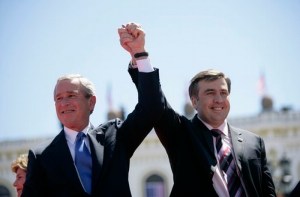
US President George W. Bush with Georgia's Mikheil Saakashvili

US President George W. Bush with Georgia’s Mikheil Saakashvili

The “things” to which Gorbachev referred were efforts by the United States to expand its geopolitical sphere of influence deep into post-Soviet territory, particularly in Ukraine and Georgia. The US administration of George W. Bush, with the aid of Western NGOs and both major American political parties, sought to promote pro-Western “color revolutions” in the ex-Soviet states. They aggressively focused particularly on Georgia, which was Moscow’s historic “center” in the Caucasus, and Ukraine, a country with which Russia shares deep historical, cultural, economic, and even personal ties. The spread of such revolutions also happily, and not coincidentally, intersected with American and Western energy interests in the region. American oil companies showed particular interest in resource-rich states like Azerbaijan and the “stans” of Central Asia.

George F. Kennan

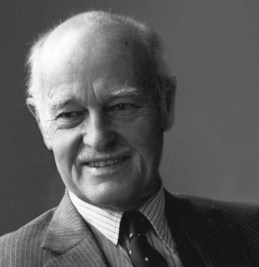
George F. Kennan

The new leaderships of both Ukraine and Georgia also set an overtly pro-Western course to join both the EU and NATO, much to the Kremlin’s annoyance. In the early 1990s, the administration of US President George H. W. Bush squarely promised Soviet leader Mikhail Gorbachev that NATO would “not move one inch eastward” beyond East Germany as a means to ensure Soviet support for German reunification. However in 1997, under the Clinton administration, the United States backpedaled on its promise to Moscow by inviting several former Warsaw Pact countries into NATO and also intimating the promise of EU membership. Though accepted by Yeltsin, the expansion of NATO by Washington annoyed and antagonized Moscow. In this regard, the words of the great diplomat, George F. Kennan in February 1997 were especially prophetic:

Expanding NATO would be the most fateful error of American policy in the entire post-cold war era. Such a decision may be expected to inflame the nationalistic, anti-Western and militaristic tendencies in Russian opinion; to have an adverse effect on the development of Russian democracy; to restore the atmosphere of the cold war to East-West relations, and to impel Russian foreign policy in directions decidedly not to our liking.

Gorbachev echoed this sentiment in his 1999 book On My Country and the World:

The danger of a new division of the continent has arisen with NATO’s expansion to the East, which will inevitably encourage military preparations in a number of countries on the continent.

Václav Havel

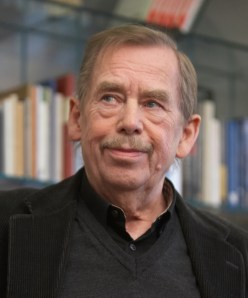
Václav Havel

However, neither Kennan’s nor Gorbachev’s words were ever heeded by Washington policymakers. Eventually, both NATO and the EU expanded to include virtually all of the former Warsaw Pact states in Central-Eastern Europe as well as the three former Soviet Baltic states. The late Czech President Václav Havel likewise observed that while the Kremlin was annoyed by NATO expansion in Central-Eastern Europe, the expansion into the three Baltic states caused even greater concern to them. Now NATO was on the very doorstep of St. Petersburg. Havel specifically recalled in his 2007 memoir To the Castle and Back:

It was no longer just a small compromise, but a clear indication that the spheres of interest once defined by the Iron Curtain had come to an end. Yeltsin had generously supported Czech membership in NATO, but the Baltic republics must have been very hard for Putin to swallow.

Feeling threatened by the prospect of further NATO expansion and by the provocative behavior of the new “color revolution” governments in Kiev, and especially Tbilisi (with Georgian President Mikheil Saakashvili being especially antagonistic), Moscow redoubled its post-Soviet integration efforts. The groundwork for the present-day Eurasian Customs Union was first laid in August 2006 at an informal EurAsEC summit meeting in Sochi between Putin, Nazarbayev, and Belarus’ Aleksandr Lukashenko.

Efforts toward forming the actual Customs Union intensified in 2008, the year of the NATO Bucharest Summit, the South Ossetian war, and the start of the Eurozone crisis.  They intensified even more the following year, especially after the official formation of the EU’s Eastern Partnership (EaP) program to bring ex-Soviet republics like Ukraine and Georgia into the EU. In November 2009, the Presidents of Belarus, Kazakhstan, and Russia officially agreed to form the customs union in Minsk. On 1 January 2010, the Customs Union of Belarus, Kazakhstan and Russia (today the Eurasian Economic Community Customs Union) was officially launched. In November 2011, the leaders of the three countries met and set 2015 as the target date for establishing the new supranational union. It also recognized the Eurasian Economic Commission, paving the way for the Eurasian economic space in 2012.

Mikhail Gorbachev (NBC)

Mikhail Gorbachev (NBC)

The primary Russian motive behind the establishment of the Eurasian Union is not historic imperial ambition. In fact, from a Russian perspective, some of the ex-Soviet countries can be viewed as a liability. However, for economic, historic, geopolitical, and security reasons, they are viewed as essential. For Moscow, their necessity has been even more pronounced in light of recent American and Western efforts to aggressively expand NATO into the post-Soviet space, despite earlier promises to the contrary. Yet none of this changes the fact that the prevailing popular perception of the Eurasian Union in the West and among some in the former Soviet countries is that it is a “new Russian empire,” a sad commentary on that which is a falsely propagated historical perspective. In his 2009 interview with RT, Gorbachev, referring to the US-backed “color revolution” governments, stated that “they keep thinking that Russia wants to create a new empire.” When asked whether or not this was the case, he immediately responded:

Not at all. Putin was giving an interview to Le Figaro. He got the same question about imperial ambitions. His answer was a definite no. Russia’s position [by Yeltsin] defined the fall of the Soviet Union. If it were not for Russia, the Soviet Union would still exist. This was the first time I heard this revelation from Putin. I think we need economic co-operation [in the former USSR].

Russian Prime Minister Dmitry Medvedev expressed the same opinion in an interview with Georgian television in August 2013 where he stated that the CU “is not about restoring the Soviet Union. Who needs the restoration of the Soviet Union? We live in the 21st century.”

Russian President Vladimir Putin

Russian President Vladimir Putin

The perception of the CU as a “new Russian empire” happily coincides with Western geopolitical distrust of Russia and with prevailing narratives in the Western media that Russia is engaging in “19th century diplomacy” and that Putin has “neo-Soviet” ambitions (which is a misnomer because Putin is a moderate nationalist, not a communist). Further, in April 2005, Putin himself publicly lamented the breakup of the USSR as the “greatest geopolitical catastrophe” of the 20th century. In that quote, Putin was referring to the conglomerate of republics (USSR), not communism. Though this sentiment is widespread in the former USSR and has been even endorsed by Mikhail Gorbachev, many in the West have taken this quote as evidence of Putin’s clandestine neo-imperial agenda. The same quote has only heightened suspicions toward the CU among many in the former Soviet republics as to the real intentions of the Kremlin-backed geopolitical project. Also, a month later, Putin even clarified his remarks in an interview with German television by stating:

Germany reunites, and the Soviet Union breaks up, and this surprises you. That’s strange.

I think you’ve thrown the baby out with the bathwater – that’s the problem. Liberation from dictatorship should not necessarily be accompanied by the collapse of the state.

As for the tragedy that I talked about, it is obvious. Imagine that one morning people woke up and discovered that from now on they did not live in a common nation, but outside the borders of the Russian Federation, although they always identified themselves as a part of the Russian people. And there are not five, ten or even a thousand of these people, and not just a million. There are 25 million of them. Just think about this figure! This is the obvious tragedy, which was accompanied with the severance of family and economic ties, with the loss of all the money people had saved in the bank accounts their entire lives, along with other difficult consequences. Is this not a tragedy for individual people? Of course it’s a tragedy!

People in Russia say that those who do not regret the collapse of the Soviet Union have no heart, and those that do regret it have no brain. We do not regret this, we simply state the fact and know that we need to look ahead, not backwards. We will not allow the past to drag us down and stop us from moving ahead. We understand where we should move. But we must act based on a clear understanding of what happened.

Overall, the Eurasian Union concept is not new.  It is not a Russian imperial conspiracy rooted in Duginist neo-fascist tracts, but rather a liberal pro-market project aimed at opening borders and encouraging economic development among the former Soviet states.  It is this reality that the West should fundamentally understand when analyzing Russia’s Eurasian Union initiative.

Why Ukraine is Not Czechoslovakia

Map of Czechoslovakia in 1980, showing the Czech Socialist Republic and the Slovak Socialist Republic.

Map of the former Czechoslovakia in 1980, showing the Czech Socialist Republic and the Slovak Socialist Republic.

With regard to Ukraine’s social and cultural divisions, commentators have rushed to speculate that the country may very well split into even East and West halves in the manner of Czechoslovakia in 1993. However, such commentaries fail to understand the genuine dynamics of Ukraine today or indeed, the dynamics of the historical entity of Czechoslovakia.

Primarily, throughout their history, the Czechs and the Slovaks viewed themselves as two distinct, though closely related, ethnic groups who speak two distinct, though mutually intelligible West Slavic languages. During the communist era and specifically beginning in 1969, Czechoslovakia existed as a federation comprised of two states: the Czech Socialist Republic and the Slovak Socialist Republic. With the dissolution of Czechoslovakia, this internal administrative boundary, defined by geography, history, and language, became an international boundary.

By contrast, while there are strong regional divisions within Ukraine, the vast majority of the people in the country self-identify as “Ukrainians.” The only exceptions to this would be the Carpatho-Ukrainians (also known as the Carpathian Ruthenians or Rusyns) of the far-west Zakarpattia Oblast who speak their own distinct East Slavic language, and ethnic minorities like Russians, Romanians, Belarusians, Bulgarians, Hungarians, Poles, Jews, Armenians, Greeks, and others.

Therefore, if the people in Lviv have anything in common with the people of Donetsk, it is that the majority of the population still self-identifies as being ethnic Ukrainian. Certainly, the concept of what it means to be Ukrainian would vary from Lviv to Donetsk. At the end of the day though, neither would identify as being part of a “Galician” or “Donbasian” ethnic group. They would regard themselves as “Ukrainians.”

Further complicating the overly-simplistic “East” vs. “West” narrative is the added presence of Central Ukraine. As I have reported in my earlier analysis, the people here are not strictly Ukrainian or Russian speakers. Rather, they speak Surzhyk, a mixed Russian-Ukrainian language, in the countryside and Russian in urban areas. Consequently, it is Central Ukraine that forms the point at which the Ukrainian-speaking Western Ukraine gradually blends into the Russian-speaking East. Politically, the people here are more moderate and navigate between the two extremes of Lviv and Donetsk. In some respects, the region acts much like a “swing state” in the American Midwest.

Linguistic Map of Ukraine

Linguistic Map of Ukraine, utilizing 2009 information from the Kiev National Linguistic University and data from the 2001 Ukrainian Census. Note that Ukrainian is highlighted in yellow. The mixed Russian-Ukrainian language Surzhyk is in orange. Russian is in red. Carpathian Ruthenian (spoken in Zakarpattia) is in the red-violet color. The Bulgarian, Greek, Hungarian, Polish, Romanian, Tatar, and Trasianka (Belarusian) minorities are also highlighted.

Further, there are also interesting cases in oblasts like Sumy and Kirovohrad. In both of these regions Russian is linguistically dominant, but politically, historically, and socially these regions are considered part of Central Ukraine. Western commentators who impose strict East-West divides onto Ukraine often include Sumy and Kirovohrad in the “West” simply because the Central Ukrainian oblasts have been voting for more pro-Western politicians since the 2004 Orange Revolution. In fact, in the case of regions like Kirovohrad, the pro-Western candidate just happened to get a slight electoral edge over their pro-Moscow competitor. Yet to define the people of Central Ukraine as being definitively part of Western Ukraine would be an oversimplification and would ignore the historical fact that the people of Central Ukraine have been largely part of the Russian Empire and the Soviet Union for the bulk of their modern history.

Thus, unlike the case of the Czechs and Slovaks in the former Czechoslovakia, the divide between what is “Eastern Ukraine” and what is “Western Ukraine” is unclear. This makes any effort at partitioning Ukraine into precise “East” and “West” halves impossible, thus ruling out any sort of “Velvet Divorce” Czechoslovak-style breakup. It also makes the overall situation in Ukraine potentially more dangerous, especially since the government in Kiev has been seized by mostly West Ukrainian activists. Indeed, if one observes the composition of the current Yatsenyuk government, one will find a preponderance of individuals from all political strands (from the pro-EU liberals to the far-right fascists) who can trace their origins back to the oblasts of Western Ukraine.

The EU-Ukraine Association Agreement and Its Provision on Security

Ukrainian military exercises in Mykolaiv (Nikolayev), southern Ukraine (Reuters / Valentyn Ogirenko)

Ukrainian military exercises near the city of Mykolaiv (Nikolayev), southern Ukraine (Reuters/Valentyn Ogirenko)

Today Ukraine has signed its Association Agreement with the European Union. It was emphasized that only the political portions of the document were signed and not the ones dealing with economic a trade issues, i.e., Titles IV, V, and VI as well as the three annexes and the three protocols of the deal.

This leaves the remaining portion of the agreement, which includes the controversial provision on “security convergence” that some commentators have interpreted as “NATO expansion through the backdoor.”

The specific provision in question is Title II, Article 7, Part 1 (see here).

To quote the text in full:

The Parties shall intensify their dialogue and cooperation and promote gradual convergence in the area of foreign and security policy, including the Common Security and Defence Policy (CSDP), and shall address in particular issues of conflict prevention and crisis management, regional stability, disarmament, non-proliferation, arms control and arms export control as well as enhanced mutually-beneficial dialogue in the field of space. Cooperation will be based on common values and mutual interests, and shall aim at increasing policy convergence and effectiveness, and promoting joint policy planning. To this end, the Parties shall make use of bilateral, international and regional fora.

As you can see, NATO is not mentioned here, but the CSDP is.

What is the CSDP?

It is the Common Security and Defence Policy of the European Union. It was founded in 1999; France and Germany were its biggest proponents. The idea at the time was to develop a pan-European security alliance, independent of NATO.

However the US, under the Clinton administration, objected very strongly to this. They did not want to see NATO decline in its relevance. The 2002 Berlin Plus agreement was able to iron out points of disagreement between the EU and NATO and it led to closer cooperation between the two.

To this day, the CSDP technically remains its own independent institution, subordinate to Brussels. It includes countries like Finland, which is an EU member, and does not include non-EU members of NATO like the United States, Canada, and Turkey. At the same time, the cooperation between the CSDP and NATO is very close, so close in fact that NATO structures are even utilized by the CSDP. This complex relationship has been described as “separable, but not separate.”

Regardless of whether or not this provision indicates a direct pathway for future Ukrainian membership in NATO, it is still likely to raise serious concerns in Moscow.  From the Russian perspective, the possibility of a potential Ukrainian membership in any Western military structure excluding Russia, whether it is the CSDP or NATO, will likely be viewed with great suspicion, apprehension, and unease.