Ukrainian Navy servicemen onboard the ship “Slavutych” (from ITAR-TASS).
1. Contrary to widespread Western media reports, Russia has not actually invaded Ukraine. The use of the term “invasion” evokes images of the Soviet invasion of Hungary in 1956 and Czechoslovakia in 1968. This is not the case. Rather, the ethnic Russians in Crimea have revolted against the interim government in Kiev due to very real concerns (such as the abolition of the regional language law) and Moscow is supporting them politically and militarily. Moscow is likewise interested in protecting its Black Sea Fleet as well as access to the port. Several contingents of the Ukrainian Army and Navy have also defected to the side of the Crimean rebels. The head of Ukraine’s Navy was among those who defected. Given this, the “Russian invasion” narrative, while dramatic and eye-catching, is misleading. The actual situation is much more complex and not as black-and-white as the Cold War-style “invasion” narrative sounds.
Russian President Vladimir Putin (ITAR-TASS)
2. Putin dislikes ex-President Yanukovych, primarily for the poor, indecisive, and incompetent leadership he has exhibited and because he played the geopolitical contest between Russia and the West to the brink. If the current government in Kiev falls, Putin will likely back somebody entirely new to take its helm, but not Yanukovych.
3. Putin is not just interested in Crimea or in Southeastern Ukraine. He also has no ambition to annex Ukraine. Rather, he would ideally like to see Ukraine as a whole join as an equal partner in the Moscow-backed economic Customs Union.
Yulia Tymoshenko
4. Yulia Tymoshenko is not the savior of Ukraine and neither are much of the rest of Ukraine’s oligarchs and political elite who have plundered the country and its people since independence.
5. If not close to bankruptcy, the Ukrainian economy is totally bankrupt. It presently needs around $50 billion. They will have difficulty even paying their civil servants in the next few weeks.
6. If Ukraine goes bankrupt, it will adversely affect the availability of food. The interim government in Kiev will lose its credibility if the people of Ukraine have no bread.
7. The EU has still not recovered from the Eurozone crisis. It can barely bail out Greece, Spain, Portugal, and Italy. Meanwhile, unemployment is rising in France where President Hollande’s popularity is at an all-time low. Given all this, the EU will be unable to provide the funds that Ukraine needs to avoid default.
8. The US economy is also in very bad condition and will probably get worse. It too cannot afford to bail out Ukraine.
9. The IMF can give limited financial support to Ukraine, but this requires adhering to IMF regulations and austerity that would put the situation in a tailspin. People in Central Ukraine who are mixed Russian-Ukrainian speakers and whose support for the protest has been mixed (in contrast to the West which was pro-Maidan and the East and South which were anti-Maidan) would turn decisively against their government.
German Chancellor Angela Merkel
10. The West has limited options for retaliating against Russia over Ukraine. Sanctions are impossible. The US still needs Russia on important issues like Iran and Syria and the EU, and especially Germany, cannot afford to severe its ties with a major trade and energy partner. The best that the West can do, if they can obtain agreement among themselves, is to expel Russia from the G8, which would not phase Moscow. Putin is far more interested in Ukraine than in the G8 which has become increasingly irrelevant in recent years. To note, Germany has voiced its opposition to expel Russia from the G8.
11. By encouraging and supporting the anti-government movement in Ukraine, the West has made democratic development in the former Soviet space more difficult. Authorities in Russia and other ex-Soviet states will begin to associate genuinely peaceful protests and free expression with the violent unrest and extremism of the Maidan. Jack Matlock, the former US ambassador to the USSR in 1987-91, echoed this sentiment on a recent blog post, quoting an American friend who is a resident of Moscow:
People won’t demonstrate, and not just because of fear of the police. It will simply seem unpatriotic and remind everyone of violence in Kiev, which no one wants. Even people who dislike Yanukovich do not like how he was kicked out of office. I think it’s a fair question to ask why elections couldn’t take place as agreed, and why he had to be forced out of office immediately.
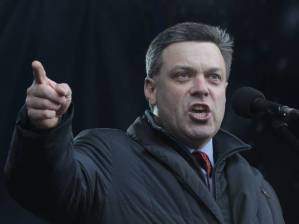
Svoboda Party leader Oleh Tyahnybok
12. The interim government in Kiev, whether one likes Yanukovych or not, came to power through illegal means and is an uneasy marriage of pro-EU liberals and far-right fascists. The far-right groups include Svoboda, Right Sector, Patriot of Ukraine, and the Ultras, all of whom make no secret of their antisemitism, Russophobia, and love of Ukrainian collaborators from World War II. This has been an anathema for most of the South, the East, and much of Central Ukraine who lost many family members in the Great Patriotic War. Overall, all of these issues – the inclusion of fascists in the government, the potential challenge for the availability of food, the impending economic collapse, the implementation of IMF-style austerity, and the inability to solve the Crimean situation – will seriously undermine the credibility of the Kiev government very quickly unless it gets massive financial support and backing from the EU and the US, which is unlikely. The loss of the present government’s credibility may, ironically, serve to also bring the country together.
Updated and expanded as of 15 May 2014 to reflect recent developments.
The ongoing crisis in Ukraine has prompted much commentary. However, few analysts have really been able to truly answer the basic question: what is Ukraine and why is this country so significant to Russia?
The name “Ukraine” itself has often been translated as “borderland.” Its diverse people and historical monuments are a testament to its being contested by regional powers throughout the centuries, including today. It has been coveted historically for its vast, fertile, and resource-rich agricultural land and for its geostrategic military position. The country has been often referred to as the “Bread Basket of Europe,” the “Bread Basket of the Russian Empire,” or the “Bread Basket of the Soviet Union,” depending on which era of history one is observing.
Wheat Field in Ukraine
As a people, the Ukrainians are distinct. They speak an East Slavic language that is closely related to, but not the same as Russian. Historically, the Ukrainians shared many state formations with the Russians from the Kievan Rus’ to the Soviet Union, sometimes as equal partners, sometimes as subordinates. As such, they have often been associated with Russia. However, they are a distinct people altogether. They have their own national dance, the hopak, also known as the Cossack dance, with its famous prisyadka (“squat-and-kick”) move that Westerners often stereotypically associate with cultural images of “Russia.” They are also renowned for their unique musical instrument, the badura, a sort of fusion between the harp and the balalaika. In cuisine, they are famous for their love of salo and borscht, which is actually of Ukrainian, not Russian, origin. The poet and artist Taras Shevchenko and the Soviet-era filmmaker Aleksandr Dovzhenko are among the foremost Ukrainian cultural icons. Further, the Cossacks, a transnational East Slavic cultural group renowned for their love of freedom and horsemanship, played a major role in the formation of the Ukrainian national identity.
The Pavlo Virsky Ukrainian National Folk Dance Ensemble dancing the Hopak with the famous prisyadka at 4:46.
Western commentators have often spoken of Ukraine as either a single monolith (“the Ukrainian people”) or as “two Ukraines,” one being “largely pro-Western” and even “majority Catholic,” and the other being “largely pro-Russian” and “majority Orthodox.” However, both are oversimplifications. The regional divisions within the country are actually much more complex than an outside observer may perceive them to be. For example, Catholics of all rites only comprise about 10% of Ukraine’s population while Orthodoxy remains dominant overall. Essentially, though, there are basically three major regions in Ukraine – Western Ukraine, Central Ukraine, and Southeastern Ukraine – and two distinct smaller regions – Zakarpattia and Crimea.
Regional Map of Ukraine
The region of Western Ukraine is comprised of three distinct regions: Galicia, Volhynia, and Chernivtsi. Of these, the historic areas of Galicia and Volhynia best correspond to the mainstream impressions of the pro-Western, Polish-leaning, Catholic Ukraine. Their distinct Western orientation and rejection of Russia goes back deep into the annals of history. Being the westernmost of the East Slavic Rus’ lands, the old medieval Kingdom of Galicia-Volhynia maintained a distinct Western outlook. Catholic influence was accepted and the kingdom perceived itself to be within the same cultural sphere as its Catholic neighbors, Poland and Hungary. Intermarriage between the princely houses of this region and Catholic states was not uncommon. By contrast, other historical lands of the Rus’ were hostile toward Western influence. Their experience with the West was shaped by images of an aggressive invader, whether it was Poland, Sweden, or the Teutonic Knights.
Volhynia (the homeland of Ukraine’s first post-Soviet President Leonid Kravchuk) was annexed by the Russian Empire under Catherine the Great in the Third Partition of Poland in 1795. The dominant Greek Catholicism was suppressed and Orthodoxy was reintroduced. The area was later annexed by interwar Poland and remained part of that state until the Molotov-Ribbentrop pact of 1939 when it became part of Soviet Ukraine.
Skyline of Lviv, the unofficial capital of Galicia in Western Ukraine. Note the Central European architectural style.
Meanwhile, Galicia (centered on the city of Lviv) remained entirely outside of the Russian Empire and the Soviet Union and was instead part of Austria-Hungary and interwar Poland until, again, the 1939 Molotov-Ribbentrop pact. As such, the region’s links with Catholic and Western Europe remained relatively strong.
The western orientation of both Galicia and Volhynia has persisted to the present day, with Catholicism still playing an important role in Galicia. After these regions were incorporated into the Soviet Union, the Soviet military faced strong partisan resistance from within this region that continued into the early 1950s. Anti-Russian sentiment and support for Ukrainian nationalism runs high here, especially in Galicia where the extremist far-right party “Svoboda” has managed to win as much as 40% of the local electorate. Ironically, though “Svoboda” has been one of the main leaders in the Euromaidan protests, it is extremely Euroskeptical and has been accused of Neo-Nazism, Russophobia, and antisemitism. Its leader, Oleh Tyahnybok, has glorified Ukrainian nationalist collaborators from World War II for fighting against “Russians, Jewry and other crap.” Stepan Bandera, largely considered a wartime collaborator throughout most of Ukraine, is seen in Western Ukraine as a national hero. Naturally, a local citizen in a city like Lviv would fully endorse the Euromaidan protests and perceive the Moscow-backed Eurasian Union to be a Russian imperial project or even a “neo-Soviet” project.
Outside of Galicia and Volhynia is Chernivtsi. Centered around the city of the same name, this region is comprised of territory that was, until World War II, part of Austria-Hungary and later, the interwar Kingdom of Romania. Most, though not all of it, corresponds to the historic region of North Bukovina. Despite its geographic place in Western Ukraine, the voting and linguistic patterns of this region more closely follow those seen in Central Ukraine than in Galicia and Volhynia. Elections here are often close and the locals largely speak Surzhyk, a mixed Russian-Ukrainian language (see the Central Ukraine section below for more details). It is also home to a significant (about 20%) Romanian minority from which the current Prime Minister Arseniy “Yats” Yatsenyuk is partially descended. With the abolition of the regional language law, there have been concerns here too since areas of Chernivtsi are majority-Romanian speaking. Ironically, Yatsenyuk, who supported abolishing the language law, also reportedly speaks some Romanian as well.
St. Nicholas Wooden Church in Zakarpattia
Further west, the secluded westernmost mountainous oblast of Zakarpattia represents an entirely distinct case all its own. Sharing four international boundaries with Romania, Hungary, Slovakia, and Poland, this is the homeland of the Carpatho-Rusyns (also known as the Carpathian Ruthenians), a distinct East Slavic people (or a subgroup of Ukrainians, depending on one’s view) who follow the Byzantine Ruthenian Catholic Church (distinct from the Ukrainian Greek Catholic Church). The local population of Zakarpattia, while tilting westward, would likely perceive imperialist ambitions on the part of not only Moscow, but Kiev too. In a 1991 referendum devised by former Ukrainian President Kravchuk, the people of this region voted overwhelmingly to be granted local autonomy. However, this was never implemented. In 2008, a group calling itself the Congress of Carpathian Ruthenians unsuccessfully attempted to proclaim a “Republic of Carpathian Ruthenia.” Notably, Zakarpattia is one of two regions in all of Ukraine that has registered a positive natural population growth rate (download the official statistics here).
This largely rural area, located at the geographic center of Europe and famous for its wooden church architecture, was part of the Kingdom of Hungary within Austria-Hungary until 1918, when it became part of interwar Czechoslovakia. It was annexed by Soviet Ukraine after World War II. Despite this history, most Czechs and Slovaks share good relations with the Carpatho-Rusyns and neither nationality has any claim to Zakarpattia.
However, there is a sizable Hungarian minority in southern Zakarpattia and this has been claimed by Hungarian nationalists who still refuse to recognize the 1920 Treaty of Trianon. Significantly, Hungary’s Viktor Orbán has been very quiet on the ongoing Ukraine crisis and, if anything, he has been closer to Yanukovych. Orbán has been keen to forge a good relationship with Yanukovych because Yanukovych supports the linguistic rights of non-Ukrainians in Ukraine, which includes the Hungarians of Zakarpattia. When the law on regional languages was recently cancelled by the new, post-revolutionary government in Kiev, the Hungarians of Zakarpattia reacted with apprehension and are now looking to Budapest for help.
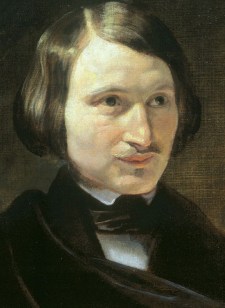
Renowned Russian writer and ethnic Ukrainian, Nikolai Gogol. A native of Central Ukraine, Gogol was the author of Dead Souls, The Inspector General, and other masterworks of Russian literature.
Then there is Central Ukraine (also known as Dnieper Ukraine), the heartland of the country that stretches from Khmelnytskyi to Sumy. Centered on the capital Kiev, this largely agricultural region was historically part of the Russia Empire and the Soviet Union throughout much of its recent history. This wide, rich, fertile, and beautiful region has also seen much tragedy. North of Kiev, near the border with Belarus occurred the Chernobyl nuclear disaster. Additionally, along with much of Southeastern Ukraine, Central Ukraine experienced the Stalin-era Holodomor famine of the 1930s as well as the horrors of World War II.
Largely Orthodox in faith, Central Ukraine’s language is primarily Russian in the major cities (such as Kiev) and Surzhyk, a Russian-Ukrainian linguistic mix, in the countryside. Emerging from “pure Ukrainian” in the west, Surzhyk is the dominant language for much of Central Ukraine until one reaches the Kharkiv Oblast and the easternmost portions of the Sumy Oblast where the language gradually blends into Russian. Central Ukraine is the birthplace to many famous cultural figures in Russia and Ukraine throughout history, including the writer Nikolai Gogol, a native of the Poltava region where the historic 1709 battle was fought. The celebrated Russian avant-garde artist Kazimir Malevich was also a native of Central Ukraine.
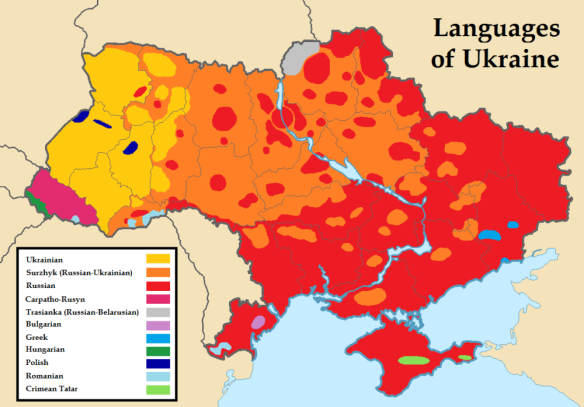
Linguistic Map of Ukraine, utilizing 2009 information from the Kiev National Linguistic University and data from the 2001 Ukrainian Census. Note that Ukrainian is highlighted in yellow. The mixed Russian-Ukrainian language Surzhyk is in orange. Russian is in red. Carpathian Ruthenian (spoken in Zakarpattia) is in the red-violet color. The Bulgarian, Greek, Hungarian, Polish, Romanian, Crimean Tatar, and Trasianka (Belarusian) minorities are also highlighted.
Politically, Central Ukraine functions much like a “swing state” in the US Midwest and thus is a potential “spoiler” for power between the nationalist West and the more Russified Southeast. Here the response to Euromaidan has been mixed. While many in Kiev appear to have given their support for the initial demonstrations, some of the more extreme aspects were rejected. The violent toppling of the Lenin monument in Kiev by the demonstrators received an overwhelmingly negative assessment, with 69% of Kiev residents expressing a negative opinion about this incident and 15% expressing indifference. 67% agreed with the statement that the “removal of Lenin’s monument in the centre of Kiev is a barbarous act,” while 57% concurred that “the actions of those who removed Lenin’s monument in fact repeated the similar practice of Bolsheviks.” It is unclear how the residents of Kiev have reacted to subsequent events.
Southeastern Ukraine forms the most Russified part of the country and is demographically mixed between Russified Ukrainians and ethnic Russians. Much (though not all) of this part of Ukraine corresponds to the old “Novorossiya” or “New Russia” of Tsarist times. It includes Yanukovych’s political base in the working-class industrial heartland of the Donbas, a coalmining region that was once the center of the Soviet-era Stakhanovite movement. Recently, the Donbas has been the scene of a major rebellion against the Turchynov-Yatsenyuk government in Kiev.
Kharkiv, the interwar capital of Soviet Ukraine, is also in the southeast. The city was founded in the 17th century and, along with nearby Sumy in Central Ukraine, became part of a region known as Sloboda Ukraine whose territory corresponds approximately to the Tsarist-era Kharkov guberniya. It is important to note that, unlike other regions and cities of the southeast, Kharkiv was never part of Novorossiya.
Map of Novorossiya, 1913. Note that it includes the territory of the Nikolayev and Kherson oblasti, the southern portions of Transnistria and the Odessa oblast (excluding the Budzhak), the southern part of the Zaporozhia oblast, the southeasternmost area of the Kharkiv oblast, the Western half of the Donbas, and most of the historical region of Zaporozhia (the Dnipropetrovsk and Kirovograd oblasti with the northern portions of the Zaporozhia oblast). This particular map of Novorossiya also includes territories that comprised the Greater Novorossiya region, specifically Bessarabia (Moldova proper with the Budzhak region of the Odessa oblast), Crimea, and the Tsarist-era Don Host Oblast (which included the eastern half of the Donbas and significant portions of Southern Russia). Note that the historical region of Sloboda Ukraine (most of the modern-day Kharkiv oblast plus the northern parts of the Donetsk and Luhansk oblasti and the southern portions of the Sumy oblast) is not included within the scope of Novorossiya.
The southeast also includes Zaporozhia, the famous Ukrainian Cossack region renowned for its freedom and independence but feared by Polish nobles as the dzikie pola, or “wild fields.” On the Black Sea coast, one finds the old shipbuilding town of Nikolayev as well as the celebrated cultural center of Odessa with its cosmopolitan mix of Ukrainian, Russian, Jewish, and Mediterranean influences. It is here where the Soviet filmmaker Sergei Eisenstein filmed The Battleship Potemkin with its iconic Odessa steps sequence, and where writers like Akhmatova, Babel, and the celebrated comedic duo Ilf and Petrov called home. Founded by Catherine the Great and her lover Prince Potemkin, Odessa is a city of humor. “‘Do you come from Odessa?’ is the start to a typical joke, to which the answer is ‘No, I am a respectable person.'”
Short BBC overview on Odessa.
At the same time, Odessa is also a city that has experienced much tragedy in its history, including anti-Jewish pogroms, the Russian Revolution, the Russian Civil War, famines, Stalin’s Terror, World War II, and the Holocaust. Most recently, the city has witnessed the tragic May 2 massacre in which 48 people died. Most were anti-Kiev demonstrators and 39 were killed in the Odessa House of Trade Unions in a fire lit by the far-right group Right Sector and far-right football fans known as the “Ultras.”
The people of Southeastern Ukraine primarily regard Orthodoxy as their faith and Russian as their primary language, though significant pockets of Surzhyk speakers can also be found throughout the region, particularly in the South. Most would see the Euromaidan protests as “futile hooliganism” and would likely perceive the Customs Union positively. As one Moscow-based journalist wrote:
Traversing Ukraine from west to east, one can’t help noticing how the country gradually blends into Russia. The architecture transforms from quaint Central European into austere Soviet with Lenin statues in central squares, and people switching languages from Ukrainian to Russian. Large industrial cities at the far east of the country, such as Kharkiv and Donetsk, are hardly distinguishable from their equivalents across the Russian border. The border itself never existed before Ukraine became independent in 1991, not even centuries ago. It was created in 1991, creating a major headache and a good number of outright tragedies for separated families.
Further south is Crimea, a disputed area claimed by Ukraine but controlled by Russia. Demographically, this region is majority Russian (58%) with significant minorities of Ukrainians (24%) and Crimean Tatars (12%). The Crimean Tatars are a Turkic Muslim people. They once ruled this region as the Crimean Khanate from which they conducted a brutal slave trade. The area eventually came under Tsarist Russian and eventually Soviet control. It was during the Soviet era that the Crimean Tatars were deported from the peninsula en masse by Joseph Stalin in 1944 to Soviet Central Asia. Only since glasnost have they been able to return. Since this time, they have formed their own parliament, the Mejlis, as a means of securing their ethnic rights. Since acceding to Russia, Moscow has rehabilitated the Tatars and has pledged greater community support, though some Tatar leaders are uncertain about this.
Crimea was a major tourist destination for both the Russian aristocracy in Tsarist times and big-wig commissars in the Soviet era. The resort city of Yalta has historically been an especially popular attraction. The celebrated Russian author, satirist, and playwright Anton Chekhov once wrote of Yalta as being better than Nice on the French Rivera. Yalta is also where Churchill, Roosevelt, and Stalin met in February 1945 at the Yalta Conference to discuss the future of post-war Europe.
UN Map of Crimea, 2014
Additionally, Crimea holds significance in Russian history for being the location of the historic city of Khersones (in modern-day Sevastopol) where Prince Vladimir the Great of Kievan Rus’ converted to Christianity. Crimea was also the site of many historically significant wars in Russia’s history including not only World War I and World War II, but also the Crimean war fought by Imperial Russia against France, Britain, the Ottoman Empire, and Sardinia in the 1850s. After World War II, four cities in Ukraine were designated “hero cities” by Soviet authorities for their exceptional bravery against Nazi Germany. These included Kiev and Odessa and two cities in Crimea – Sevastopol and Kerch. Indeed, in a Western documentary on the formerly top-secret Balaklava submarine base in Crimea, one local tour guide even described Sevastopol as being a “holy place.”
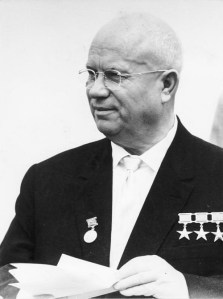
Nikita Khrushchev (German Federal Archives)
Crimea was transferred from Soviet Russia to Soviet Ukraine in 1954 by Nikita Khrushchev, himself of partial Ukrainian descent and married to an ethnic Ukrainian. A Ukrainophile, Khrushchev transferred the peninsula to Ukraine as a gift of “brotherly love” on the 300th anniversary of the 1654 Treaty of Pereyaslav in which the Ukrainian Cossacks agreed to formally join the Russian Empire. However, Slavic sentimentality was only part of the reason why Khrushchev made the decision. According to his son, Sergei Khrushchev, there were also serious economic considerations. As the Sixth Five-Year Plan was being prepared, there were two proposed irrigation canals: South-Ukrainian and North-Crimean. The first was to run entirely through Ukraine while the second was to start in Ukraine and end in Crimea which was then part of the the Russian Federation. This necessitated a division of labor between the two republics which would “cause confusion in the building process and slow it down.” Therefore, for Moscow, it was more efficient administratively for Crimea to be a part of Ukraine. At the time the decision was made, it was given little consideration by the Russian or Ukrainian public. As far as they were concerned, it was all part of the same Soviet Union. Meanwhile, Sevastopol, home to the Soviet Black Sea Fleet, continued to be administered directly by Moscow.
According to Sergei Khrushchev, concern over the political status over Crimea first arose at the Belavezha Accords in which Boris Yeltsin together with the leaders of then-Soviet Ukraine and Belarus, Lenoid Kravchuk and Stanislav Shushkevich were to agree to formally dissolve the Soviet Union into independent states. According to Khrushchev, in a lunch prior to the accords, Kravchuk apparently pressed Yeltsin on the future status of Crimea. However, Yeltsin, chiefly concerned with ousting Gorbachev from power, had no time for such questions. As a result, when Ukraine became independent from the Soviet Union in 1991, Crimea remained within its boundaries. Subsequent agreements concluded a compromise: Ukraine would formally maintain control of the peninsula while Moscow would retain its Black Sea Fleet. Sevastopol was granted a special city status. Many local residents of Crimea preferred to have been part of Russia instead but, for the time being, were content with remaining part of a friendly Ukraine.
This changed after the 2004 Orange Revolution when a pro-Western political leadership led by Viktor Yuschenko came into office. Among its most controversial decisions, the new government in Kiev announced that it would cancel Russia’s lease on its Black Sea Fleet upon its expiration in 2017. This was not only poorly received in Moscow but also by the Crimean population as well. Exacerbating the situation was Kiev’s decision to also pursue an overtly pro-NATO course, creating more tension in the region. The landing of the US marines in the Crimean city of Feodosiya in 2006 prompted major anti-NATO protests and the Crimean parliament to declare the peninsula a “NATO-free territory.” According to NYU Russian scholar Stephen F. Cohen:
An eyewitness account conveyed [the protestors’] mood: “American soldiers… Do you want a new Vietnam here? You will get it, and your mothers will cry!” Meanwhile, “Loudspeakers blasted a throaty rendition of ‘Holy War,’ the song that sent Russian soldiers off to battle during World War II.”
In 2010, the Yuschenko government was succeeded by Viktor Yanukovych, who traditionally favored closer cooperation with Moscow, but had now shifted policy to pursue a more balanced agenda between East and West. As part of this agenda, Yanukovych agreed to extend Moscow’s lease on the Black Sea Fleet, a move that was welcomed by both Russia and by the locals in Crimea.
However, the agreement fell into doubt after Yanukovych’s ouster from power following the Western-backed Maidan revolution in Ukraine of 2013-14. The new post-revolutionary leadership in Kiev was a hodge-podge mix of pro-Western liberals like Batkivshchyna and far-right political forces like Svoboda. Serious concerns soon emerged in both Moscow and Crimea regarding the future political orientation of the new government. Most of the new government’s members favored membership in NATO while others spoke about canceling Russia’s lease on the Black Sea Fleet. Far-right politicians, such as Svoboda’s Oleh Tyahnybok, called for Crimea’s political autonomy to be entirely abolished outright. An effort by the new government to cancel a Yanukovych-era law on regional languages in Ukraine did not help the situation.
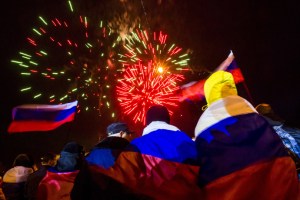
Crowds in Crimea celebrate the results of the March 16 referendum in Crimea voting to join Russia (Reuters/Thomas Peter)
A secessionist movement soon emerged in Crimea and quickly received “anonymous” military backing and support from Russia via its Black Sea naval base. A new breakaway government assumed power and held a plebiscite with the choice of Crimea having either higher autonomy within Ukraine or reunification with Russia. In the referendum, held on March 16, the overwhelming majority of people in Crimea and Sevastopol voted to join the Russia Federation, a decision accepted by Russian President Vladimir Putin. Russia’s move to accept Crimea was condemned by the West but widely supported by the Russian public. Sergei Khrushchev endorsed the move as did former Soviet President Mikhail Gorbachev who hailed it as “correcting a Soviet mistake.” On Victory Day on May 9, Putin made a special visit to Sevastopol where he received a hero’s welcome by the people. Yet, despite all of this, the West and Kiev continue to insist that Crimea is still part of Ukraine, though some voices (particularly in the German political elite) have been calling for an acceptance of the present situation.
Consequently, Ukraine is a highly diverse country with broad regional divisions that can even be sub-divided into yet smaller divisions. Under one roof live the Zakarpattian highlander, the Galician nationalist, the level-headed Kievan, the Donetsk worker, the theatrical Odessan, and (at least technically) the Sevastopol sailor. Compounding all this is the existence of at least six different churches all claiming to be the “church of Ukraine.” Yet despite Ukraine’s multiple “identity crises,” the country as a whole is the main prize in the geopolitical contest over the former Soviet west.
St. Sophia’s Cathedral in Kiev, an architectural monument of the Kievan Rus’.
For Russia, Ukraine is especially significant. Moscow would ideally like Ukraine to be in its Customs Union camp for historic, economic, and security reasons. For many Russians, Ukraine is frequently viewed as the place where Russia began, with the Kievan Rus’ in the 9th century. Of course, it is difficult to assert that the Kievan Rus’ was a “Russian” state since there was no such thing as “Ukraine,” “Russia,” or “Belarus” at the time. The land was simply a proto-East Slavic country known as Rus’. Yet, in the Russian imagination, it is Kiev that stands at the heart of Russia’s identity. To quote the great Russian writer, playwright, and Kiev native Mikhail Bulgakov, it is regarded as the “mother of Russian cities.” Likewise, Ukraine has been coveted for both its rich natural resources and for its geostrategic military position. Indeed, for historic invaders of Russia, from Napoleon Bonaparte to Adolf Hitler, capturing Ukraine was viewed as a necessary first step in order to take Russia. As such, the country is also viewed as a place where Russia fought many heroic battles against foreign invaders. Finally, from a cultural vantage point, Ukraine has been intimately associated with Russian culture.
Significantly, despite one very small opposition demonstration led by Boris Nemtsov in support of the Euromaidan, most Russians either do not support the Euromaidan demonstrations or are ambivalent toward them. Even Aleksei Navalny, one of the most outspoken opponents of the Putin government, was noticeably quiet about the protests. In a Ukrainian television interview, Navalny, who has said that he is ethnically “more Ukrainian than Russian,” expressed the opinion that Russians and Ukrainians (along with Belarusians) effectively comprised the same people. “Although he was insensitive to Ukrainians’ nationalist feelings,” wrote one Moscow-based journalist, “Navalny said what millions of people take for granted, not just in Russia, but in Ukraine itself.” According to Kiev’s Research & Branding Group, almost 50% of Ukrainians have relatives in Russia. 28% have close relatives living just across the Russian border. 60% indicated that they do not regard Russia as a foreign country. As the historian Stephen F. Cohen wrote, of all the ex-Soviet states, Russia, Ukraine, and Belarus “are the most intricately and intimately linked–by geography, history, language, religion, marriage, economics, energy pipelines, and security.”
Consequently, from a historical, cultural, and emotional standpoint, Russia can never give up on Ukraine and will do everything within its power to bring Ukraine into the CU. In the words of Cohen in a December 2013 interview with The John Batchelor Show, “…in Moscow, there is this view among rather non-political Russians that this is Putin’s great test as to whether or not he is a great Russian patriot. To let Ukraine go would be forever the infamy of Putin’s leadership.”
Given the rising tension in the current crisis, what happens next is anyone’s guess…








 Reconsidering Russia and the Former Soviet Union