Odessa: A Ukrainian Tragedy

Odessa's celebrated Potemkin Steps, once the scene of Sergei Eisenstein's famed 1925 Soviet classic, The Battleship Potemkin. (Palmyra.od.ua)

Odessa’s celebrated Potemkin Steps, once the scene of Sergei Eisenstein’s famed 1925 Soviet classic, The Battleship Potemkin. (Palmyra.od.ua)

Odessa is a beautiful, theatrical city, renown for its humor, wit, culture, and charm. Yet, at the same time, it is also a city that has experienced much pain and tragedy in its history. Since the horrors of World War II, who would have guessed that nearly 70 years later, the people of this celebrated “St. Petersburg of the south” would again have cause to mourn?

It is beyond doubt that the 2 May massacre in Odessa was a turning point for the crisis in Ukraine. Last Friday was a painful day of mourning for a country that is already on the brink of catastrophe. One might expect that such grief would lead toward greater unity within the country and perhaps pave the way for a rational, constructive dialogue toward peace.

Instead, the massacre has only hardened opinions in Ukraine. Throughout the southeast, including Odessa, popular anger and opposition to the Turchynov-Yatsenyuk government is currently on the rise. In Central Ukraine and Kiev, public opinion over the tragedy is divided. In Western Ukraine, while many have expressed sorrow for the deaths, the popular stance largely does not want to fully explore what happened in Odessa.  The involvement of the pro-Kiev activists is downplayed and “pro-Russian provocateurs” are blamed instead.  According to one observer in Western Ukraine, the reaction from some in the West on social media has been “less than compassionate” and “even hubristic.”  Further west, in the remote Rusyn-speaking oblast of Zakarpattia, popular reaction to the tragedy in Odessa is unclear.  Meanwhile, as tensions rise, Odessa’s historic Jewish community, which had been experiencing a cultural and religious revival in recent years (including a Yiddish language revival), is planning to evacuate the city en masse.

In the United States, mainstream media networks like ABC, CNN, and Fox have practically ignored the massacre. In the rare case that it is mentioned, the question of responsibility is always vague. Official Washington offered its condolences on Saturday in the same manner, without naming any perpetrators. Later, though the US Ambassador in Kiev Geoffrey Pyatt admitted in an interview with CNN that there was no evidence of a Russian role in the massacre.

Frank-Walter Steinmeier (Frank-walter-steinmeier.de)

Germany’s Frank-Walter Steinmeier has called for fresh talks to de-escalate the crisis.  (Frank-walter-steinmeier.de)

In Germany, opposition to the events in Ukraine as well as a desire for a resolution to the crisis are growing. One member of the ruling Christian Democrats stated that Germany “should stop being a servant of the Americans” and that confrontation with Russia over Ukraine was “blind to history and deaf to the other side.” Meanwhile, Germany’s Social Democrat Foreign Minister Frank-Walter Steinmeier called for a new round of Geneva talks.  A veteran diplomat, Steinmeier has stated that the new talks will “send a ‘strong political signal’ that previous agreements will be implemented.” The plan now has the backing of Chancellor Angela Merkel.

Russia’s response to Odessa has been remarkably reserved. Moscow condemned the massacre in very strong terms and the State Duma has demanded a probe into the tragedy. However, Russia has refrained from intervening directly in Ukraine, despite anger in Moscow and pressure by hardliners in the Kremlin to invade.

It is undeniably apparent that Right Sector and far-right football fans known as the “Ultras” were singularly responsible for what happened in Odessa. On YouTube, footage has emerged showing the nationalists starting the fire and later shooting anti-Kiev activists who attempted to leave the burning building.

The Turchynov-Yatsenyuk government has sought to downplay the massacre, instead expressing very general “sorrow” for the victims and emphasizing the clashes that preceded it between supporters and opponents of the government. In every case, they are quick to blame the initial clashes on “pro-Russian provocateurs.” During his visit to Odessa, Prime Minister Yatsenyuk reiterated the same script, though also blaming the security services for not stopping the violence.

Yatsenyuk also pledged a de-centralization of powers to the oblasti and to this end, a bill for a nationwide plebiscite on the issue has been registered at the Ukrainian Rada. Yet people living in Ukraine’s southeast are skeptical. The government has announced vaguely-worded “de-centralizations” in the past, but these were ultimately never realized. In a much less calculated move, the government has also dispatched a special all-volunteer battalion of Kiev’s National Guard to Odessa. It is doubtful that such a move will help de-escalate tensions and build confidence in this part of Ukraine. Opposition to the government runs high in Odessa.  Some have even gone so far as to refer to the massacre as an act of “genocide.” Meanwhile, the “anti-terrorist operation” continues in Eastern Ukraine, which is now effectively in a state of war with Kiev.

Overall, anxiety and apprehension remain high throughout Ukraine in the aftermath of the Odessa massacre. If social media is any indication, it demonstrates that people throughout the country have fundamentally different views and interpretations of the event. Dialogue is extremely important to restoring order and peace, but it is increasingly being supplemented by a discourse of “my interpretation is better than yours” and even worse “us vs. them.” In the backdrop of all this is a fast deteriorating socioeconomic situation and the near-bankruptcy of the country. Ukrainians together need to emerge with white flag in hand to set aside their differences and engage in a serious, meaningful dialogue to find solutions to their problems. War, no matter what, should never be an option.

The 2 May Odessa Massacre and Its Significance on the Ukraine Crisis

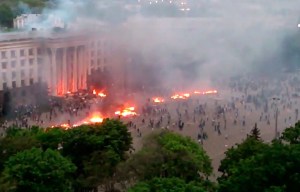
The Trade Union building of Odessa in flames (ITAR-TASS)

The Trade Union building of Odessa in flames (ITAR-TASS)

On Friday, at least 46 people, mostly anti-Kiev activists, were killed in the southern Ukrainian city of Odessa.  At least 39 died after being trapped in the Odessa House of Trade Unions which was reported to have been lit on fire by far-right football hooligans and activists from the far-right Kiev-affiliated group Right Sector (Praviy Sektor). Some were burned alive while others suffocated to death or jumped out the windows to escape.  At least three were reportedly shot dead. Close to 200 were injured with at least 25 in critical condition.

The massacre was the bloody culmination of clashes between supporters and opponents of the controversial Turchynov-Yatsenyuk government in Kiev. The supporters were primarily Right Sector and its allies, including far-right football hooligans known as the Ultras, who are said to have instigated the violence.  “Glory to Ukraine,” “Death to enemies,” and “Knife the Moskali” they chanted.

The city of Odessa has declared a three-day period of mourning on 3 May.  Russian President Putin has expressed “deep condolences” to the families of those who died.

The significance of this massacre to the ongoing crisis in Ukraine is threefold:

  1. It represents the worst violence of the Ukraine crisis since the events in February.
  2. It will likely further erode the credibility of the Turchynov-Yatsenyuk government throughout all regions of Ukraine.
  3. It has demonstrated that Russia, though harshly critical about the actions that took place in Odessa, has been nonetheless restrained in responding to this tragedy. This is very difficult for Moscow because of its anger over the overall situation as well as pressure from Russian hardliners who want Russia to invade Ukraine. Still, the Kremlin will likely continue to show restraint on the issue (at least for now) as the stakes of a direct intervention in Ukraine are too high. In the meantime, Kiev appears to be provoking Moscow to respond to events occurring in the Russophone regions. It is specifically using Right Sector to accomplish this.  Now headquartered in the southeastern town of Dnipropetrovsk, Right Sector activists have launched attacks on cities and towns in and throughout southeastern Ukraine.

The massacre is an especially tragic event for Odessa, a multicultural, cosmopolitan, and theatrical port city on the Black City. Renown for its humor, Odessa is blessed with a heritage of mixed Russian, Ukrainian, Jewish, and Mediterranean influences. Its people speak their own colorful dialect of Russian with smatterings of Ukrainian and Yiddish.  Yet, the May massacre will likely go down as yet another tragedy in Odessan history, a history that also includes several anti-Jewish pogroms, the Russian Revolution, the Russian Civil War, famine, Stalin’s Terror, World War II, and the horrors of the Holocaust. Yet as in these tragedies, the people of Odessa will likely turn to their quick wit, irreverence, and celebrated sense of humor to deal with this latest painful episode in their collective history.

The Myth of the European Panacea

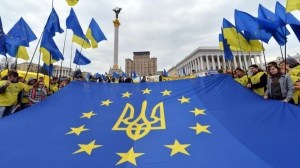
The EU flag was a prominent symbol of Ukraine's Euromaidan (img.pravda.com.ua)

The EU flag was a prominent symbol of Ukraine’s Euromaidan (img.pravda.com.ua)

Capitalism hit the former Soviet Union very hard in the 1990s. That was the Boris Yeltsin era of “shock therapy” wherein the economic ideas of Larry Summers, Jeffrey Sachs, and others transformed the countries of the former USSR from state-dominated economies with capitalist elements to the capitalism of the wild, unregulated sort. The results of such a severe and rapid transition were disastrous for these countries, socially, politically, and economically. The ramifications of those years are still felt throughout much of the former Soviet space today, both directly and indirectly.

In Russia itself, the “shock therapy” brand of capitalism was implemented with aid from American advisors such as Sachs and by “democratic” Russian “reformers” like Yegor Gaidar, Anatoly Chubais, and others.  Their subsequent “reforms” plunged approximately 75% of Russians into poverty and reversed many of the country’s hard-won 20th century achievements, becoming, in the words of Russian scholar Stephen F. Cohen of NYU, “the first nation ever to undergo actual demodernization in peacetime.” It changed public perceptions with regard to the West. If there were many Russians in 1991-92 who were supportive of the basic idea of having democracy, the years of “shock therapy” created a desire for much-needed “stabilnost” and caused many to view the West as primarily responsible for such a terrible economic catastrophe.

Similar rapid transitions to market economies occurred throughout the former Soviet sphere, leaving legacies of entrenched oligarchies, monopolies, economic disparity, poverty, bad business environments, and most of all, corruption. For the citizens of former Soviet states like Ukraine, Georgia, Moldova, and Armenia, the EU and its Eastern Partnership program appear to be effective remedies to finally “cure” their economies of these diseases once and for all. The reputation of the EU for its rules, regulations, and carrot-and-stick initiatives seemed to be a cure-all solution to many.

“Like hopeless alcoholics, we are trying to toss ourselves into a rehab, where caring Europeans will cure us from the addiction (in our case – corruption),” wrote the Armenian comedian Sergey Sargsyan. Indeed, corruption remains a very serious problem for all four of the Eastern Partnership states that sought deeper ties with the EU, with Georgia ranking 55, Armenia 94, Moldova 102, and Ukraine 144 on the 2013 Corruption Perceptions Index of 177 countries (CPI) by Transparency International.  The issue of corruption is especially serious in Ukraine where the oligarchy and the political elite, from Tymoshenko to Yanukovych, have robbed the country and its people into bankruptcy.  Consequently, the EU is viewed as a panacea, a “symbol” for the hope of a better future.  In the words of Mark Adomanis and Luka Orešković with regard to Ukraine specifically:

Given Ukraine’s omnipresent corruption, the lack of legal security and, most importantly, the country’s economic implosion, it is not surprising that many citizens would latch onto a symbol (“Europe”) that is associated with all of the things that the country itself lacks. Throughout Ukraine, Europe is popularly identified with economic prosperity, transparency, democracy, and the rule of law, with the possibility of living a “normal life” of dignity and material security.

In contrast to the EU, the Moscow-backed Eurasian Union at face-value appears to offer little, especially with regard to combating corruption. With a CPI ranking of 127, corruption is widespread in Russia, though the Kremlin does realize the gravity of the issue and has been trying to fix it in recent years. Still, the continued presence of corruption combined with oligarchic monopolies, has likewise made opportunities for independent businesses and entrepreneurs very difficult. Together, these issues stifle real economic growth and potential and pose a serious challenge to competition, innovation, and entrepreneurship. Additionally, the fact that much of Russia’s economy is also based on non-renewable natural resources has also raised very serious concerns.

“The main reason why many Armenians are not crazy about joining the Russian Customs Union is not the Russian people, culture, literature, or cuisine,” wrote the Armenian comedian Sergey Sargsyan. “The problem is corruption.”

Despite this, Russia is remarkably holding its own. The Kremlin managed to pay off much of its foreign debt from the 1990s. Moscow’s economy is also currently growing much faster than that of the EU. Additionally, the birthrate of the once “dying Russia” has also bounced back and is on the rise, not only in national autonomous republics like Chechnya, but also deep into the Slavic Russian heartland as well.

Still, is the EU a viable alternative solution to these countries’ economic woes?  It is true that the Europeans would undoubtedly implement their rules, regulations, and carrot-and-stick reforms on these countries. However, by placing their hopes on the EU, which is still limping along from the devastating 2008 Eurozone crisis, these countries are staking their fate on a supranational union that cannot bring them any serious promises of lasting economic prosperity and stability. In November 2013, the noted American Economist Paul Krugman wrote in The New York Times that his…

…joke slogan for Obama has been, ‘It’s not as bad as the Great Depression!’ But Europe can’t even claim that. At this point it’s just as bad as the Great Depression — and where European economies were recovering strongly by this point in the 30s, they’re stalling now. Doing worse than the 30s; that’s a remarkable achievement.

Indeed, by investing so much hope in an entity as economically unstable as the EU, the people of the ex-Soviet states “run the risk of being sorely disappointed with their ‘civilizational choice’” in the manner that ordinary Russians were sorely disappointed with capitalism in the Yeltsin era of the 1990s.  There is also no guarantee that the corruption issue has been completely solved either.  In Bulgaria and Romania for instance, corruption remains particularly widespread. Even more interesting, according to the 2013 CPI report, non-EU member Georgia actually ranked higher on transparency than not only Bulgaria and Romania, but other EU members such as Croatia, the Czech Republic, Slovakia, Italy, and Greece. Meanwhile, Armenia and Moldova rank higher than prospective EU member Albania! Further, according to Adomanis and Orešković:

The three most recent entrants to the EU (Bulgaria, Romania, and Croatia) have performed terribly since the onset of the financial crisis. Croatia, in particular, has seen no economic growth for the past seven years.  After many years of painstaking reform, per capita incomes in these countries are still less than 40% of West European averages. Even more alarmingly, these three countries have almost entirely stopped converging with the “old” EU members in the West.

In spite of all this, both politicians and citizens in the former Soviet Union seem completely sold on the vision of the “European paradise.” At Ukraine’s Maidan, some activists even believed that “in Europe there is no police brutality.” Apparently, they have never been to Greece, Spain, Portugal, Italy, Bulgaria, or France.

Joining the EU at this point will likely not bring about the long-desired dream of economic prosperity. In fact, it could become potentially destabilizing, especially for a country as large and diverse as Ukraine with an economy that, if not near bankruptcy, is already bankrupt.  That said, as unrest continues in Ukraine, ordinary Ukrainians must consider the question, “should we rely on the EU to help us out of our situation, or is up to us, the Ukrainians alone, to create a better future for ourselves?”

Russia Betrayed?: Voices of the Opposition: A Documentary Film

Here is a must-see prophetic film, especially in light on the continuing crisis in Ukraine.

Produced by Rosemarie Reed on the eve of the 1996 Russian presidential election, it is entitled Russia Betrayed?: Voices of the Opposition. The film includes interviews between Russian scholar Stephen F. Cohen and oppositionists Aleksandr Lebed, Aleksandr Rutskoi, Grigory Yavlinsky, and Gennady Zyuganov. Most interesting are the portions of the film that touch upon Russian foreign policy, Russian-American relations, and NATO expansion.

Watch the entire film in four parts below, presented with permission of the filmmaker:


How Moscow Views the Ukraine Crisis

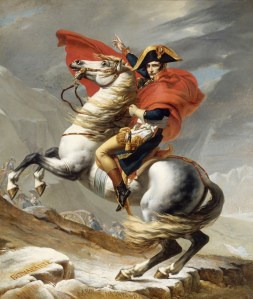
Bonaparte Crossing the Grand Saint-Bernard Pass by Jacques-Louis David, 1800.  The historical memory of the Western invasions of Russia (including the Napoleonic invasion of 1812) still affects Russian perceptions of the West today.

Bonaparte Crossing the Grand Saint-Bernard Pass by Jacques-Louis David, 1800. The historical memories of the West’s invasions of Russia (including the Napoleonic invasion of 1812) still loom large in the Russian consciousness.

Throughout the ongoing Ukraine crisis, few Western commentators and/or observers have considered Moscow’s view of the situation. In the Western media, the prevailing image is that Russia is an aggressor, intent on dominating its neighbors. Western influence is presented as “positive.” Russian influence as “negative.” Joining the EU is depicted as being a road to economic and social prosperity and NATO is offered as a defensive bulwark against the “terrible” Kremlin. Remarkably, at least in the United States, liberals and conservatives are singing the same song. Further, the discourse of “invasion,” “occupation,” “aggression,” and “World War III” is hardly diplomatic. How does anyone believe that negotiations can ensue when such language is thrown about?

By contrast, in Moscow, the view of the situation in Ukraine is entirely different. It perceives the West as encroaching on countries to which it has been very closely associated. Ukraine (the entire country, East, South, Central, and even West), along with Belarus, is viewed as a fraternal East Slavic nation to which Russia is intimately bound. The capital Kiev is regarded by all Russians as the “mother Russian city,” the common point of origin for all East Slavs. To view Kiev within the boundaries of the EU and NATO is more than just a violation of a sphere of influence.  To the Russians, it is almost sacrilege.

Meanwhile, it does not help that some of the most vocal advocates for Ukrainian membership in the EU and NATO come from countries that Russia perceives as historical invaders. They include Poland and Sweden, the co-founders of the Eastern Partnership program that sponsored the Ukraine-EU Association Agreement. Both countries have a history of animosity toward Russia, but it is Poland in particular that Moscow views as being one of the chief advocates for Western expansionism.

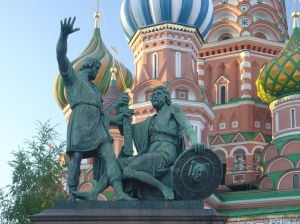
Minin and Pozharsky Statue in front of St. Basil's Cathedral, Moscow (Kotomka)

Minin and Pozharsky Statue in front of St. Basil’s Cathedral, Moscow (Kotomka)

We in the West regard Poland primarily as the victim of Russian aggression, particularly communism. We reflect on Russia’s participation in Poland’s partitions, its suppression of Polish uprisings, the Polish-Soviet War, the Molotov-Ribbentrop Pact, the Katyń massacre, and the establishment of communist Poland. Conversely, to a Russian with a sense of history, Poland is perceived as a historical invader, a country that during the Time of Troubles in Russia (1598-1613) supported the Tsar-pretender “False Dmitriy,” attempted to bring Catholicism to Orthodox Russia, and eventually invaded and occupied Moscow in 1609. That invasion was repelled in 1612 by the duo of Kuzma Minin and Dmitriy Pozharsky, whose statue stands today in front of St. Basil’s in Moscow.

Even in more recent times, Russians recall that it was Poland’s Marshal Piłsudski who, during the Polish-Soviet War of 1919-21, not only tried to ensure the freedom of Poland, but also sought to annex to Poland large swathes of Lithuania, Belarus, Ukraine, and Western Russia to restore the Polish-Lithuanian Commonwealth of old. Piłsudski is still admired by some in Poland today, including members of the political elite such as the late Polish President Lech Kaczyński and his twin brother, Jarosław. He is also greatly admired by former Georgian President Mikheil Saakashvili.

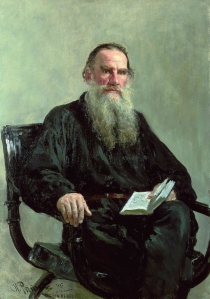
Russian author Leo Tolstoy in a portrait by Ilya Repin, 1887.

Russian author Leo Tolstoy in a portrait by Ilya Repin, 1887.

Russians likewise recall Polish participation in the Napoleonic invasion of Russia. In Leo Tolstoy’s War and Peace, it is the Polish legion that is depicted as being the most fanatically supportive of an expansion toward Russia, so much so that they drown in the River Viliya for Napoleon. Today, the Russians see very much the same thing, except that Napoleon is now replaced by NATO and that the Poles are now showing their loyalty, not by drowning in the Viliya, but by asking for NATO troops to be stationed in their country.

In another Tolstoyan parallel, Moscow also likely views the Ukrainians who protested on the Maidan as being the modern equivalents of the muzhiks of War and Peace. It was the muzhiks who rose up against their oppressive landlords for Napoleon, who they viewed as the embodiment of the French revolutionary ideals of liberté, égalité, et fraternité. Today though, the modern landlords are Ukraine’s corrupt political elite and oligarchs, while the liberal ideals of Napoleon and revolutionary France are today the liberal ideals of Brussels and the European Union. Moscow regards the latter ideals in 2014 just as they regarded Naopleon’s ideals in 1812 – that is, as false promises motivated only by geopolitical ambitions rather than by any genuine sense of altruism.

Given this, it would be wise to recall history before permitting the rhetoric to get too out of control.

German Federalism: An Example for Ukraine

German states (länder) of the German Federal Republic.

German states (länder) of the German Federal Republic.  German federalism is a successful model that Ukraine could follow as an example.

Federalism in Ukraine has been discussed in a previous entry on this publication, but now I wish to highlight a practical example that Ukraine could follow in this regard: Germany.

Germany is a state much like Ukraine with broad regional divisions. Catholics from Bavaria and the Rhineland are largely concentrated in the south and west respectively. Protestants are primarily concentrated in the northwest. The former East Germany, located in the northeast, is largely secular. Yet somehow all of these groups manage to get along in a single, federal state with a strong central government in Berlin. The states (länder) are self-governing with their local representatives directly elected by the people. Meanwhile, it is Berlin that regulates the foreign, economic, and security policy of the German Federal Republic as a totality.

The German example is one that Kiev could follow.  This would make each of Ukraine’s oblasti self-governing in the same way that the länder are in Germany.  Each would have their local governors elected directly by the people, not appointed by official Kiev. For example, if the people of Poltava oblast do not want to be represented by Svoboda, then why should Turchynov or Yatsenyuk appoint a Svoboda party member to represent them? The people of Poltava should instead elect their own governor who best reflects their views and interests, not some appointee from Svoboda.

Each would also be able to regulate their own language policy. Again, to use the example of Zakarpattia, that oblast could have Ukrainian and Rusyn as co-official languages with Hungarian, Romanian, and Russian as minority languages. In another example, the languages of the Odessa oblast could be Ukrainian and Russian co-official, with Bulgarian, Romanian, and Yiddish minority languages.

At the same time, it would be official Kiev that would regulate the country’s foreign, trade, economic, and defense policies. It would be the best of all worlds. The people would finally have a say in their government, and at the same time Kiev would still have the ultimate say on the most important issues. Following the German federal model like this would be a good model for Ukraine, especially in this time of crisis.

Who Are the Rusyns?

In the midst of the ongoing Ukraine crisis, one region of the country has been obscured from the spotlight. This is the westernmost Zakarpattia oblast, a mountainous region that shares four international boundaries with Poland, Slovakia, Hungary, and Romania. Located at the center of Europe, its capital is Uzhgorod, a city located literally on the border with Slovakia and which, architecturally, shares much in common with neighboring locales across the border such as Prešov and Košice. The majority of the local population is comprised of a group known as the Rusyns, a distinct East Slavic people. Most significantly, it is through this region that major energy pipelines pass from Russia, through Ukraine, and into the EU.
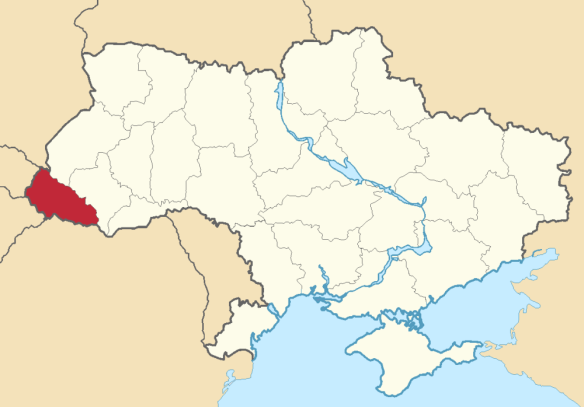
Location of the Zakarpattia Oblast within Ukraine.
Location of the Zakarpattia Oblast within Ukraine.

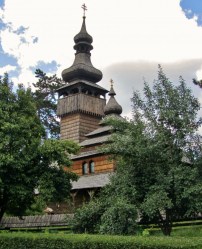
Church of Archangel Michael in the wooden style commonly seen in Zakarpattia (Sobory.ru)

Church of Archangel Michael in the wooden style commonly seen in Zakarpattia. (Sobory.ru)

Language, faith, and identity

The Rusyns derive their name from their self-designation “Rusyni” indicating “people of the Rus’ as in the old “Kievan Rus’.” At one point, the Russians, Ukrainians, and Belarusians all self-identified as “Rusyni” until they adopted their respective ethnonyms over time. In some cases, the residual use of the self-designation “Rusyni” in both Ukraine and Belarus lasted well into the early 20th century. The Rusyns are also known by other names too such as “Ruthenians,” a term which is also used to apply generally to all East Slavs (Russians, Ukrainians, and Belarusians). Indeed, “Ruthenia” is merely a Latin rendering of the name “Rus’,” though today it almost exclusively applies to Zakarpattia as a distinct region. More specific names for the people of this region include “Carpatho-Rusyns” or “Carpathian Ruthenians,” both of which designate the specific area in which these people live – the Carpathian Mountains. There are subgroups of Rusyns as well such as the Lemkos, Hutsuls, and Boykos.
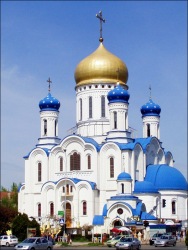
Cathedral of Christ the Savior, Uzhgorod

Orthodox Cathedral of Christ the Savior, Uzhgorod (Ukraine Trek)

In terms of faith, the Rusyns are largely members of the Byzantine Ruthenian Catholic Church (distinct from the Ukrainian Greek Catholic Church). In recent years, some Rusyns have also been gravitating toward Orthodox Christianity of the Moscow Patriarchate. In 2000, the Orthodox Cathedral of Christ the Savior was inaugurated in Uzhgorod. The church reflects common architectural styles found in much of Russia, Ukraine, and Belarus. Yet the more prominent architectural style that one finds throughout Zakarpattia is the simple, wooden church style.  Indeed, wood churches are a major art in this region and comprise an important part of the Rusyn culture, heritage, and identity.

The Rusyn homeland is primarily centered on the Zakarpattia Oblast of Ukraine, which encompasses the bulk of it. However, Rusyns also inhabit a few adjoining areas, notably portions of eastern Slovakia and southeastern border areas of Poland (particularly in the Subcarpathian Voivodeship). Geography is key here for it was the mountains that isolated the Rusyns from the other East Slavs and allowed them to develop their own unique culture and East Slavic language.
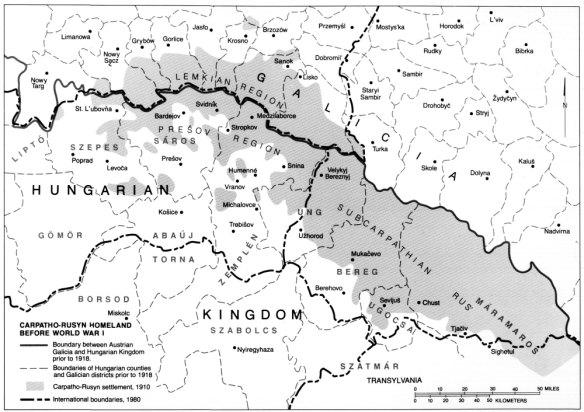
Map showing the full geographic extent of the Rusyn people in Central Europe. (carpathorusynsociety.org)

Map showing the full geographic extent of the Rusyn people in Central Europe, prior to World War I. (carpathorusynsociety.org)

In fact, it is interesting to observe precisely where the Rusyn language stands within the geographic and linguistic position of the Slavic languages. In the Czech Republic, one finds the West Slavic Czech language. When one reaches the eastern fringes of the historical Czech region of Moravia, the Moravian dialect gradually begins to transition into Slovak, a language that shares many affinities with Czech. The further east one travels in Slovakia, the more divergent the Slovak dialects become from the standard language. By the time one reaches the mountainous regions of Prešov and Košice, the eastern dialects of Slovak gradually begin to blend into an East Slavic language: Rusyn.

Rusyn is the linguistically dominant language of Ukraine’s Zakarpattia oblast. From Zakarpattia, Rusyn gradually transitions into standard Ukrainian in Galicia and Volhynia. However, by the time one reaches the Khmelnytskyi oblast, Ukrainian begins to change into Surzhyk, a mixed Russian-Ukrainian language. Then, as one moves further east to the Sumy and Kharkov oblasti, Surzhyk begins to blend into Russian, specifically the southern dialect of Russian. By the time one reaches Moscow, the language has evolved into standard Russian.
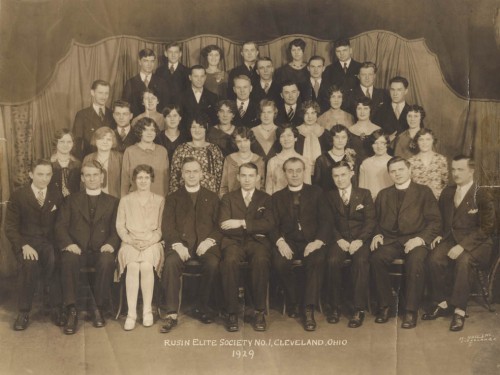
The Rusyn Elite Society in Cleveland, Ohio in 1929, one of many Rusyn immigrant associations in the United States. (Cleveland Cultural Gardens)
The Rusyn Elite Society in Cleveland, Ohio in 1929, one of many Rusyn immigrant associations in the United States. (Cleveland Cultural Gardens)

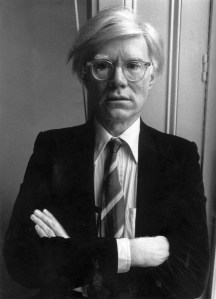
Andy Warhol

Andy Warhol

In the 19th century, significant numbers of Rusyns also moved further south from their historic homeland into the region of Pannonia. Their descendents are today the Rusyn minority in the former Yugoslavia, primarily Vojvodina, the autonomous region of northern Serbia where Rusyn is a co-official language, and in Slavonia and other regions of Croatia. Still more Rusyns emigrated to the United States and Canada in the 19th and early 20th centuries, settling in New York, New Jersey, Cleveland, Chicago, Detroit, and Minneapolis, as well as parts of southern Connecticut and the coalmining towns of western Pennsylvania. One of the most prominent Rusyn-Americans who is always mentioned in discussions on Rusyns is the eccentric pop artist Andy Warhol.

Historical overview

The origins of the Rusyns can be partially traced to the White Croats, an early Slavic tribe distantly related to the modern Croats of the former Yugoslavia.   The historical Rusyn homeland in Zakarpattia existed as a disputed borderland area between the Kievan Rus’ and the medieval Kingdom of Hungary.  Hungary’s administration of the region strengthened following the downfall of the Rus’ state.

For many subsequent centuries, Zakarpattia remained under Hungarian rule. Thus, within Austria-Hungary, the people here were ruled by the Hungarian monarchy, in contrast to their neighbors in Galicia who were ruled directly by the Austrians in Vienna. Under Hungarian influence, the locals adopted some Hungarian cultural attributes. For example, Hungarian Bogrács Gulyás is a staple of Rusyn cuisine. The Rusyns also adopted the Catholicism of their Hungarian and Slovak neighbors. In 1646, at the Union of Uzhgorod, the largely Orthodox Rusyns formally joined the Catholic Church under the Byzantine rite, forming the Byzantine Ruthenian Catholic Church.
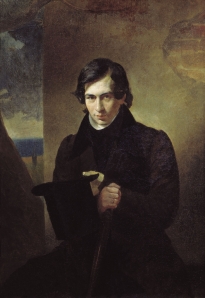
St. Petersburg-born Rusyn-Russian playwright Nestor Kukolnik (portrait by Karl Bryullov, 1836)

St. Petersburg-born Rusyn-Russian playwright Nestor Kukolnik (portrait by Karl Bryullov, 1836)

However, the Rusyns were far less receptive to being forcibly assimilated by the Hungarians. In the 18th and 19th centuries, a significant Russophile movement emerged in Zakarpattia in response to Hungarian cultural suppression and Magyarization. The great Rusyn writer and theologian Aleksandr Dukhnovich was active in this movement. Another was the academic Vasily Kukolnik whose St. Petersburg-born son, Nestor Kukolnik, would later become a prominent romantic Russian playwright. Russophile sentiment also existed in Galicia, though it was later supplemented by Ukrainian nationalism. By contrast, in Zakarpattia, the Russophile movement persisted even to the present-day. Indeed, many in the region still harbor affinities for Russia as evidenced by the closeness of elections here between pro-Russian and pro-Western candidates.

With the collapse of the Habsburg monarchy at the end of World War I, the West Ukrainian People’s Republic sought to claim Zakarpattia as part of its territory. However, it remained under Hungarian rule until 1919 when the Paris Peace Conference assigned it to Czechoslovakia. This was the result of a National Council led by Rusyn-American leader Grigory Žatkovich. Given the instability of Russia and Ukraine at the time, Žatkovich was advised by the Wilson administration that a Rusyn union with Czechoslovakia would be the only viable option for the territory’s future. Consequently, in 1918 Žatkovich signed the Philadelphia Agreement with Tomáš Masaryk, ensuring Rusyn autonomy in a future Czechoslovak state. The Treaty of St. Germain in 1919 reaffirmed this. However, actual political autonomy of the region proved to be less than that desired by the Rusyns of Zakarpattia, largely due to the inefficiency and bureaucracy in Prague. Žatkovich, who Masaryk appointed as governor to the region, eventually resigned in frustration.
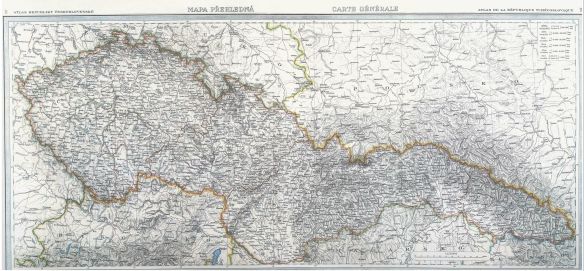
Map of interwar Czechoslovakia in 1935 with

Map of interwar Czechoslovakia in 1935 with “Podkarpatská Rus” (“Subcarpathian Rus”), the present-day Zakarpattia Oblast.

Another significant aspect of Zakarpattia’s union with Czechslovakia was the precise determination of the borders. The frontiers of Zakarpattia, as determined at the Paris Peace Conference and later at the Treaty of Trianon also included a substantial Hungarian minority in the southernmost portion of the region. Most of these Hungarians did not want to separate from Hungary nor were they interested in joining the new Czechoslovak state.

Following Hitler’s annexation of the German-inhabited Sudetenland in 1938, the remainder of Czechoslovakia was slowly dismembered. Germany moved to snatch the rest of the Czech lands while Slovakia became a German fascist puppet state ruled by the collaborator Jozef Tiso. Horthy’s Hungary then was given permission by Hitler to annex the Hungarian-inhabited areas of southern Slovakia in the First Vienna Award. The Nazis also granted Zakarpattia to Budapest as well. This left the region with no choice but to declare its independence. On March 15, 1939, the Rusyns moved to declare a Republic of Carpatho-Ukraine. Within one day, it was crushed by Horthy’s invading army and declared part of Hungary. Under Hungarian rule, the Rusyns were allowed to continue reading and writing in their language as long as it was pro-Hungarian in orientation. Those opposed to Hungarian rule sought to flee Zakarpattia across the mountains into Soviet Ukraine. Hoping to be welcomed by the Soviets, they were instead arrested by the NKVD for “illegally crossing into Soviet territory” and sent to Gulag labor camps. Meanwhile, during the war, Zakarpattia’s historic Jewish community suffered greatly. Most were deported to Nazi death camps and perished in the Holocaust.
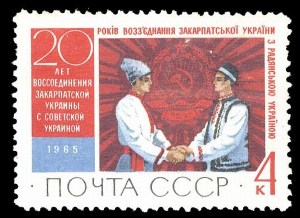
A Soviet-era stamp celebrating the 20th anniversary of Zakarpattia's 'reunification' with Soviet Ukraine.

A Soviet-era stamp celebrating the 20th anniversary of Zakarpattia’s “reunification” with Soviet Ukraine.

Zakarpattia remained part of Hungary for much of the war until it was liberated by Soviet troops in 1944. Throughout the war, Moscow promised the Western allies that it would restore Czechoslovakia’s pre-1938 borders. However, after the liberation of Zakarpattia, new considerations were drawn up and it was decided to incorporate the region into Soviet Ukraine instead. The decision was informed by both ethnic-historical and geopolitical considerations. With the Soviet incorporation of the region, all of the historic East Slav lands were now under the jurisdiction of a single state for the first time since the Kievan Rus’. Geopolitically, the region was also strategically significant, as it gave the Soviet Union a direct land boundary with Hungary. The cession was officially acknowledged by Czechoslovak President Edvard Beneš in June 1945. The borders of Zakarpattia remained virtually unchanged except for the new addition of the border city of Chop, an important railway juncture.

The incorporation of Zakarpattia into the Soviet Union brought about significant changes. The Soviets attempted to modernize the economy and to bring collectivization to the countryside. The Soviets also attempted to suppress the native Byzantine Ruthenian Catholic Church. Though instead of moving to repress religion, they sought to bring this church under the jurisdiction of the Russian Orthodox Church. This was met with limited success, though Orthodoxy in Zakarpattia has arguably experienced some activity since Ukraine’s independence.

The Soviets also inherited Zakarpattia’s community of Jehovah’s Witnesses, the result of missionary work in interwar Czechoslovakia.  The Soviets distrusted the Witnesses as a “non-traditional sect” and thus sought to limit their activities.  Yet, the Witnesses continued to pursue their beliefs regardless and earned a degree of respect in Soviet society for their “dissident” and “anti-Soviet” approach.
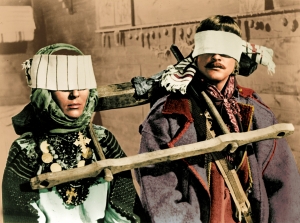
A still from Parajanov's Shadows of Forgotten Ancestors.

A still from Parajanov’s Shadows of Forgotten Ancestors.

Meanwhile, education and literacy were also promoted as was Russian-language instruction. Ethnic Russian teachers, workers, and supervisors from Moscow descended on the new region, creating a new Russian minority. They also were genuinely astounded by this unique and mountainous “lost province” that, in their view had been separated for so long from the “Russian motherland.” The fascination with Zakarpattia continued for much of the Soviet era and was even the subject of films and popular media. The great Soviet Armenian filmmaker Sergei Parajanov even made a film about Zakarpattia called Shadows of Forgotten Ancestors that met with critical acclaim internationally.

The Soviet nationalities’ policy also sought to promote the “Ukrainian” ethnonym among the Rusyn people of this region. The ethnonym has been largely adopted by the people, though most still speak the Rusyn language and adhere to their own cultural norms. The sense of uniqueness also persisted, though any debate about the Rusyn question was banned in the Soviet Union until glasnost. Under Gorbachev, discussion of the “Rusyn question” began to re-emerge and the Byzantine Ruthenian Catholic Church was rehabilitated. In 1991, voters in Zakarpattia overwhelmingly backed Gorbachev’s New Union Treaty. Later that year, Ukraine’s Kravchuk proposed a ballot on state sovereignty in Ukraine. This too was approved by voters in the region. However, more significantly, another provision on the ballot promising local autonomy passed by an even wider margin. Despite this vote, autonomy for the region was never granted.
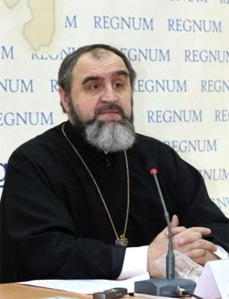
Fr. Dmitro Sydor

Fr. Dmitro Sydor

In 2008, some activists unsuccessfully attempted to declare a “Republic of Carpathian Ruthenia.” Those involved were later sent in for questioning by the Security Service of Ukraine for challenging “state integrity.” They included Fr. Dmitro Sydor, a Mukachevo-born priest of the Ukrainian Orthodox Church (Moscow Patriarchate) and chairman of the Congress of Carpathian Ruthenians. The main goal of the Congress is to achieve autonomy for the region. In March 2012, Sydor was found guilty for violation of the territorial integrity of Ukraine. He was sentenced to three years imprisonment with a suspended sentence of two years.

Politically, the region’s leanings have been mixed. As referenced earlier, Zakarpattia’s electoral politics is more like that of a Central Ukrainian than a Western Ukrainian region. The Party of Regions managed to carry Zakarpattia in the 2012 Ukrainian parliamentary election, contesting it heavily with Tymoshenko’s Batkivshchyna Party and the centrist United Center Party which draws its main base of voters from this region. In the 2010 presidential election, Tymoshenko won Zakarpattia, but by a very narrow margin against Yanukovych.

Meanwhile, the substantial Hungarian minority of Zakarpattia remains at a crossroads. Successive Hungarian governments have made a point to defend Magyar minority rights in neighboring countries. The Hungarians of Zakarpattia were no exception, and to this end, Hungary’s Viktor Orban supported of former Ukrainian President Yanukovych who placed great emphasis on protecting linguistic rights.

Since the Euromaidan revolution, the local Hungarian community has been uneasy and has viewed the influence of the far-right in the government as a serious concern. Among other things, local Hungarians were concerned about the initiative by the government (since abandoned) to scrap Ukraine’s regional language law.  Fortunately, in the wake of the unrest in Eastern Ukraine, the Turchynov-Yatsenyuk government has announced that it will allow for enhanced linguistic rights in the various oblasti.  Also, the Orban government in Budapest has opened the door in recent years for Hungarians abroad to receive Hungarian passports. This has been very significant for Hungarians in Zakarpattia, wary of nationalism in Ukraine and eager for jobs in the EU.

It is still unclear what full impact the Maidan revolution will have on the Rusyns. The region is currently governed by a member of the Batkivshchyna party appointed by the Turchynov-Yatsenyuk government. However, there is uncertainty with regard to how influential Kiev is in this region and how much support it has. It is very likely that most of the people here would favor a new federal constitution for Ukraine which would finally give them their long-desired autonomy. Yet, as always, what happens next remains to be seen.

UPDATE (13 June 2014): Watch rare footage of life in Zakarpattia/Carpathian Rus’ in interwar Czechoslovakia from the Czech National Film Archive here!

Who Governs What in Ukraine?

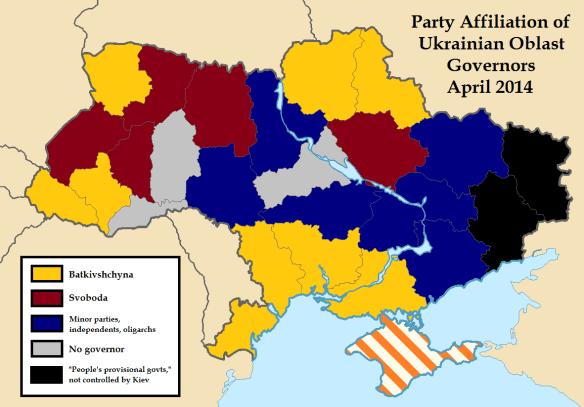
As events continue to unfold in Eastern Ukraine, there remains the question of who is governing the rest of the country. Following the overthrow of Yaukovych, the Turchynov-Yatsenyuk government appointed new regional governors across most of Ukraine. Their political affiliations are diverse and reflect the very hodge-podge and unstable nature of the present government. Herein is an oblast-by-oblast breakdown of who governs what in Ukraine, with an accompanying map. Overall, local leadership in the country can be broken down into five categories:

Party Affiliation of Ukrainian Oblast Governors, April 2014

Party Affiliation of Ukrainian Oblast Governors, April 2014

Batkivshchyna Party: The party of Turchynov, Yatsenyuk, and Tymoshenko governs eight oblasti. These include Volyn, Ivano-Frankivsk, and Zakarpattia in Western Ukraine, Chernihiv and Sumy in Central Ukraine, and Odessa, Nikolayev, and Kherson in Southern Ukraine. It is unclear how much authority Batkivshchyna wields in these regions. In Western Ukraine, the far-right group Right Sector was influential in Ivano-Frankivsk, where it has conducted fascist-style parades in March (though its credibility there is now reportedly on the decline). In Southern Ukraine, there is a growing movement in the Odessa oblast to overthrow the Batkivshchyna governor and to declare a “provisional people’s government” as was done in Donetsk and Luhansk in the Donbas. In the remote westernmost oblast of Zakarpattia, the Carpatho-Rusyns have been advocating regional autonomy since Ukraine’s independence in 1991. It is unclear what the current situation is there and how much genuine control Batkivshchyna has over this mountainous region.

Svoboda Party: The far-right Svoboda party is led by Oleh Tyahnybok who is known for his antisemitism, Russophobia, and admiration for wartime Nazi collaborator, Stepan Bandera. The Turchynov-Yatsenyuk government has granted Svoboda party members the governorship of five oblasti. These include three oblasti in Western Ukraine (Lviv, Ternopil, and Rivne) and two Central Ukrainian oblasti where Svoboda has historically had very little popular support (Zhytomyr and Poltava). It is unclear how much influence Svoboda’s militant ideological ally, Right Sector, has in these regions. However, it appears that there is some. Prior to his death in a shootout with police with the aid of the Kiev government’s interior ministry, Right Sector activist Oleksandr Muzychko seemed to have significant influence in the Svoboda-controlled Rivne oblast. This was particularly the case in the power vacuum that developed after Yanukovych fled the country following threats by Right Sector activists. A notorious war criminal, Russophobe, and antisemite, Muzychko (nicknamed Sashko Bilyi by his followers) was famously caught on video bullying and assaulting a local prosecutor in Rivne, shouting expletives at him, and threatening to pull him to Maidan with a rope around his neck.

It is unclear though if Muzychko’s assassination indicates a split between Svoboda and Right Sector. Though ideological allies, both seem to be vying for the position of “Ukraine’s true far-right.” To this end (and to seize power), both are attempting to expand their voter base by trying to appear “more moderate.” At first glance, this appearance of such a sudden embrace of centrism seems like a miracle akin to St. Paul falling off his horse on the Road to Damascus. Except, unlike St. Paul, there is nothing “saintly” about sinful scoundrels and antisemites like Muzychko, Oleh Tyahnybok, Dmytro Yarosh, and others whose politics can be best classified as “to the right of Genghis Khan.” These individuals and groups are just as extremist as they have always been. Western commentators must not be fooled. Israel certainly was not. In February, Right Sector attempted to persuade the Israeli ambassador to Ukraine that they were “not antisemetic.” Tel Aviv was unimpressed, so much so that it abstained from the UN vote on Crimea, much to the surprise and frustration of Washington.

Minor parties, independents, and oligarchs: In six more oblasti, the Kiev government has appointed minor party politicians, independent candidates, and oligarchs. These include the three Central oblasti of Kiev, Kirovograd, and Vinnytsia, the Eastern oblast of Kharkiv, and the two Southern oblasti of Zaporizhia and Dnipropetrovsk which once comprised the core of Nestor Makhno‘s breakaway anarchist “Free Territory” during the Russian Civil War of 1917-22. Two independent-oligarch governors were also appointed in the Donbas (Donetsk and Luhansk) but were overthrown in the recent unrest there. These Kiev-installed governors now effectively have no authority in these regions. Further, in the Kiev oblast, Right Sector has attempted to exercise some influence. In the Kiev suburb of Vasylkiv, Right Sector activists seized control of the town council amid protests shortly after Yanukovych’s overthrow. On the whole though, both Right Sector and Svoboda maintain much more influence in Western Ukraine. In regional elections, the far-right has always fared poorly in Central Ukraine.

No governors: Meanwhile, there are presently no governors at all in two Central Ukrainian oblasti (Cherkasy and Khmelnytsky) and one Western oblast (Chernivtsi).  Khmelnytsky and Chernivsti straddle the Central-West divide in terms of culture, language, and electoral politics.

Self-declared people’s provisional governments: In the Donbas, protests against the Turchynov-Yatsenyuk government have led to the declarations of “People’s Republics” with “provisional governments” in the oblasti of Donetsk and Luhansk. The Kiev-appointed governors have effectively lost authority in these regions which are practically controlled entirely by the rebels. Kiev claims that the rebels are “agents of Moscow.” Moscow disavows any involvement. In truth, there are Russians who are involved in the Eastern Ukrainian unrest, but these are not “government agents” but rather Russian nationalists who seek to assist their “compatriots” from across the border. On the whole though, much of the frustration leading to the unrest appears to have come from a genuine rejection of the Turchynov-Yatsenyuk government. To exclude any discontent among the people of Eastern Ukraine with the government in Kiev assumes that Ukraine and its Eastern oblasti specifically have no domestic concerns. In fact this is not the case. Kiev has been unable to assert control in this region. There was an attempt to do so this week by military means, prompting commentators’ fears of the start of a civil war. In the end, the troops from Kiev refused to fire on their East Ukrainian compatriots. Some simply drove away, while others defected to the rebels’ side. Meanwhile, there is a possibility that more “provisional governments” could appear in other Southeastern and even Central Ukrainian oblasti. Already in Odessa, there has been talk of a possible proclamation of an “Odessan People’s Republic” with “People’s Provisional Government of Odessa.”

A presidential election alone would not likely remedy this situation. Parliamentary elections, in which these distinct regions are properly represented, are a reasonable immediate solution to this current chaos.

Abashidze-Karasin Meeting Today

Georgia's Special Representative for Relations with Russia Zurab Abashidze (Tabula)

Georgia’s Special Representative for Relations with Russia Zurab Abashidze (Tabula)

Today, Georgia’s special envoy to Russia, Zurab Abashidze, will meet with his Russian counterpart Grigory Karasin in Prague to discuss bilateral relations between the two countries and to lay the groundwork for a future meeting between Russian President Vladimir Putin and the Georgian political leadership, the first such meeting since 2008.  The Abashidze-Karasin summit was  originally scheduled for March 4-5 but was postponed twice.

The stakes are relatively high for both Tbilisi and Moscow. From a geostrategic perspective, Moscow specifically needs Georgia as part of its planned Eurasian Customs Union. Not only would it geographically link Russia with prospective Eurasian Union member Armenia, but it would also discourage further Western efforts to expand its geopolitical and energy interests into former Soviet territory. Political circles in the West, and particularly Washington, view Georgia as a critical part of its efforts to gain access to natural gas and oil reserves in the Caspian basin and Central Asia.

Moscow views this expansion as a threat to its security. Consequently, Russia has been reaching out to Georgia in recent months. Its efforts include both Medvedev’s August  invitation to Tbilisi to join the Eurasian Union and Putin’s friendly comments toward Georgians during his December press conference. In the meantime, the West has been also reaching out to Georgia, expanding the presence of the EU and NATO, and taking advantage of the fact that Georgia has not yet fully restored its relationship with Russia.

Bidzina Ivanishvili (RFE/RL/Mzia Saganelidze)

Bidzina Ivanishvili (RFE/RL/Mzia Saganelidze)

The post-Saakashvili Georgian Dream government kept the pursuit of the both the EU and NATO on the table, likely as leverage in its relations with Moscow. The major force behind the party, billionaire Bidzina Ivanishvili, is a patriot in his own right who can be best described as neither pro-Western nor pro-Russian, but pro-Georgian. Whoever can offer Ivanishvili, and by extension Georgia, the best deal, Tbilisi will accept. So far, the West recently increased its efforts to bring Georgia fully into its camp. It has moved up the date of Georgia’s planned signing of the EU Association Agreement to June and has discussed the possibility of granting Georgia a NATO MAP (Membership Action Plan) at the next NATO summit in Wales in September. Yet, unlike his predecessor Saakashvili, Ivanishvili and his party have not ruled out the Russian option completely.  In September 2013, just six days after neighboring Armenia formally reversed its course on its EU Association Agreement in favor of Eurasian Union membership, Ivanishvili announced that Georgia too may consider joining the Moscow-backed union “if it will be advantageous for our country.”

In plain Georgian, this means that if Moscow wants to see Georgia join its Eurasian Customs Union, then Georgia needs to be enticed to join. Tbilisi will not accept any solution that would involve forgoing claims to its breakaway territories, Abkhazia and South Ossetia. Significantly, Ivanishvili and others in his Georgian Dream party have placed more emphasis on Georgian unity than any other issue. For Georgians, the unity of their state, including all of its historic and ethnically distinct regions is a top priority, even more so than EU or NATO membership.

Irakli Gabribashvili (Government.ge)

Irakli Gabribashvili (Government.ge)

In a December interview with Eduard Shevardnadze’s granddaughter Sophie Shevardnadze on the Moscow-backed news service RT, Georgia’s new Prime Minister Irakli Gabribashvili, expressed his sadness at the present situation vis-a-vis Georgia’s breakaway regions. While acknowledging the mistakes of Georgia’s earlier post-Soviet governments, Gabribashvili stated “we are hurt because our Abkhazian and Ossetian brothers no longer live with us.” He also stated that “if, as a hope – I am quite optimistic about this issue – the Russian government decides one day to reset relations with Georgia by means of peaceful conflict resolution, it will be the best case scenario.”

Consequently, only a peace deal between Georgia and its breakaways involving a federal solution would be the best possible outcome, satisfying all parties in the dispute. Such a solution would ensure Moscow’s security in the region, the unity of the Georgian state, and, most importantly, the ethnic rights of the Abkhaz and the Ossetes.

However, if Moscow tries to entice Georgia to join the Eurasian Union without any incentive for a peace deal on its breakaway regions, then the situation could become very dangerous. If Tbilisi were to make a U-turn on the EU and NATO without any significant concessions from Moscow, then Euromaidan-style civil unrest could break out in Georgia, led by Saakashvili’s party, the United National Movement (UNM). Kiev-style violence and unrest is especially concerning for a country like Georgia, which experienced a very violent civil war in the 1990s. If the UNM were to launch a revolt in Tbilisi, succeed in overthrowing the potentially friendly Georgian Dream government, and replacing it with a staunchly pro-Western nationalist government, then it would be a geopolitical nightmare for Moscow.

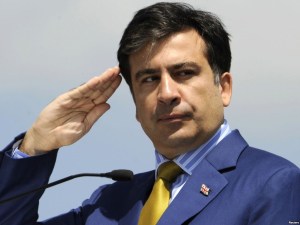
Former Georgian President Mikheil Saakashvili (Reuters)

Mikheil Saakashvili (Reuters)

Already the Georgian government is taking precautions in the case of such an eventuality. Prosecutions and questionings of UNM lawmakers and activists, including former President Saakashvili, on various unresolved controversies have increased in recent weeks. Also, Georgia’s Interior Ministry recently spoke of concerns with regard to UNM launching a Maidan-style revolution. Prime Minister Garibashvili has responded by declaring that “no one will dare to stir destabilization in this country while we are in the government” and that “if anyone has any such desire or attempt, they will be strictly punished.”  Indeed, in light of the recent Ukraine crisis, the UNM has become increasingly aggressive, nationalistic, and Russophobic, calling for sanctions against Russia by Georgia, an end to any diplomatic communication with Moscow, and for denial of “Russian aggression against Georgia” to be criminalized. From his base in Ukraine as an advisor to the Yatsenyuk government, Saakashvili has been particularly provocative, not only against his traditional enemy Russian President Putin, but also his domestic arch-rival Ivanishvili and the Georgian Dream government, which Saakashvili dismisses as “completely worthless.”

Certainly, the UNM could try to launch a Maidan-style revoltion even if Moscow does grant Tbilisi concessions on Abkhazia and South Ossetia. However, its effectiveness would be greatly diluted given its already declining popularity and the fact that a peace resolution on the two breakaways would seriously undermine their credibility even further among the Georgian public. Conversely, if Moscow attempted to entice Georgia into the Eurasian Union with no concessions on the breakaways, it would create an angry backlash in Georgian society on which the UNM could easily capitalize to launch a “Georgian Maidan” in Tbilisi. Saakashvili might even take advantage of this to restore his political career and return to the Georgian presidency in a coup d’état.

Given this, Russia has to very cautious and very prudent. The recognition of Abkhazia and South Ossetia back in 2008 has served its purpose by discrediting and neutralizing Saakashvili and by illustrating to the West the potential dangers of the Kosovo precedent.  Now Moscow has to consider its strategic priorities.  Specifically, Russia must ensure its security in the region as well as the overall stability of the Caucasus.

If Moscow can entice Tbilisi into its Eurasian Union, then this would be a major diplomatic success. If not, Russia will continue to be vulnerable to Western expansionism, not just in the Caucasus but in Central Asia as well.  Much of this depends on the outcome of tomorrow’s meeting as well as any future meeting between the Georgian and Russian leaderships. Already there are some concerns because a Georgian TV crew was detained yesterday for accidentally crossing the border into breakaway South Ossetia. Given Moscow’s concerns regarding Georgia, releasing these journalists should be a top priority, which in turn would build trust and confidence between both sides.

Conversations with Gorbachev: A Documentary Film

In light of the recent Ukraine crisis, there has been a renewed interest in the events surrounding the final years of the Soviet Union. This 1994 documentary, Conversations with Gorbachev, by Rosemarie Reed helps shed light on those events, from the first-hand perspective of former Soviet President Mikhail Gorbachev, interviewed by Professor of Russian and Soviet Studies at NYU and Princeton Dr. Stephen F. Cohen.

It also includes Gorbachev’s insights on reintegration in the post-Soviet space and his support for the basic concept for a Eurasian Customs Union of former Soviet republics. When Dr. Cohen asks him “what do you think will be the reaction in the United States if any kind of new ‘larger Russia’ union, confederation, association begins to emerge?”, Gorbachev responds “But why? But why? But why is it that Washington ought to decide what relations there should be between the former republics of the Soviet Union?”

Watch the entire film in four parts below, presented with permission of the filmmaker: